In 1917, Britain promised a Jewish national home in Palestine without its Arab majority's consent. Thirty years later, New Zealand voted for UN partition despite warnings of violence. The Nakba displaced some 750,000 Palestinians, destroyed communities and left generations unable to return. Nearly eight decades later, Gaza lies devastated while settlement expansion and displacement continue across the West Bank. From Balfour to the Nakba, this is the story of a homeland divided, its people dispossessed, and New Zealand's forgotten role in a tragedy that continues today.
eLocal Report | Historical Investigation
A Promise Made About Someone Else's Homeland
On 2 November 1917, British Foreign Secretary Arthur James Balfour signed a letter that would help transform the political future of Palestine and the wider Middle East. Addressed to Lord Walter Rothschild, a prominent British supporter of Zionism, it declared the British government's support for establishing a Jewish national home in Palestine. At the time, Palestine remained part of the Ottoman Empire. Britain did not possess sovereignty over the territory, and its predominantly Arab population had not consented to the undertaking.

The Balfour Declaration, signed by British Foreign Secretary Arthur James Balfour on 2 November 1917. The letter expressed British support for a Jewish national home in Palestine without recognising equivalent Palestinian Arab national political rights. Image: British Library / United Kingdom Government. Public-domain reproduction via Wikimedia Commons.
The document contained a qualification: nothing should prejudice the civil and religious rights of Palestine's existing non-Jewish communities. But the distinction in its language was profound. It explicitly recognised a Jewish national project while making no corresponding commitment to Palestinian Arab national independence or political self-determination. The people who formed the majority of Palestine's population were referred to collectively as communities whose civil and religious rights should be protected, not as a nation whose political consent was required.
The Balfour Declaration did not explicitly promise a sovereign Jewish state. Nor did it legally transfer ownership of Palestine to anyone. Nevertheless, it gave the Zionist movement the formal backing of a major imperial power and became a foundation of subsequent British policy.
For Palestinians, the underlying question was straightforward: by what authority could a foreign government promise support for a national project in their homeland without obtaining their agreement?
The Empire Draws the Map
The Balfour Declaration did not emerge in isolation. In 1916, Britain and France had secretly negotiated the Sykes–Picot Agreement, outlining spheres of influence across parts of the Ottoman Empire. During the First World War, Britain had also communicated with Arab leaders about the prospect of Arab independence, although the territorial scope of those commitments remains historically disputed.
These overlapping undertakings exposed the realities of imperial diplomacy. European governments were planning the future of Middle Eastern territories while the populations living there possessed little effective control over the negotiations.
British forces occupied Jerusalem in December 1917. Following the Ottoman defeat, Palestine came under British military administration. The decisions that followed would give Britain's earlier political promise an international institutional framework.
The League of Nations Makes It Official
After the First World War, the League of Nations was established with the stated purpose of preventing another international catastrophe. Its mandate system placed certain former imperial territories under the administration of victorious powers, ostensibly preparing them for self-government.
Palestine became a particularly consequential exception.
In 1922, the League approved the British Mandate for Palestine, which formally came into force in September 1923. The Mandate incorporated the Balfour Declaration and required Britain to facilitate the establishment of a Jewish national home while safeguarding the civil and religious rights of all inhabitants.
The consequences were far-reaching. What had begun as a British government declaration now formed part of an internationally sanctioned system of administration. Yet the Mandate did not expressly recognise Palestinian Arab national self-determination in equivalent terms.
Jewish immigration increased during the Mandate, especially as persecution intensified in Europe and, later, under Nazi rule. For Jewish refugees escaping antisemitism, Palestine offered the prospect of sanctuary and national security. For Palestinian Arabs, however, the growing national movement and British support for it raised fundamental fears about political control, land and their own future.
These competing aspirations produced mounting tensions, protests, violence and rebellion. The Palestinian Arab revolt of 1936–1939 was met with extensive British military repression. The conflict was already deeply entrenched long before the United Nations entered the picture.
From the League of Nations to the United Nations
The Second World War exposed the failure of the League of Nations to prevent another global catastrophe. In 1945, the victorious Allied powers established the United Nations, intended to provide a new framework for collective security and international cooperation.
The League was formally dissolved in 1946. But the Palestine question had not been resolved.
Britain remained responsible for administering the territory under its Mandate. It faced escalating conflict between Jewish and Arab communities, an armed Zionist insurgency against British rule, and growing international pressure concerning Jewish refugees and displaced persons after the Holocaust.
In February 1947, Britain referred Palestine's future to the United Nations.
The institutional transition is central to understanding what happened next. The League had approved the Mandate incorporating Britain's promise of a Jewish national home. The United Nations was now being asked to recommend a political settlement for the territory.
The people most directly affected were not sovereign participants with an equal vote in that international decision.
A new international organisation had inherited an unresolved imperial problem. Whether it could solve that problem without repeating the exclusion of Palestinian political consent would become one of its earliest and most consequential tests.
Partition Without Consent
The United Nations established a Special Committee on Palestine, known as UNSCOP, to examine competing claims and propose a settlement.
There were alternatives.
The committee's majority recommended partition into separate Jewish and Arab states, linked through an economic union, with Jerusalem under a special international regime. A minority proposed a single independent federal state with Arab and Jewish constituent states.
The Jewish Agency accepted partition as a basis for Jewish statehood, although it had objections to particular boundaries and arrangements. Palestinian Arab political leaders rejected the proposal, arguing that partition violated the majority population's right to determine its own future.
Palestinian representatives were heard during UN deliberations. But their opposition did not prevent the proposal from proceeding, and no referendum of Palestine's inhabitants was held.
On 29 November 1947, the UN General Assembly adopted Resolution 181 by 33 votes to 13, with 10 abstentions and one country absent.
The proposed Jewish state would receive approximately 55–56 per cent of Mandatory Palestine, despite Jews constituting roughly one-third of its population at the time. The proposed Arab state would receive most of the remaining territory, excluding internationally administered Jerusalem.
The General Assembly resolution was a recommendation for partition, not a completed transfer of sovereignty or an order to expel Palestinian residents. Its political significance was nevertheless enormous. The UN had endorsed a division of Palestine that its Arab majority rejected.
And among the 33 countries voting in favour was New Zealand.
Peter Fraser: The Prime Minister Behind the Vote
New Zealand's Prime Minister in November 1947 was Peter Fraser, leader of the Labour government and Minister of External Affairs.

Peter Fraser, New Zealand Prime Minister from 1940 to 1949. His Labour government voted in favour of the United Nations partition recommendation on 29 November 1947. Photographer unknown. Image reproduced from J. T. Paul, Humanism in Politics (1946), via Wikimedia Commons.
Fraser was no peripheral figure in the emerging international order. He had participated prominently in the founding of the United Nations and advocated collective security, the rights of smaller countries and international cooperation. He opposed excessive great-power privilege and believed the UN could become an institution capable of preventing another world war.
But his position on Palestine presents a more complicated picture.
In her 1982 University of Canterbury thesis, New Zealand and the UN Partition of Palestine, 1947–49, historian Marjorie Noel Galvin concluded that Fraser was strongly sympathetic to Zionism and showed limited sympathy for Palestinian Arab political aspirations. Her research challenged the idea that New Zealand's policy was evenly balanced between the two populations.
Galvin also found that Fraser was prepared to depart from Britain's position and persist in supporting partition even when the United States temporarily wavered over its implementation.
This was not simply a government automatically following London's lead.
Fraser had longstanding convictions about Jewish national aspirations, the humanitarian catastrophe facing European Jews and the importance of a successful United Nations. Those commitments shaped his approach to Palestine.
But how did he reconcile them with the right of Palestinian Arabs to determine the political future of their homeland?
The Warning Fraser Put in Writing
New Zealand's representative at the United Nations, Sir Carl Berendsen, repeatedly warned that the proposed partition could not be safely implemented without effective international enforcement.
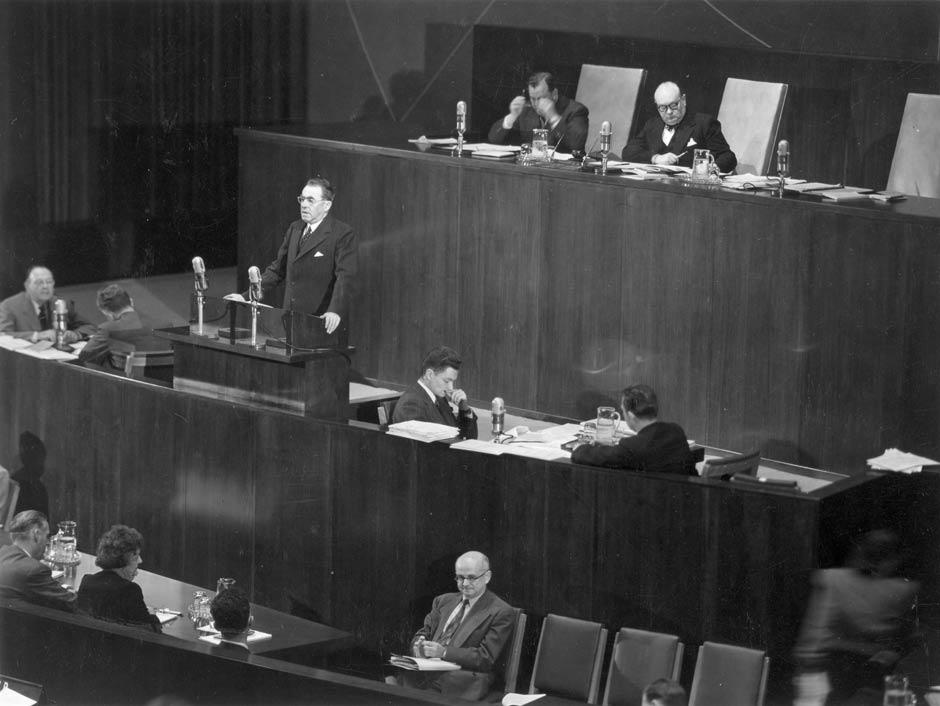
Sir Carl Berendsen addressing the United Nations General Assembly in 1946. Berendsen represented New Zealand during the Palestine partition debate and raised serious concerns about enforcement and the danger of violence. Photograph: Alexander Turnbull Library, National Library of New Zealand, reference PAColl-6001-10, via NZHistory. Reproduction permission required.
Berendsen feared that the General Assembly might adopt a political settlement while leaving the people of Palestine exposed to violence. He wanted the major powers, particularly the United States, to accept responsibility for implementing the decision.
Fraser understood the dilemma.
In a telegram dated 24 November 1947, preserved in New Zealand External Affairs records and examined in subsequent historical research, Fraser considered two potentially disastrous alternatives. One was to reach no decision; the other was to approve partition without adequate arrangements for implementation.
He warned that either course could produce chaos and acknowledged his reluctance to accept responsibility for blocking partition.
That is a revealing admission. Five days before New Zealand's decisive vote, its Prime Minister was contemplating the possibility of chaos if partition proceeded without effective enforcement.
New Zealand initially abstained in committee, where Berendsen's concerns about implementation remained unresolved.
But Fraser ultimately instructed his representative to support Resolution 181 in the General Assembly.
On 29 November 1947, New Zealand voted yes.
The historical record establishes that Fraser anticipated serious disorder. It does not prove that he foresaw the scale of the Nakba or intended the expulsion of Palestinians. Nevertheless, the danger was not invisible to him.
The Zionist Lobbying Connection
Fraser's support for Zionism was established well before the UN partition debate.
He had engaged with New Zealand's Jewish community, attended events involving Zionist leaders and expressed sympathy for the establishment of a Jewish national home.
The diplomatic campaign for partition also reached Wellington.
According to a published family account by Yitzhak Treister, a relative of prominent New Zealand Zionist advocate Isaac Gotlieb, Chaim Weizmann sent Fraser a telegram on 22 November 1947, urging New Zealand to support partition.
A further claim in the account is especially intriguing: Fraser and political colleagues reportedly visited Gotlieb's home on 28 November, the evening before the General Assembly vote, to discuss the decision.
Gotlieb had been the first president of the Zionist Federation of New Zealand and was a committed advocate of Jewish statehood.
The reported meeting provides a specific lead for further investigation. However, it remains a family account and should not be treated as independently verified evidence that Gotlieb changed Fraser's vote.
Indeed, the chronology complicates that interpretation.
Treister's account reports that Fraser had already told the British Secretary of State on 21 November that New Zealand should support partition as the most promising available solution.
If that account is accurate, Fraser's support substantially predated the reported meeting at Gotlieb's home.
The stronger conclusion is that Zionist advocates had access to a Prime Minister who was already sympathetic to their political objectives. Their appeals may have reinforced his position, but the available evidence does not establish that lobbying alone determined New Zealand's vote.
The more fundamental question is whether Palestinian Arab representatives enjoyed comparable access, influence or consideration when their own political future was being decided.
The War Begins
The adoption of Resolution 181 did not bring peace.
Armed conflict between Jewish and Arab communities intensified almost immediately. Attacks, reprisals, military operations and the breakdown of local security transformed the political dispute into a widening civil war while Britain prepared to withdraw.
The fighting had already displaced large numbers of Palestinians before Israel declared independence.
On 9 April 1948, fighters from the Zionist Irgun and Lehi organisations attacked the Palestinian village of Deir Yassin near Jerusalem. More than 100 villagers were killed, although historical estimates vary. The massacre became one of the most notorious atrocities of the conflict.
News of Deir Yassin spread far beyond the village. It intensified fear among Palestinian communities already threatened by armed attacks and military advances.
The village was not simply a symbol. It was a community of families whose lives were violently shattered.
Across Palestine, civilians faced decisions no family should have to make: remain in their homes amid advancing forces and the possibility of death, or flee in the hope that they could return when the fighting stopped.
Many chose flight. Others were forcibly expelled.
The Nakba: A Homeland Torn Apart
On 14 May 1948, David Ben-Gurion proclaimed the establishment of the State of Israel as Britain's Mandate ended. The United States quickly recognised the new government.
The following day, armies from neighbouring Arab countries entered the war. But the displacement of Palestinian civilians had already begun months earlier.
By the end of the 1947–1949 conflict, approximately 700,000 to 750,000 Palestinians had become refugees.
The Arabic word Nakba means catastrophe. For Palestinians, it describes the destruction of a society and the mass displacement of its people.
Archival photograph — Palestinian families fleeing Jaffa, 1948: View the original UNRWA archive photograph.
Palestinian girls carrying belongings in prams and carts as families flee Jaffa during the 1948 war. Photograph: United Nations Archive, 1948. Photographer unknown. Image reproduced in the UNRWA historical collection.
The process was not identical in every town or village. Some residents were directly expelled by armed forces. Others fled attacks, shelling or advancing troops. Some left because they feared massacres or because neighbouring communities had already been emptied. Local leadership and public services collapsed in parts of the country.
In July 1948, Israeli forces captured Lydda and Ramle. Tens of thousands of Palestinians were expelled or driven from the towns, with many forced to walk in severe summer heat.
In other locations, communities were emptied during military offensives or after residents had fled.
The historical record does not support reducing every Palestinian departure to a single cause. It does, however, establish that forced expulsions occurred, that military operations generated mass flight, and that hundreds of Palestinian communities were depopulated.
The catastrophe did not end when the shooting stopped.
The Villages That Disappeared
For refugees, leaving a home during war did not necessarily mean abandoning it forever.
Many Palestinians expected to return to their houses, farms, orchards, shops and places of worship once the fighting subsided.
Most were not permitted to do so.
Hundreds of Palestinian villages were depopulated, and many were subsequently demolished or transformed. Homes and agricultural lands came under Israeli control. Legislation and administrative measures enabled the transfer of substantial amounts of refugee property.
Archival photograph — Refugees leaving Gaza by boat, 1948: View the original UNRWA archive photograph.
Palestinian refugees, previously displaced to Beach Camp in Gaza, boarding boats bound for Lebanon or Egypt during the 1948 war. Photograph: Hrant Nakashian / UNRWA, 1948.
The consequences reached far beyond the immediate refugee generation.
Families lost land that had supported them for generations. Children grew up in camps and exile. Community records, cemeteries, schools and familiar landscapes became memories of places to which people could no longer freely return.
For Palestinians, the loss was not only territorial. It was the destruction of ordinary life.
A house was no longer a house. It became a remembered address. A village became a name recited by grandparents to grandchildren who had never seen it.
The United Nations Recognised the Refugees — But Not Their Return
On 11 December 1948, the United Nations General Assembly adopted Resolution 194.
Paragraph 11 addressed the return of refugees wishing to live at peace with their neighbours and compensation for those choosing not to return, together with compensation for qualifying property losses and damage.
This was a remarkable development.
The international organisation that had recommended partition in November 1947 was now acknowledging the displacement of hundreds of thousands of Palestinians.
Yet the central refugee provisions of Resolution 194 were never implemented as envisaged.
Most Palestinians displaced during the Nakba were not permitted to return to their former homes. The broad programme of return and compensation contemplated by the resolution was not carried out.
Humanitarian assistance was a different matter.
The United Nations and relief organisations did provide food, shelter and emergency support. In December 1949, General Assembly Resolution 302 established the United Nations Relief and Works Agency for Palestine Refugees in the Near East — UNRWA.
Its creation recognised that the refugee crisis required sustained international assistance.
But relief did not restore the lost villages, reverse the displacement or resolve the political status of the refugees.
The international community helped sustain displaced Palestinians, but it did not deliver the return and compensation envisaged in its own 1948 resolution.
That failure is evidence of the enduring consequences of displacement and the political refusal to resolve the refugee question. It is not, by itself, proof that the UN deliberately designed a depopulation programme. Such a claim would require separate documentary evidence of intent.
For Palestinian families, however, the practical result was devastating: survival in exile rather than restoration of their homes.
Eight Decades of Changing Borders
The territorial consequences of the 1948 war extended far beyond the boundaries recommended by the United Nations in 1947.
Israel emerged from the conflict controlling approximately 78 per cent of former Mandatory Palestine. The West Bank, including East Jerusalem, came under Jordanian control, while Gaza was administered by Egypt. The independent Arab state proposed under Resolution 181 did not emerge.
The 1949 armistice agreements established military demarcation lines rather than internationally agreed permanent borders.
The territorial situation changed again in 1967, when Israel occupied the West Bank, East Jerusalem and Gaza.
Subsequent settlement expansion, military restrictions and territorial divisions increasingly fragmented the land available for Palestinian self-government.

Palestine: Land and Control, 1949–2026. An illustrative comparison of the territory under Israeli control following the 1949 armistice and the fragmented Palestinian territories in 2026. The 1947 UN partition proposal was never implemented. The map is schematic, not a cadastral or legally definitive boundary map; its 2026 shaded areas should not be interpreted as exact Palestinian ownership or administrative boundaries. Graphic: eLocal editorial illustration, 2026.
The comparison reveals the importance of distinguishing territory, administration, occupation and sovereignty.
In 1949, the West Bank and Gaza were outside Israeli control but did not constitute an independent Palestinian state. In 2026, both remain central to Palestinian claims for statehood, while the West Bank is fragmented by settlements, different administrative arrangements and extensive Israeli military control.
The map cannot capture every village lost, every property confiscated or every family displaced.
But it helps explain why the question of land remains inseparable from the history of the Nakba.
The Nakba Did Not End in 1948
For Palestinians, the Nakba is not simply a chapter in a history book. It is a catastrophe whose consequences have extended across nearly eight decades, from the villages emptied in 1948 to the shattered neighbourhoods of Gaza and the increasingly fragmented Palestinian communities of the occupied West Bank.
The parallels are impossible to ignore. Families forced from their homes. Communities destroyed or rendered uninhabitable. Land placed beyond the reach of its former inhabitants. Civilians dependent on international humanitarian assistance while their ability to return, rebuild and determine their political future remains constrained.
In November 2026, United Nations humanitarian reporting continued to document the displacement of Palestinian communities in the West Bank through demolitions, settler violence and access restrictions. The same reporting described severe damage to temporary shelters in Gaza, where families already displaced by war faced further hardship from flooding and inadequate living conditions.
These are not distant echoes of 1948. They are contemporary experiences of displacement, documented by international humanitarian agencies. The mechanisms and circumstances differ, but the consequences bear unmistakable similarities: loss of home, insecurity, separation from land and the erosion of community life.
The Israeli government maintains that its military operations and security restrictions respond to threats, including attacks by Palestinian armed groups. Those explanations must be examined against international humanitarian law, which protects civilians and prohibits forcible transfer except under narrowly defined circumstances.
The historical evidence does not establish that every Israeli government since 1948 has operated under one uninterrupted master plan. It does establish repeated episodes of Palestinian displacement and continuing policies that have contributed to territorial fragmentation and the loss of homes and livelihoods.
For Palestinians whose families were displaced in 1948, and whose descendants face displacement today, the distinction between an original catastrophe and its continuing consequences may offer little comfort.
A homeland is not merely a territory marked on a map. It is the ability to live in one's home, cultivate one's land, raise one's children in safety and belong to a community without fear of being driven away.
That is what was lost by hundreds of thousands during the Nakba. And it is what many Palestinians continue to struggle to secure today.
Gaza: Another Generation of Ruins
The Gaza Strip became home to large numbers of Palestinians displaced during the 1948 war and their descendants. For decades, refugee camps and densely populated neighbourhoods housed families whose original villages lay elsewhere in what became Israel.
The war that followed the Hamas-led attacks of 7 October 2023 brought extraordinary destruction. Hamas and other armed groups killed civilians and took hostages in Israel. Israel's subsequent military campaign devastated large areas of Gaza, killed large numbers of Palestinians and repeatedly displaced civilians, including families descended from the refugees of 1948.
The humanitarian consequences remained severe in 2026, despite the October 2025 ceasefire agreement. United Nations reporting in November continued to document casualties, damaged shelters, restrictions affecting essential supplies and immense pressure on health services.
For a family whose grandparents lost their village in 1948, the destruction of their home in Gaza represents another rupture in the same family history.
The circumstances of the two wars differ, and individual legal responsibility must be established through evidence. Yet the recurring experience of displacement is undeniable.
Providing food, tents and medical assistance can save lives. It cannot, on its own, restore a destroyed neighbourhood or resolve the question of whether a family can return to a safe and permanent home.
The same fundamental distinction that emerged after Resolution 194 remains relevant:
Humanitarian relief is not a substitute for the restoration of rights.
The West Bank: A Homeland Divided into Fragments
The West Bank provides another stark illustration of the continuing territorial struggle.
Israeli settlements, military zones, checkpoints, road restrictions and the separation barrier have fragmented Palestinian communities and complicated travel between towns, farmland, schools, hospitals and workplaces.
Palestinian residents in parts of the West Bank face serious obstacles to obtaining building permits, while demolitions and settler violence have displaced families from their homes and agricultural communities.
UN humanitarian reporting has documented the demolition of homes and essential infrastructure, settler attacks affecting olive harvests and communities displaced by violence and access restrictions.
In some communities, the geography of everyday life has become a series of boundaries residents cannot control.
A farmer may own land but be unable to reach it safely. A family may live in a home threatened with demolition. A village may become isolated by settlement expansion and restricted roads.
The International Court of Justice's July 2024 advisory opinion concluded that Israel's continued presence in the occupied Palestinian territory was unlawful and called for an end to settlement activity. Israel rejects the opinion's principal conclusions.
The cumulative effect of settlement expansion, displacement and restrictions is territorial fragmentation and insecurity.
It raises a question that has haunted Palestine since the Mandate era: who has the power to determine where Palestinians may live, build, travel and exercise political authority?
The Human Cost of an Unresolved Homeland
Historical dispossession is not an abstract grievance that disappears with the passing of time.
It survives in family records, photographs, property deeds, village names, oral histories and the memories of parents and grandparents.
For many Palestinians, the Nakba is not confined to 1948 because its consequences were never comprehensively remedied.
The loss of a homeland has become a continuing political and personal experience.
The anger arising from dispossession is understandable. But the history must also distinguish between the legitimate pursuit of rights and self-determination and violence against civilians, which cannot be justified by historical suffering.
Likewise, the security fears of Israeli civilians, including the trauma of attacks and hostage-taking, cannot erase the rights of Palestinians or justify collective punishment.
The persistence of conflict is inseparable from the failure to establish a durable political settlement recognising the rights, security and dignity of both peoples.
Without addressing the unresolved claims of refugees, the future of occupied territory, settlements and Palestinian self-determination, the foundations of the conflict remain.
What Responsibility Did New Zealand Carry?
New Zealand did not create the Balfour Declaration. It did not administer the British Mandate. It did not command the armed forces that fought in Palestine in 1948.
Those distinctions matter when assigning historical responsibility.
But New Zealand was a participant in the international decision-making that preceded the war.
Peter Fraser's government supported partition despite Palestinian Arab opposition and despite its own representative's warnings about inadequate arrangements for maintaining peace.
The UN vote did not itself order expulsions, village destruction or the seizure of refugee property. Responsibility for those actions must be examined through the decisions and conduct of the forces and authorities involved.
Nevertheless, New Zealand's vote forms part of the political history of the partition proposal.
A country that prided itself on supporting smaller nations and collective security had endorsed a settlement whose legitimacy was fiercely contested by the majority population of Palestine.
That contradiction deserves a place in New Zealand's historical memory.
A Vote That History Cannot Erase
The Balfour Declaration was a short letter. Its consequences extended across generations.
The League of Nations incorporated its promise into an international mandate. The United Nations later recommended partition. New Zealand, under Peter Fraser's Labour government, voted in favour.
Then came the war, the expulsions, the flight, the massacres, the destroyed villages and the refugees who were prevented from returning.
The United Nations subsequently acknowledged the refugee crisis and recommended return and compensation. Humanitarian relief followed, but the central political and property claims remained unresolved.
Nearly eight decades later, the devastation of Gaza and the continuing displacement of Palestinians in the West Bank demonstrate that the struggle over homeland, security, national rights and political control has not been settled.
For Palestinians, the Nakba was not simply the loss of territory on a map. It was the destruction of communities, the separation of families and the loss of a future in places their ancestors had inhabited for generations.
And for New Zealand, there remains an uncomfortable historical question.
What responsibility belongs to a country that supported partition despite knowing that the proposed settlement lacked adequate protection against the violence its own leaders feared?
That question cannot be answered by pretending New Zealand caused every subsequent event. Nor should it be dismissed because the vote took place nearly eighty years ago.
The historical record deserves examination, the political decisions deserve scrutiny, and the human consequences deserve to be remembered.
The loss of a homeland was also the loss of communities and lives. The failure to resolve that dispossession remains part of the tragedy today.
Sources
- United Nations — History of the Question of Palestine — British Mandate, partition, the 1948 war and displacement.
- UN General Assembly Resolution 181 (II), 29 November 1947 — partition recommendation and voting record.
- UNRWA — Resolution 194 — refugee return and compensation provisions.
- UNRWA — General Assembly Resolution 302 — establishment of UNRWA.
- Marjorie Noel Galvin — New Zealand and the UN Partition of Palestine, 1947–49, University of Canterbury, 1982.
- Historical research citing Fraser's 24 November 1947 telegram — New Zealand's concerns about implementation and voting instructions.
- The Jerusalem Post — New Zealand's Role in the Creation of Israel — reporting on Weizmann's telegram and the Gotlieb family account.
- NZHistory — Carl Berendsen at the United Nations, 1946 — photograph and archival attribution.
- UNRWA — The 1940s — original photographs of the 1948 Palestinian refugee exodus.
- UNESCO — UNRWA Photo and Film Archives — archival documentation of Palestinian displacement.
- UN OCHA — Humanitarian Reports — Gaza and West Bank conditions.
- International Court of Justice — Advisory Opinion, 19 July 2024 — legal findings concerning Israel's presence in the occupied Palestinian territory.
Editorial note: The comparative map is illustrative and should not be used as a definitive depiction of territorial sovereignty, private land ownership or administrative boundaries.