Is Europe becoming politically, economically and diplomatically irrelevant? Swiss academic Pascal Lottaz argues that Europe’s declining influence is the consequence of its own policy choices, dependence on Washington, colonial mindset and selective application of international law. As global power shifts towards Eurasia, he challenges the very concept of Europe as a distinct continent, proposing instead that it be recognised for what he considers it to be: Eurasia’s Far West
Opinion by Pascal Lottaz
On November 19, 2026, the presidents of the United States, China, and Russia sat down at Kylin Villa in Shenzhen for the first trilateral meeting their countries have ever held at the highest level. They issued a four-point declaration on the reform of the United Nations, on petroleum supplies, on the limits of international criminal courts, and on nuclear risk (Council on Foreign Relations 2026). No European was in the room, and the document mentions neither Europe nor Ukraine. Russian state television made sure its viewers understood the point, stressing that Europe “wasn’t invited” (Associated Press 2026). Obviously, there is a formal explanation: the meeting took place on the sidelines of the Asia-Pacific Economic Cooperation summit, and Europe is not a Pacific power. However, that is the whole problem. The three states that decide questions of war and peace now meet on the shore of the South China Sea, and the Europeans learn the results from the press.
Europe is being pushed to the margins of world politics and the Europeans (my native Switzerland included) have nobody to blame but themselves. Europe was the seat of the only colonial empire that ever became global, and it has never left the mental world of that empire, a world in which Europeans stand at the center of the map and everybody else is located by their distance from it. Well, those days are over. The powers that now shape events, Russia, China, and Iran among them, think in Eurasian terms and describe themselves as civilizations with long memories. From their vantage point (and increasingly from any vantage point) the lands between the Atlantic and the Dnieper have ceased to matter. In combination with the fact that the distinction between “Europe” and “Asia” always was a purely artificial one — you can walk from Lisbon to Singapore — the time has come to give up not only “Eurocentrism” but to trash the entire concept of a European continent. Hence I propose (much like Glenn Diesen [2021]) renaming the political entity and the geographic area it occupies as what it actually is: Eurasia’s “Far West”.
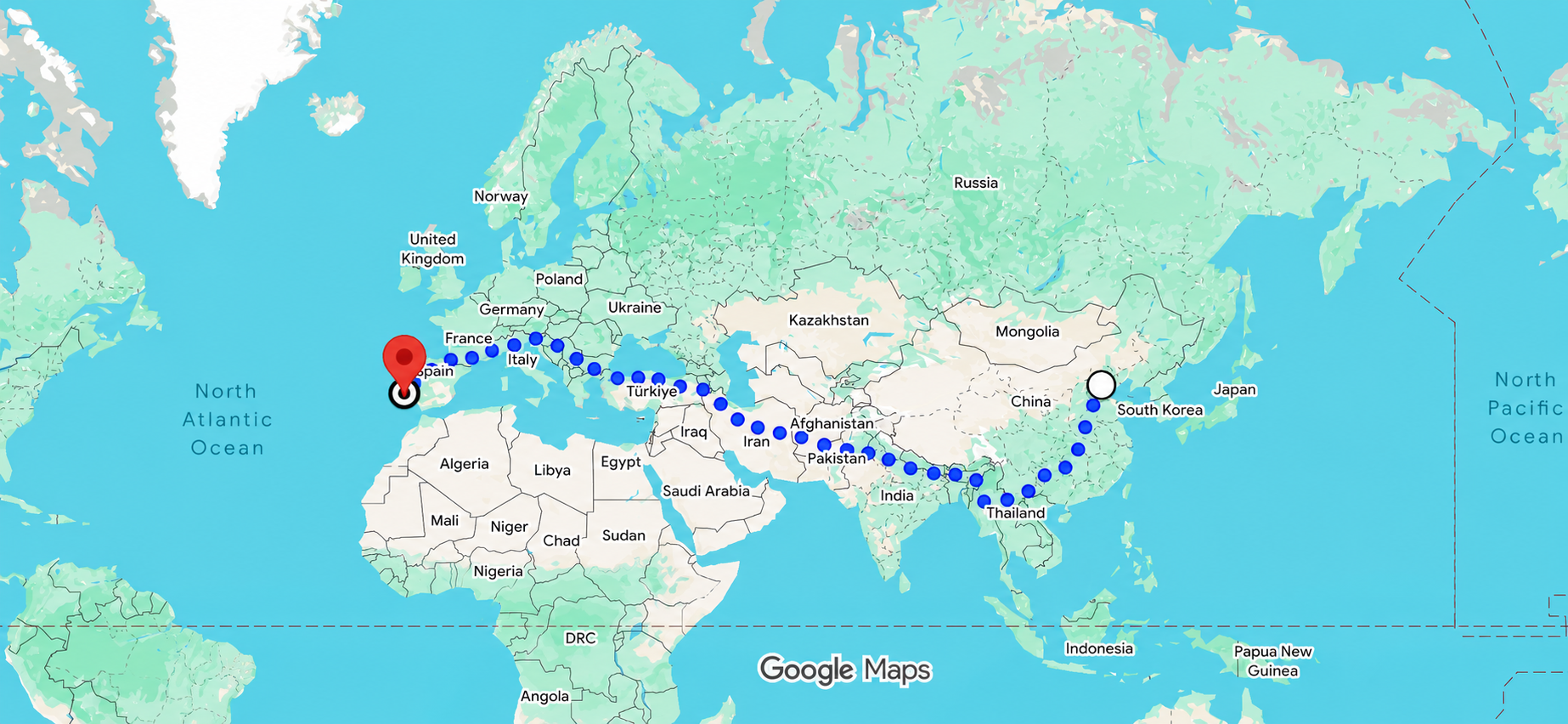
Turn by turn walking directions from Beijing to Lisbon (google maps). — Source: Pascal Lottaz, original Substack article.
Nobody Cares about Vassals
But let’s start on the political level. The clearest measure of a state’s weight is whether others need its signature. By that measure, the war in Ukraine has become a humiliation for the Europeans, who have financed and armed one side for more than four years and still cannot secure a chair at the negotiations that are supposed to end it. Already in February 2025, Washington’s envoy Keith Kellogg told the Munich Security Conference that the Europeans would not sit at the table (Al Jazeera 2025a). Little has changed since. When Russian, American, and Ukrainian delegations met in Abu Dhabi in November 2026, European representatives were again excluded. The American envoys Steve Witkoff and Jared Kushner then announced, after a meeting with Vladimir Putin in Moscow, that the Europeans would join the next round, only for the Kremlin aide Yuri Ushakov to reply within days that Russia had agreed to no such thing (Kyiv Post 2026; Reuters 2026). The Europeans now depend on Americans to ask Russians whether they may attend talks about their own continent.
The fate of Kaja Kallas, the European Union’s High Representative for Foreign Affairs, illustrates the condition better than any statistic. In February 2025, the U.S. Secretary of State Marco Rubio cancelled their meeting when she had already landed in Washington (Euronews 2025). In September 2025, the Chinese foreign ministry dismissed her comments on Beijing’s war commemorations as “full of ideological bias” and lacking basic historical knowledge (Global Times 2025). Moscow, of course, does not hide its contempt for her either. The most telling snub, however, came from her own side. At an informal summit in Dublin in November 2026, the EU’s heads of government declined to appoint her as their envoy to the peace talks and assembled a seven-member negotiating team from which her diplomatic service is excluded; Kallas herself conceded that “Russians don’t want me” (Euronews 2026a)—albeit she left no doubt that she thought this was a distinguishing feature of hers, not a criticism. The person whom the treaties charge with conducting the Union’s foreign policy is unwelcome in Washington, Beijing, and Moscow, and her employers have noticed.
None of this fell from the sky. The Europeans were offered a negotiation about their security order, repeatedly, and they declined. In 2007, Putin warned at the Munich Security Conference that NATO expansion was being read in Moscow as a provocation. In 2008, President Dmitry Medvedev proposed a new European Security Treaty in Berlin, and a draft followed in 2009. On December 17, 2021, the Russian foreign ministry published two draft treaties, one addressed to the United States and one to NATO, built around the principle of “indivisible, equal and undiminished security” (Ministry of Foreign Affairs of the Russian Federation 2021). It is worth noting that this principle was no Russian invention. The Europeans had signed it themselves, in the OSCE’s Istanbul Charter of 1999 and again in the Astana Declaration of 2010, both of which hold that no state will strengthen its security at the expense of others (OSCE 1999; OSCE 2010). When Foreign Minister Sergey Lavrov wrote to his Western counterparts on January 28, 2022, to ask how each of them understood that commitment, he expressly requested an answer from every government in its own name. What he received were two collective letters, one from NATO’s Secretary General and one from the EU’s High Representative Josep Borrell, neither of whom he had addressed, and Moscow called the procedure disrespectful (Reuters 2022). Borrell maintained in public that every member state was free to respond as it wished (Asharq Al-Awsat 2022). However, Evarist Bartolo, Malta’s foreign minister at the time, remembers this differently. As he recounted at the Kyoto symposium I organized in October 2026, he was the only foreign minister who answered Lavrov’s letter himself, and he replied in the terms of the cooperative-security documents that Lavrov had cited. For this he was regarded as a rebel. Colleagues told him that he should not have done it and that he was “playing into the hands of the enemy” (Bartolo 2026; see also Newsbook 2026). Jens Stoltenberg, then NATO’s Secretary General, later described the episode to the European Parliament with remarkable candor. Putin had sent a draft treaty as a precondition for not invading Ukraine, he recalled, and “of course we didn’t sign that” (Stoltenberg 2023).
One does not have to accept the Russian drafts as reasonable in every clause to see what was thrown away. In 2021, Moscow still wanted a European security architecture and regarded the Europeans as parties to it. That is no longer the case. On June 14, 2024, Putin told his diplomats that the Euro-Atlantic system had collapsed and that the task ahead was a new architecture of security for Eurasia as a whole, from which the military presence of external powers should gradually be phased out (Putin 2024). Lavrov has developed the idea at the annual Minsk conferences on Eurasian security, where he lists Russia’s partners as China, India, Iran, and North Korea, and where he declared in November 2026 that the Euro-Atlantic concept had failed because the West ignored the indivisibility principles of 1999 and 2010 (Lavrov 2025; Izvestia 2026). In February 2026, Russia, Belarus, Iran, North Korea, and Myanmar agreed to begin consultations on a Eurasian Charter of Diversity and Multipolarity (Ministry of Foreign Affairs of the Republic of Belarus 2026).
This shift in rhetoric clearly denotes a shift in rank. In the Russian conception of 2021, Europe was the subject of the negotiation. In the conception of 2026, Europe is one theater among several, to be managed alongside the Caucasus, the Gulf, and the Korean peninsula, within a framework whose principal interlocutors sit in Beijing, Tehran, and New Delhi. All of this suggests that the Europeans lost far more than just a “seat at the table” as it is often expressed these days. They refused the last invitation to be the center of anybody’s security thinking.
A Customs Union with a Flag
Shenzhen shows where the great powers now find it natural to gather. APEC is an economic forum of the Pacific Rim, and, of course, nobody expects Germany or France to attend. Yet in November 2026 it was the venue at which Washington, Beijing, and Moscow discussed the United Nations, energy, nuclear weapons, and the jurisdiction of international courts, which is to say the general business of world order. A century ago such a conversation would have been held in Paris, London, or Geneva, and a Chinese delegate would have been lucky to be heard, as the Chinese delegation at Versailles learned in 1919. Today the Europeans are the ones waiting outside. In Berlin, Chancellor Friedrich Merz called the meeting a photo opportunity and announced that “a Yalta format will not bring peace” (Euronews 2026b) — bitter words of someone who fears that this might actually be one of the outcomes of a process that he was not part of.
Eurasia’s new power centers have a different view of who they are and of where they stand in history. Russia, China, and Iran each describe themselves as something older and larger than a simple “Westphalian” nation-state. They view themselves as civilizations. The Russian Foreign Policy Concept of 2023 defines the country as a “unique country-civilization” and a Eurasian and Euro-Pacific power (Ministry of Foreign Affairs of the Russian Federation 2023). Xi Jinping launched a Global Civilization Initiative in the same year. Iran placed the idea before the United Nations a generation ago, when President Mohammad Khatami proposed a “dialogue among civilizations” and the General Assembly dedicated the year 2001 to it. European commentators tend to treat this language as propaganda, a costume that authoritarian governments wear to escape liberal scrutiny (see also Christopher Coker, 2019).
The self-description is nevertheless not without merit, and serious scholars have said so for decades. Lucian Pye, hardly an apologist for Beijing, observed long ago that China is “a civilization pretending to be a state” (Pye 1990, 58). Martin Jacques (2009) and Zhang Weiwei (2012) built on that insight to argue that the Chinese state derives its legitimacy from the guardianship of a continuous civilization, a written tradition and an administrative culture that reach back more than two millennia, and that Western categories of nationhood miss this entirely. Homa Katouzian’s history of Iran traces a comparable continuity of language, statecraft, and cultural memory from the Achaemenids to the Islamic Republic, through conquests that would have dissolved a lesser identity (Katouzian 2009). The Russian claim is the youngest of the three, counting roughly a thousand years from the baptism of Rus, although it rests on a real experience of ruling a multi-confessional space across two continents. Amitav Acharya has recently drawn the general lesson: the ideas and institutions of world order have many civilizational sources, and the Western chapter of that story is only one among several (Acharya 2025).
Of course, civilizational rhetoric can serve as an instrument of power, and each of these governments uses it as one. The point here is a different one. These three states think about time in centuries and about space in continents, and they have the historical depth to make the claim plausible to their own populations. The European Union, by contrast, describes itself as a “project” and dates its founding to a coal and steel agreement of 1951. When those who measure themselves by the Han, the Achaemenids, and Byzantium look west, what they see is barely more than a customs union with a flag.
Cheerleaders for War
If Ukraine shows Europe excluded from a war it pays for, Iran shows Europe enlisted in a war it does not control. On February 26, 2026, American and Iranian negotiators concluded a third round of indirect talks in Geneva. The Omani mediator reported “significant progress,” and the parties agreed to continue in Vienna the following week (Al Jazeera 2026a). Two days later, the United States and Israel opened a bombing campaign across Iran that killed the country’s Supreme Leader and much of its senior leadership. It was the second time in nine months that a negotiation was the prelude to an attack, since the Israeli strikes of June 2025 had likewise begun days before a scheduled round of talks.
The European governments were not consulted about the war, and they had no part in the ceasefire of April or in the memorandum that Washington and Tehran signed in June. Their contribution was of a different kind. In an interview with the Financial Times, NATO’s Secretary General Mark Rutte, a former Dutch prime minister, answered American complaints about insufficient allied support by pointing to some 5,000 U.S. military flights launched from European bases during the campaign. “Europe again is one big platform of power projection for the United States,” he said (Rutte, quoted in TASS 2026; see also Stars and Stripes 2026). He meant it as a boast. Pathetic. It is difficult to think of a sentence that states the European condition more precisely: a continent of 450 million people describing itself, with pride, as a runway.
To be fair, there was some European opposition to the attack on Iran. Spain condemned the strikes as a breach of international law from the first day, and Italy’s defense ministry hurried to insist that its authorization had covered logistics only (Decode39 2026). However, these were exceptions. In Germany, Chancellor Friedrich Merz had already set the tone in June 2025, when he thanked a television interviewer for the term she had offered him and declared of the Israeli attack on Iran: “this is the dirty work that Israel is doing for all of us” (ZDF 2025). On March 1, 2026, with American and Israeli bombs falling for the second day, he expressed his solidarity with both attackers and explained that classifying the events under international law would have “relatively little effect” (Merz, quoted in German Practice in International Law 2026). Note that the same chancellor describes Russia’s invasion of Ukraine as a crime that must never be rewarded. Hypocrite.
A belligerent has war aims, bears costs, and sits at the peace table. A neutral stays out and offers its services to both sides. The Europeans have managed to combine the liabilities of both positions with the benefits of neither. They are implicated enough for Tehran to hold them responsible for what its deputy foreign minister called the infrastructure of aggression (Press TV 2026), and they are irrelevant enough that nobody thought to ask their opinion before, during, or after. This is the role of a satellite, and the Europeans applauded themselves into it.
They Have Nothing
Power in international politics rests, in the end, on having something that others cannot do without. The Europeans once had a great deal: capital, industrial technology, navies, and the administrative control of half the planet. What do they have today? In one word: nothing.
The economy first. Mario Draghi, who can hardly be accused of hostility to the European project, warned in 2024 that the Union faces an “existential challenge” and that without radical change it would have to scale back its ambitions (Draghi 2024). They didn’t change a thing.
The energy shock of the Iran war then met an industrial base that had already lost its cheap Russian gas. By mid-2026, forecasters had cut their expectation for euro-area growth to about half a percent, the German government had halved its own projection to the same figure, and the Federation of German Industries reported that industrial production had been falling again since February (EY 2026; BDI 2026). European companies pay several times what their American and Chinese competitors pay for energy. The trade arrangement that the Commission accepted from Washington in July 2025, a fifteen percent tariff on European exports together with pledges to buy American energy and to invest in the United States on a vast scale, was the settlement of a client.
The defense sector tells the same story. Decades of devotion to “interoperability” within NATO have produced armed forces that function as components of an American system. According to the Stockholm International Peace Research Institute, the European members of NATO more than doubled their arms imports between 2016–20 and 2021–25, and the United States supplied 58 percent of them (SIPRI 2026). The combat aircraft on which a dozen European air forces now depend cannot be maintained, updated, or fully operated without American software and American consent. Rearmament, the great European project of the moment, therefore deepens the dependency it is supposed to cure. Meanwhile, the material foundations of military power lie elsewhere. Chinese firms control more than 90 percent of the world’s processing capacity for rare earths, the elements without which no guided missile, radar, or fighter engine can be built, and Beijing has shown since 2025 that it is prepared to restrict their export (Chatham House 2025). Chinese yards took 69 percent of the world’s new shipbuilding orders in 2025 (South China Morning Post 2026). Europe has no comparable position in any raw material, and it imports its energy.
There are only a few pockets of excellence left. A Dutch company builds the lithography machines on which the world’s most advanced semiconductors depend, and European firms remain strong in aerospace, pharmaceuticals, and precision engineering. But the Dutch example proves the rule. Since 2023, the question of which machines ASML may sell to China has been decided in consultation with Washington, under American export-control law. A technological asset that its owner cannot dispose of freely is a hostage, and the same holds for the financial infrastructure, the cloud services, and the satellite intelligence on which European states rely.
The consequence for diplomacy is pretty bleak: Russia has energy, grain, and a nuclear arsenal. China has the factories, the minerals, and the shipyards. The United States has the dollar and the military machine. Iran sits on the Strait of Hormuz, and the world discovered in 2026 what that means. Each of these actors can grant or withhold something that the others need, and this is why they negotiate with one another. Nobody needs a European concession, because there is nothing left that Europe could concede.
Moral Bankruptcy
Next point, the famous “values” of the Eurocrats. For a generation, Europeans consoled themselves for their declining hard power with the idea that they remained a “normative power,” the conscience of the international system and the custodian of its law. This self-portrait was always vanity, and never more than skin deep. Since October 2023, with the onset of the Gaza Genocide, it has turned into a bad joke, and nobody outside Europe is laughing.
In September 2025, the United Nations Independent International Commission of Inquiry, chaired by the South African jurist Navi Pillay, concluded that Israel has committed genocide against the Palestinians in the Gaza Strip (OHCHR 2025). Israel rejects the finding, and the International Court of Justice has yet to rule on the merits of South Africa’s case. However, what cannot be disputed is how the Europeans behaved while the evidence accumulated. Germany remained Israel’s second-largest arms supplier and announced in January 2024 that it would intervene on Israel’s side in The Hague (Al Jazeera 2024). The European Union’s own review concluded in June 2025 that there were “indications” of Israel breaching the human rights clause of its Association Agreement with the EU, and the agreement stayed in force (Associated Press 2025). Against Russia, the same Union has adopted some twenty packages of sanctions. Hage Geingob, the late president of Namibia, where the German Empire carried out the first genocide of the twentieth century, put the matter in a single sentence in January 2024: Germany could not morally profess its commitment to the Genocide Convention while supporting “the equivalent of a holocaust and genocide in Gaza” (Geingob 2024).
The International Criminal Court is the second exhibit. The court sits in The Hague, is funded largely by Europeans, and for its first two decades indicted almost exclusively Africans, which led the African Union to debate a collective withdrawal in 2017. Its prosecutor, Karim Khan, reported in 2024 that a senior Western leader had told him the court was “built for Africa and for thugs like Putin” (Khan, quoted in CNN 2024). European conduct has confirmed that understanding of its purpose. When the court issued a warrant for Vladimir Putin in March 2023, European capitals celebrated, and the EU publicly reproached Mongolia in 2024 for failing to arrest him when on a state visit to Ulaanbaatar. When the same court issued a warrant for Benjamin Netanyahu in November 2024, France discovered that he enjoyed immunity, Friedrich Merz promised to find a way for him to visit Germany without being arrested, and Hungary received him with military honors and announced its departure from the court (Al Jazeera 2025b; Times of Israel 2025). At Shenzhen, of all places, the three great powers, none of them a party to the Rome Statute, jointly warned the court against abusing its jurisdiction. Europe built a tribunal for other people’s crimes, and now even that instrument is being taken out of its hands.
And the pattern is much older than Gaza. There are at least three further examples: The first is aggressive war. Britain and Poland took part in the invasion of Iraq in 2003 without a mandate from the Security Council, with Spain, Italy, and Denmark lined up behind them, and Britain and France stretched a resolution on the protection of civilians into regime change in Libya in 2011; no European official has ever stood trial for either, and the same governments lecture Russia on the UN Charter. The second is territorial integrity. In 1999, NATO bombed Yugoslavia for 78 days without UN authorization, and in 2008 most European states recognized Kosovo’s secession from Serbia, only to declare six years later, over Crimea, that borders can never be changed by force. The third is the treatment of refugees. In March 2022, the EU activated its Temporary Protection Directive within days and opened its doors to millions of Ukrainians, which was the decent thing to do. During the same decade, more than 30,000 people fleeing wars in Africa and the Middle East, several of them wars that Europeans helped to start, died or disappeared in the Mediterranean while European governments funded Libyan coast guards to push the survivors back (IOM 2024). The rule behind all three cases is that law is for enemies and mercy is for people who look like us.
The Global South has watched all of this, and its intellectuals no longer bother to be polite about it. India’s foreign minister, Subrahmanyam Jaishankar, gave the canonical formulation in Bratislava in 2022: Europe must grow out of the mindset that its problems are the world’s problems while the world’s problems are not Europe’s (Jaishankar 2022). Pankaj Mishra argues that Gaza has shattered, for most of humanity, the moral authority that the West built on the memory of the Holocaust (Mishra 2025). Kishore Mahbubani, Singapore’s former ambassador to the United Nations, describes a Europe that has followed Washington so long that it has forgotten how to identify its own interests, and he calls the EU “geopolitically incompetent” (Mahbubani 2025; Mahbubani, quoted in Irish Times 2025). After the attack on Iran, even a former EU ambassador to the Palestinian territories, writing from Cape Town, conceded that “the Global South will be the ultimate judge” of whether Europe means what it says (Kühn von Burgsdorff 2026). The judgment is already in. Outside the West, European statements on human rights are now received the way one receives a sermon from a man known to beat his servants.
Post-Planetary Empire
To understand why the rest of the world shows so little sympathy for Europe’s present troubles, one has to remember what Europe was. History knows many empires, and several of them were brutal: the Mongols, the Ottomans, the Qing, Japan, and Russia’s own expansion across Siberia and Central Asia all belong in that record. But only one imperial system ever spanned the entire globe. It spoke Spanish, Portuguese, Dutch, English, French, German, Italian, and Flemish, it answered to rival dynasties and headquarters, and its members fought each other constantly. Seen from the receiving end, in Tenochtitlán, Bengal, the Congo basin, or Tasmania, these were distinctions without a difference. It was one civilization on the move, and by 1914 it controlled more than four fifths of the earth’s land surface.
The scale of the destruction has no parallel. The conquest of the Americas killed an estimated 56 million people within little more than a century, about nine tenths of the indigenous population, a collapse so vast that the regrowth of forest on abandoned farmland appears to have cooled the global climate (Koch et al. 2019). In Australia, the Aboriginal population fell from several hundred thousand in 1788 to roughly a hundred thousand by 1900, and in Tasmania it was all but annihilated within a single lifetime (Madley 2004). The Māori of New Zealand declined from about 100,000 at the time of contact to some 42,000 in 1896, at which point respectable colonial opinion expected them to die out (Pool 1991). In the Congo of Leopold II, roughly ten million people perished in two decades for the sake of rubber (Hochschild 1998). And for four centuries, European ships carried some 12.5 million Africans across the Atlantic in chains, of whom nearly two million did not survive the passage (Eltis and Richardson 2010).
On March 25, 2026, the General Assembly of the United Nations finally named this last enterprise for what it was. A resolution introduced by Ghana declared “the trafficking of enslaved Africans and racialised chattel enslavement of Africans” to be “the gravest crime against humanity” and called for reparatory justice. It passed with 123 votes in favor. Three states voted against: the United States, Israel, and Argentina. Fifty-two abstained, among them the United Kingdom and the member states of the European Union (United Nations 2026; Al Jazeera 2026b). The heirs of the slave-trading powers could not bring themselves to vote yes on a non-binding text about a crime that ended more than a century ago. That abstention says more about the unreformed European mind than any speech delivered in Brussels on the values of the Union.
The American vote was unsurprising, because the United States is the European empire’s most successful offshoot. Patrick Wolfe’s dictum about settler colonialism, that invasion is “a structure not an event,” describes it exactly (Wolfe 2006, 388). The population of the United States consists of the descendants of European settlers, the descendants of the Africans they enslaved, the survivors of the peoples they displaced, and later arrivals from everywhere else. The descendants of the settlers are now engaged in deciding, once more, who among the others may stay. The deportation campaign that Immigration and Customs Enforcement has conducted since 2025, with its masked agents and its workplace raids, is the latest chapter of a very old story in which those who arrived by conquest define who counts as an intruder.
I find the standard progressive response to this almost as revealing as the raids themselves. The argument one hears most often in defense of migrants is that “they do the jobs nobody else wants.” I know this argument well, because I grew up with it. Switzerland has conducted the same debate since the Schwarzenbach initiative of 1970, which proposed to cap the foreign population and would have expelled hundreds of thousands of mostly Italian workers; it failed, but 46 percent voted for it. Conservatives wished to remove whoever did not belong to the country’s supposedly natural fabric. Progressives replied, with the best of intentions, that the economy needed these people for its building sites, hospitals, and kitchens. Max Frisch saw through both camps already in 1965: “we called for labor, and human beings are coming” (Frisch 1965). Both positions measure the foreigner by his usefulness to the master of the house. One side wants the servants gone, the other wants to keep them because the work would otherwise remain undone. This is a thoroughly colonial way of reasoning, and it is entirely at home on both sides of the Atlantic.
Imperial Mindset
While the formal empires were dismantled between 1945 and 1975, the mental empires were not. Academics have a word for this: “Eurocentrism,” which Samir Amin (1988) analyzed as an ideology and which a distinguished literature from Edward Said (1978) to Dipesh Chakrabarty (2000) has taken apart. I have come to think that even this term lets the Europeans off too lightly. It sounds like a bias, a correctable distortion of perspective, the sort of thing one fixes with a more inclusive reading list. The real issue at heart here is that of entitlement. Most Europeans to this day believe that they are entitled to be regarded as separate from the rest of Eurasia and, at the same time, as the center of the world, so that any event anywhere is to be discussed in terms of how it affects them and how they see it.
Even modern academia still carries the remnants of such belief structures. There is “Sinology”, “Japanology”, “Indology”, “Iranian studies”, “African studies”, and there was, until the word became embarrassing, “Orientalism”. Until the 1960s there were no European studies. Germans study German literature and the English study English history, but they do so as participants in their own culture, in departments of history, philosophy, and law that carry no ethnic prefix because their subject is assumed to be the human norm. Immanuel Wallerstein and his colleagues described the nineteenth-century division of labor precisely: sociology, economics, and political science were invented for the study of the modern West, anthropology for the “primitive” peoples, and Oriental studies for the civilizations that were too literate to be primitive and too foreign to be normal (Wallerstein et al. 1996). The disciplines have reformed themselves a great deal since then. Their architecture still says that Europeans are the ones who explain and that everybody else is what gets explained.
We have similar problems in the field of geography. The term “Middle East” was popularized in 1902 by the American naval strategist Alfred Thayer Mahan, in an article for a London review, to designate the region between Arabia and India as seen from the British Admiralty (Mahan 1902). “Near East” and “Far East” are older and express the identical logic. They measure the distance from London and Paris. A Chinese scholar who writes about the “Far East” is describing his own home as far away, and an Iranian diplomat who speaks of the “Middle East” locates his country midway on somebody else’s journey. For a long time, the Europeans were masters at persuading everybody else that this was simply how the world is arranged. The persuasion worked because it was backed by facts. The fate of a peasant in Punjab or a merchant in Canton really was decided in London, as the fate of the Congo was decided in Brussels and that of Indochina in Paris.
While Europe’s political power to be a norm setter has gone, the habits have not. Josep Borrell, Kallas’s predecessor, told an audience of young European diplomats in 2022 that Europe is a garden and that “most of the rest of the world is a jungle” which could invade it (Borrell 2022). He apologized afterwards, but nobody who heard the remark in Lagos, Jakarta, or São Paulo took it for a slip of the tongue. It was the authentic voice of a class that still pictures itself at the center of the map, long after the map has been redrawn by others. Peo Hansen and Stefan Jonsson (2014) wrote a good book about the EU’s condescending history toward Africa.
The Far West Returns
If the political power has passed, the concept that expressed it should pass too. “Europe” as a continent is a geographical fiction, and geographers have known it for a long time. No ocean separates it from Asia. The conventional boundary along the Ural Mountains was proposed in the eighteenth century by Vasily Tatishchev and Philip Johan von Strahlenberg, servants of a Russian empire that wished to be counted among the European powers, and it follows a range of hills that no army, trader, or migrating people ever experienced as a frontier. Martin Lewis and Kären Wigen (1997) have shown that the very scheme of continents was designed to elevate a modest corner of the landmass to the rank of Asia’s equal. Paul Valéry asked the decisive question already in 1919, in the shock of the first great European self-destruction: would Europe become what it is in reality, “un petit cap du continent asiatique,” a little cape of the Asian continent (Valéry 1919)?
A century later, the question has been answered. Glenn Diesen (2021) describes Europe, in the title of one of his books, as the western peninsula of Greater Eurasia, and he shows how the economic connectivity of the continent is being organized from its eastern and central regions while the peninsula cuts itself off from the pipelines, railways, and markets that might have included it. I think Diesen is right, and I would only add that the Europeans did the cutting themselves. They declined to negotiate a common security order when it was offered. They surrendered their energy supply, their arms industry, and their diplomacy to a patron across the ocean who now negotiates with their neighbors without them. They spent their moral capital defending the indefensible in Gaza and applauding an illegal war on Iran. And they did all of this while continuing to address the rest of humanity in the tone of a schoolmaster.
There is no “Middle” and no “Far” East, because there is no European center from which to measure. There is the Eurasian continent, whose great concentrations of population, production, and historical memory lie in China, India, Iran, Palestine, and Russia, and whose political center of gravity has shifted accordingly. If directional labels are needed at all, they should be assigned from where the weight now is. Seen from Shenzhen, Tehran, or Moscow, the lands beyond the Dnieper are a distant periphery, quarrelsome, aging, brutal, and much given to moral instruction. It is time to bury “Europe” as a concept and to call the place what it always was and is once again becoming: the lonely, barbaric, and rather boring “Far West” of the Eurasian high cultures.
The name is not even new. When the Jesuit Matteo Ricci settled in Ming China at the end of the sixteenth century, he presented himself to his hosts as a man from Taixi (泰西), the “Far West.” “I, Matteo, from the Far West, have sailed across the seas,” he wrote in the preface to his essay on friendship for a Chinese prince (Ricci 2009). The term mirrored the European “Far East” and turned it around. It placed Europe on the outer fringe of a world whose center lay in China, and it stuck: for the next three centuries, Chinese scholars filed European knowledge under Taixi xue, “learning from the Far West,” and the Japanese spoke of Taisei (Mungello 2009). Of course, Ricci was a missionary and had every reason to flatter his hosts. But he also understood something that his successors forgot. He came from a small and quarrelsome region to a civilization that produced, together with India, about half of the world’s wealth (Maddison 2007), and he behaved accordingly. He learned the language, dressed as a Confucian scholar, and earned his hearing with mathematics and maps. Then came the gunboats, and for some two centuries Europeans could afford to forget where they lived. That interlude is over. It is time for Europe to return to where it stood four hundred years ago: at the far western end of Eurasia, a guest at other people’s tables, with interesting things to offer to those who are willing to listen and no power to make anyone do so.
Don’t get me wrong, what I wrote here is not a story that laments the decline of the Far West. Not at all. It’s high time this happened, because the barbarians of Western Eurasia have terrorized the globe for too long. Neither is this a bad thing for this peninsula. Peripheries can be a decent place to live. They have often prospered as bridges and meeting grounds, which is, incidentally, what the neutral states of the continent used to offer. But that would require the Far West to accept its new place in the old world of Eurasian civilizations.
About the author
Pascal Lottaz is a Swiss academic and Associate Professor at Kyoto University, Japan, specialising in neutrality in international relations. He hosts the YouTube programme Neutrality Studies.
Original publication: The Far West — Pascal Lottaz, 26 November 2026