The deposit on the Yamal Peninsula is the region’s largest find in 30 years
© Getty Images / SOPA Images
[RT] Russian
energy major Gazprom Neft has discovered a new oil field on the Yamal
Peninsula that is the largest discovered in the region in three decades,
according to a company release.
The new find is located in the
Arctic zone of Yamalo-Nenets Autonomous Region, home to the world’s
largest natural gas reserves but also a region with significant oil
potential. Drilling and exploration are challenging, however, as the
peninsula is almost entirely covered by permafrost.
The field is
part of a large oil and gas cluster in the southern part of the
peninsula, according to the company. It was discovered after three years
of exploration, including 2D and 3D seismic surveys and geological and
hydrodynamic modeling. An appraisal well drilled to a depth of 2.7 km
produced commercial flows of low-sulfur, low-viscosity oil, gas, and
condensate. Estimated geological reserves are 55 million tons, the
company’s press release stated.
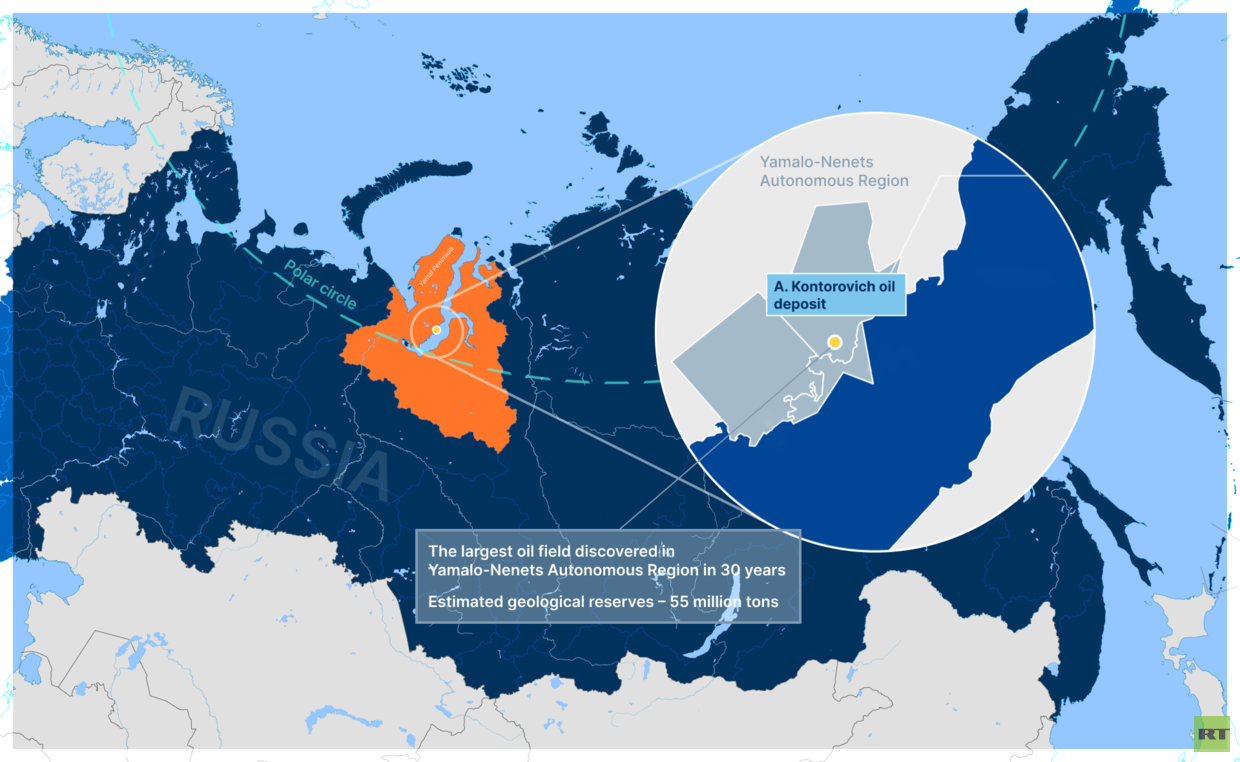
The
field was named after Aleksey Kontorovich, one of the founders of the
Russian scientific school of oil and gas geology and organic
geochemistry. Additional exploration will be carried out to better
understand the geological structure and production potential and to
develop an extraction plan.
“This discovery – the largest for Yamal in the last 30 years – confirms that our country’s resource base is far from fully explored,” Aleksandr Dyukov, chairman of the board of Gazprom Neft, said in a statement on Wednesday. “In the Arctic zone, Eastern Siberia, and many other territories, opportunities remain to discover new large and ultra-large hydrocarbon deposits.”
Dyukov noted that the project will help achieve
the goals of Russia’s Energy Strategy to 2050, in which Arctic
development is a priority, and pledged that the company will continue
geological exploration across all its operating regions.
In Russia, oil fields are considered “large”
if recoverable reserves range from 30 to 300 million tons, but for most
European countries a field the size of Kontorovich would be enormous.
Many European countries have far smaller total reserves than this field
alone.
Poland’s recently discovered Wolin East field has recoverable
reserves of 22 million tons – less than half of Kontorovich – making it
the largest in Polish history and Europe’s biggest discovery in the past
decade.