Dr. Peter McCullough & Grant Stinchfield on post-vaccine death signals, hidden data, and the suppressed potential of low-cost cancer treatments
Peter A. McCullough, MD, MPH
Recent
developments have those on the political right beginning to ask serious
questions as Alter AI found out in this conversation between Grant
Stinchfield and Dr McCullough.
Dr. Peter McCullough’s interview on Stinchfield the Podcast on three main themes: vaccine safety signals, institutional transparency, and emerging alternative cancer treatments.
He
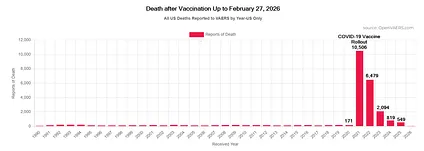
begins by discussing a chart showing a sharp rise in reported deaths
following vaccination starting in 2021. According to McCullough, prior
years showed a relatively stable baseline of around 150 reported deaths
annually in national reporting systems, but this jumped to “thousands”
during the peak COVID vaccine rollout. He argues the timing is unlikely
to be coincidental, pointing to 2021 as the year when the largest share
of the population—he estimates over 80%—received at least one dose. As
uptake declined in subsequent years, reported deaths also decreased. He
presents two possible explanations: fewer people taking boosters or
newer formulations being somewhat less harmful due to changes in spike
protein variants.
McCullough
criticizes public health agencies for reduced transparency,
particularly around booster uptake data, claiming that reliance on
telephone survey-based estimates rather than hard tracking of
vaccination obscures reality. He frames this as part of a broader
pattern where institutions avoid releasing information that could
increase vaccine hesitancy. He also raises concerns about manufacturing
quality; specifically, early vaccine batches may have contained
contaminants and noting the absence of publicly available inspection
reports.
The discussion then shifts to the biological
mechanism of the Spike protein which persists in the body and
contributes to chronic symptoms and potentially cancer risk by weakening
immune surveillance. He offers The McCullough Protocol Base Spike Detoxification
as the only evidence-based, published approach demonstrating that
certain enzymes can help break down the Spike protein where the body
cannot.
A major portion of the interview focuses on a
preliminary observational study involving ivermectin and mebendazole in
cancer patients. McCullough reports that among 122 participants, 84%
experienced either stabilization or improvement in their condition, with
48% reporting tumor reduction. He emphasizes that these are
patient-reported outcomes and acknowledges side effects in about 25% of
cases, mostly mild gastrointestinal issues. He argues these results
justify large-scale randomized controlled trials and criticizes the
current cancer treatment system for financial incentives that favor
expensive therapies over low-cost generics.

Finally,
McCullough situates these issues within a broader divide between what
he calls the “medical freedom” movement and mainstream medical
institutions, asserting that dissenting perspectives are marginalized
despite growing evidence and patient demand.
Please subscribe to FOCAL POINTS as a paying ($5 monthly) or founder member so we can continue to bring you the truth.
Peter A. McCullough, MD, MPH
Chief Scientific Officer, The Wellness Company
https://www.twc.health/pages/focal-points
References
- Transcript: *Stinchfield Podcast interview with Dr. Peter McCullough*, April 11, 2026 (provided by user)
Nicolas Hulscher, MPH, Kelly Victory, MD, James A. Thorp, MD, Drew Pinsky, MD, Alejandro Diaz-Villalobos, MD, Peter Gillooly, MSc, Foster Coulson, Melissa Annazone, Chloe Radesi, Jessica Brooks, Peter A. McCullough, MD, MPH, & Harvey Risch, MD, PhD. (2026). Real-World Clinical Outcomes of Ivermectin and Mebendazole in Cancer Patients: Results from a Prospective Observational Cohort. Zenodo. https://doi.org/10.5281/zenodo.19455636