Court affirms injured patients’ right to access manufacturer data, forcing disclosure.
Jon Fleetwood
In
a major procedural victory for vaccine-injured plaintiffs, a German
court has ordered BioNTech to turn over internal data on its Comirnaty
mRNA COVID-19 vaccine—affirming that individuals claiming harm have the
right to access the manufacturer’s own records to challenge its safety
claims and pursue damages.
The Regional Court of Aurich
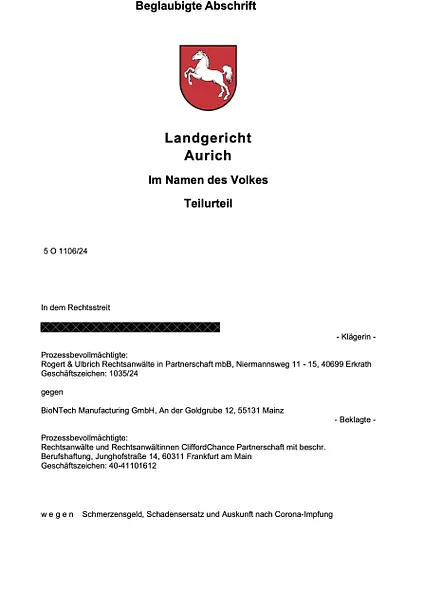
(Landgericht Aurich), in case 5 O 1106/24, issued a certified partial
judgment (“Teilurteil”) ordering BioNTech Manufacturing GmbH to provide
detailed information on the vaccine’s effects, side effects, and
underlying biological and manufacturing characteristics.
The court’s order states, translated and paraphrased for readability:
The
defendant is ordered … to provide information … on the effects and side
effects known to it … as well as on other findings that may be relevant
for the assessment of the justifiability of harmful effects …
The
ruling directly addresses a core imbalance that has defined vaccine
injury litigation: injured individuals have been expected to prove
causation while being denied access to the very data needed to do so.
This decision breaks that barrier.
Independent journalist Bastian Barucker first reported on the ruling.
Court Order Forces Disclosure Across Manufacturing, Biology, and Safety
The certified judgment (“Beglaubigte Abschrift”)—posted by Tobias Ulbrich (@AnwaltUlbrich), the plaintiff’s lead lawyer from Rogert & Ulbrich—shows the court is not ordering narrow or limited disclosure.
It is compelling BioNTech to provide specific, technical categories of internal data, including:
- Toxicity and immunological effects of lipid nanoparticles (ALC-0159, ALC-0315)
- Pharmaceutical purity and variability of key components
- Manufacturing processes, suppliers, and batch-level differences
- Residual DNA contamination and sequencing data (“Process 2”)
- Spike protein design, function, and biological behavior (including ACE2 interaction and cleavage mechanisms)
- Whether spike protein remains membrane-bound or becomes freely circulating in the body
- Biodistribution and potential exposure of organs and tissues
- Pharmacovigilance data on recorded injuries matching the plaintiff’s conditions
- Genotoxicity findings in humans
- Reproductive and fertility-related effects
- Sex-based risk differences, including higher risk signals in women
- Cancer-related mechanisms, including P53 interaction and oncomiR findings
- Internal evaluations tied to risk-benefit assessments
- Batch-specific quality control and contamination measurements
- Quantification of spike protein production in the body
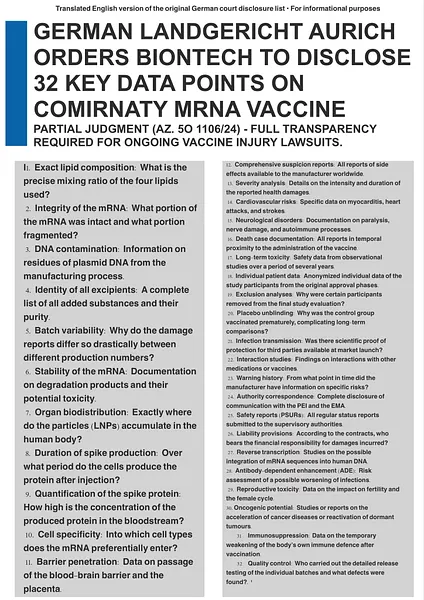
These categories align with a broader disclosure request submitted by the plaintiff—commonly circulated as a “32-point” data list—now substantiated by the court’s order itself.
Plaintiff Presented Evidence of Severe Post-Vaccination Injury
The case involves a woman who received two doses of Comirnaty in 2021 and subsequently developed multiple conditions, including:
- Autoimmune disease
- Circulatory disorders
- Vascular occlusion
- Cardiac arrhythmias
- Hyperinflammation syndrome
- Neurological dysfunction
- Menstrual disruption
Court records indicate no clear pre-existing conditions prior to vaccination.
The court found these claims sufficient to trigger the manufacturer’s obligation to disclose all relevant internal findings.
Court: Manufacturer Must Provide What It Knows
The ruling makes clear that disclosure is not limited to publicly available summaries or pre-selected data.
It extends to:
all effects, side effects, and findings known to the manufacturer relevant to evaluating potential harm
The
court further emphasized that regulatory approval does not eliminate
the need for independent evidentiary review—especially in cases where
plaintiffs allege injury.
Builds on National Precedent Expanding Access to Data
The
decision follows a March 2026 ruling by Germany’s Federal Court of
Justice (BGH), which affirmed that plaintiffs have a right to
comprehensive access to manufacturer-held data under §84a of the
Medicines Act.
Judges in Aurich applied that precedent directly,
reinforcing that without access to this data, injured individuals cannot
meaningfully challenge a manufacturer’s claims or present expert
evidence.
Plaintiff’s Legal Team Signals Broader Impact
Attorney
Tobias Ulbrich, representing the plaintiff, described the ruling as the
beginning of a broader shift in litigation strategy, arguing that
failure to provide required information could itself carry legal
consequences for manufacturers.
He compared the situation to past
German litigation against Volkswagen, where courts ruled against the
company after it failed to fully disclose technical details tied to
alleged wrongdoing.
Not a Final Liability Ruling—But a Forced Opening of the Data
The court did not determine that the vaccine caused the plaintiff’s injuries.
It issued a partial judgment requiring disclosure.
But
the immediate effect is that BioNTech must now provide internal data on
how the vaccine was made, how it behaves in the body, and what adverse
effects were known to the company.
Bottom Line
A
certified German court ruling has ordered BioNTech to disclose internal
data on its mRNA vaccine—covering manufacturing, biological activity,
and recorded adverse effects—in an active injury case.
The
decision affirms that individuals claiming harm are entitled to access
the manufacturer’s own data to test those claims in court.
The case is not resolved.
But the data is no longer out of reach.