New Zealand has been approached by the United States to join a potential multinational effort to reopen the Strait of Hormuz, one of the world’s most critical energy shipping routes.
The passage has been largely shut since the escalation of the Middle East conflict, sending shockwaves through global oil markets and raising concerns over energy security.
According to reporting, the Trump administration has instructed US embassies to lobby partner nations to participate in a coalition aimed at restoring access to the strait.
Government Response: “Early Stages Only”
Foreign Affairs Minister Winston Peters’ office confirmed New Zealand has received preliminary information but emphasized that no decisions are imminent.
“We are in the process of asking questions and seeking more information about this preliminary proposal. Accordingly, we are not close to a point where the New Zealand Government would be making any decisions about it.”
Officials also confirmed New Zealand is engaged in discussions with a range of international partners, including involvement in early-stage planning led by the United Kingdom and France for a potential multinational operation.
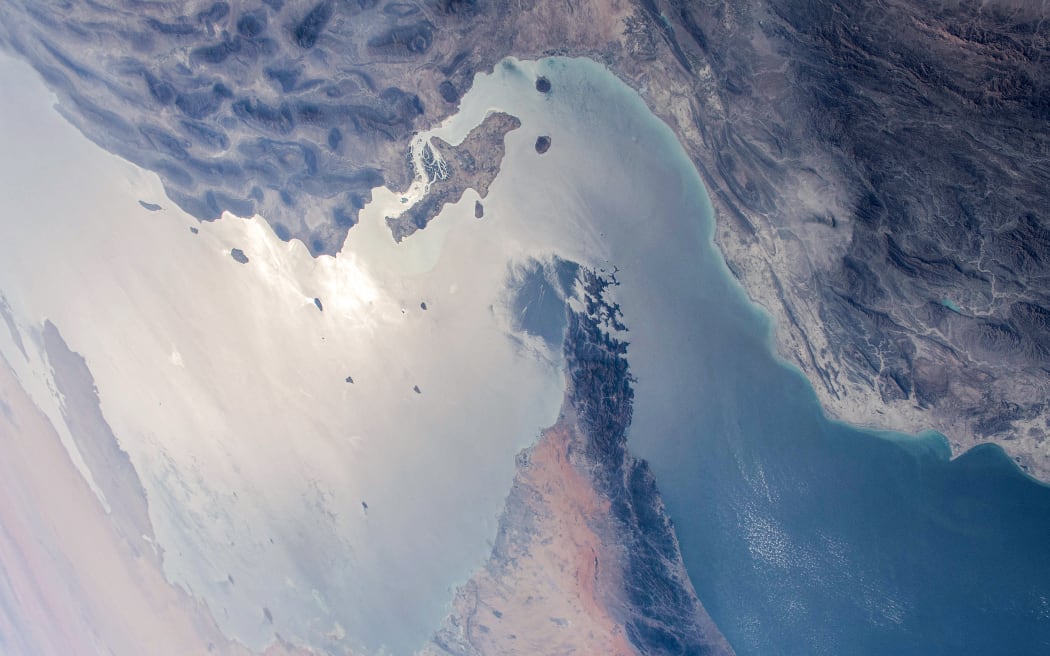
The Strait of Hormuz, seen from space. Photo: AFP PHOTO /NASA/HANDOUT
Ceasefire Condition Emerging As Key Threshold
The New Zealand government has signalled that any involvement would be conditional on a ceasefire agreement in the region.
Participation would also require Cabinet approval and would depend heavily on the structure and legality of the mission.
Prime Minister Christopher Luxon reinforced that position, noting that no firm proposal has yet been received from either the US or European partners.
“We will basically need to seek a lot more information on both those proposals and understand exactly how they would work, and then whether there is a contribution from New Zealand or not.”
Multilateral Push Building
Finance Minister Nicola Willis suggested the discussions reflect a broader international consensus forming around a coordinated response.
“There are a number of countries around the world who recognise that a multilateral solution going forward is going to be a good idea.”
However, how such a coalition would operate remains unclear.
Opposition Calls For Strict Legal Framework
Labour’s foreign affairs spokesperson Vanushi Walters said any involvement must meet strict criteria, including compliance with international law and ideally a United Nations mandate.
“If there was a sustainable ceasefire, and there was compliance with international law, so ideally a UN mandate, with Iran’s consent, then there’s possibility that there could be some intervention.”
She warned New Zealand must avoid being seen as a belligerent party and maintain its longstanding position on international law.

Prime Minister Christopher Luxon said there were not yet any firm proposals from the US, or the UK and France. Photo: Marika Khabazi / RNZ
Military Capability Exists, But Deployment Would Take Time
Former Defence Minister Wayne Mapp said New Zealand does have the capability to contribute, although logistics would be a factor.
Naval deployment could take weeks, but surveillance operations could be carried out using P-8 Poseidon aircraft.
“A lot of this is monitoring who’s there, what they’re doing, how they’re doing it, and those aircraft have certainly got that sort of surveillance capability.”
Strategic Implications
The Strait of Hormuz is a chokepoint for a significant portion of the world’s oil supply. Any prolonged disruption has immediate global economic consequences, including fuel price volatility and supply chain risk.
For New Zealand, the decision carries both geopolitical and economic weight. Participation could reinforce alliances but also risks entanglement in an escalating conflict.
Both government and opposition figures suggest that New Zealand is unlikely to face serious consequences if it declines participation, particularly if other nations take a similar stance.
A Decision Still Down The Track
For now, the government remains in information-gathering mode.
Any commitment would require not just strategic alignment, but legal clarity, international backing, and a stabilised security environment on the ground.
The situation remains fluid, with New Zealand carefully weighing its position as pressure builds from major allies.