What if World War I was not primarily about alliances, nationalism or the assassination of Archduke Franz Ferdinand?
Report by eLocal
According to independent researcher and journalist Ali McFarlane of alimcforever.com, the true forces behind the First World War were industrial chemistry, strategic resources, economic survival and the control of critical supply chains.
In a detailed presentation titled "The Real History of War – The Truth About WW1 and Zionism", McFarlane presents a sweeping re-examination of events leading up to World War I, arguing that many of the key decisions that shaped the modern world were driven by access to chemicals, industrial production and mineral resources rather than the explanations typically found in history books.
The Chemical Revolution That Changed Warfare
McFarlane begins with a seemingly obscure technological breakthrough that transformed warfare forever.
Before the late nineteenth century, armies relied on black powder. Every shot produced large clouds of smoke, obscuring battlefields and revealing troop positions.
That changed when French chemists developed smokeless propellants based on nitrocellulose. Britain quickly recognised the military significance of the breakthrough and began racing to develop its own version.
The result was Cordite, Britain's smokeless propellant that would become central to its military power. But producing Cordite required enormous quantities of acetone, a solvent essential to the manufacturing process.
Britain's Hidden Vulnerability
According to McFarlane, Britain faced a problem.
The British Empire had largely exhausted its own hardwood forests centuries earlier through shipbuilding, iron production and industrial expansion.
Germany, meanwhile, had done the opposite.
By 1914 Germany possessed extensive managed forests, a world-leading chemical industry and cutting-edge scientific research institutions. Companies such as BASF and Bayer dominated global markets in synthetic dyes, pharmaceuticals and industrial chemicals. Germany had also pioneered the Haber-Bosch process, allowing industrial-scale production of ammonia from atmospheric nitrogen.
In McFarlane's telling, Germany was rapidly becoming an industrial superpower capable of challenging British dominance.
He points to a quote attributed to Arthur Balfour in 1909:
"We are probably fools not to find a reason for declaring war on Germany before she builds too many ships."
For McFarlane, the quote reflects a growing concern within sections of the British establishment that Germany's industrial rise threatened Britain's global position.
The Acetone Crisis
Before the war, Britain imported significant quantities of chemicals and industrial products from Germany.
When Britain declared war in August 1914, those supply lines disappeared almost overnight.
McFarlane argues that Britain suddenly found itself engaged in a modern industrial war while cut off from some of the very chemical inputs required to sustain it.
The result was what became known as the Shell Crisis of 1915.
The official narrative focused on shortages of artillery shells. McFarlane argues that behind the headlines lay a deeper crisis involving the production of Cordite and the availability of acetone itself.
Chaim Weizmann Enters The Story
At the centre of the presentation stands Chaim Weizmann.
Born in what is now Belarus, Weizmann trained within the German scientific tradition before eventually arriving in Manchester.
McFarlane traces Weizmann's academic path through Germany, Switzerland and Britain, arguing that his expertise in bacterial fermentation would ultimately prove crucial to Britain's war effort.
Working on industrial fermentation processes, Weizmann developed a bacterial method capable of producing acetone at industrial scale.
The process provided Britain with a domestic source of a chemical that had become vital to ammunition production.
Historical records widely acknowledge Weizmann's contribution to wartime acetone production. McFarlane's presentation focuses on the political consequences that followed.
Churchill, Manchester And Wartime Networks
According to McFarlane, the relationship between Winston Churchill and Weizmann pre-dated the war by many years.
He points to Churchill's political connections in Manchester and his relationships with prominent Jewish figures, including influential donors and community leaders.
Photographs, speeches and political associations from the period are used to argue that Churchill's connections with Zionist leaders existed long before wartime events elevated Weizmann's national importance.
McFarlane contends that these networks became increasingly significant as Britain searched for solutions to its wartime industrial problems.
Reinterpreting The Balfour Declaration
The most controversial section of the presentation concerns the 1917 Balfour Declaration.
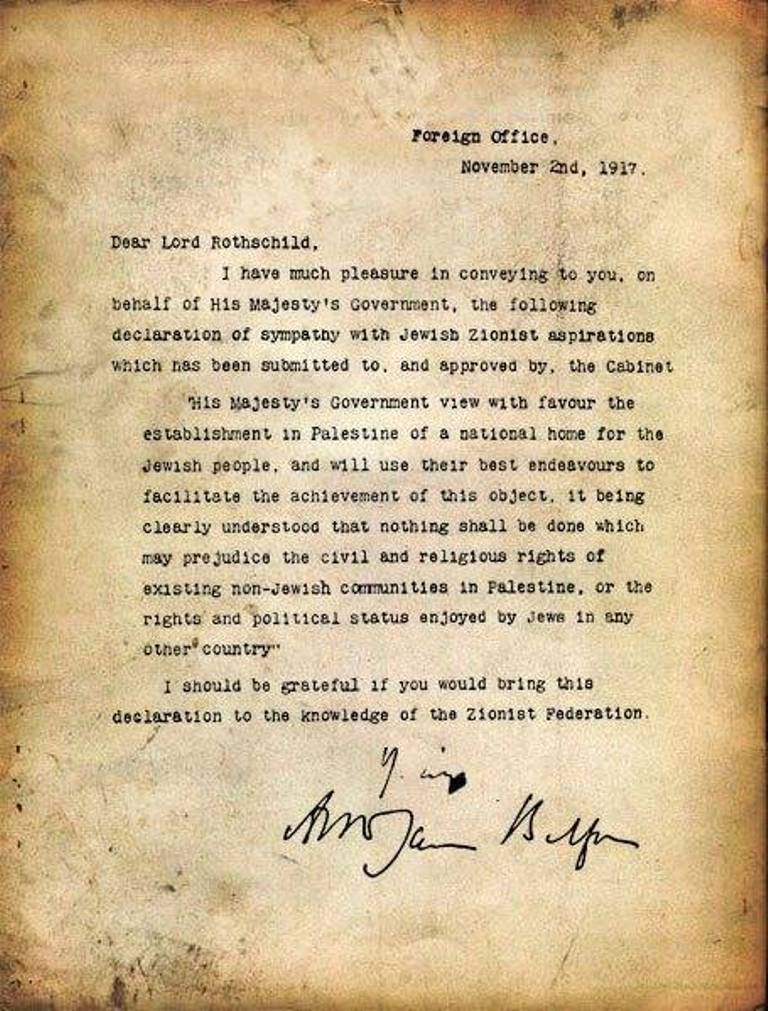
Conventional histories often describe the declaration as Britain's support for a Jewish homeland in Palestine, influenced by wartime diplomacy and Zionist advocacy.
McFarlane presents a different interpretation.
According to his research, the declaration cannot be fully understood without examining the enormous mineral wealth contained within the Dead Sea region.
The Dead Sea And The Potash Prize
Potash was among the most valuable strategic commodities of the early twentieth century.
Essential for fertilisers, explosives and industrial production, control over potash reserves carried enormous economic significance.
According to McFarlane, Zionist leaders understood the importance of Dead Sea potash long before the declaration was issued.
British officials also understood its value.
He notes that following Britain's capture of Jerusalem, military engineers were dispatched to assess the mineral potential of the Dead Sea. Herbert Samuel, who would later become the first High Commissioner of Palestine, reportedly valued the deposits at hundreds of millions of pounds sterling.
McFarlane argues that these resources formed an overlooked but crucial element in Britain's strategic calculations.
The Homeland Or The Resources?
One of the most striking arguments in the presentation is that debates about Zionism have often obscured deeper economic interests.
McFarlane contends that the focus on religion, ethnicity and nationalism distracts from what he sees as the central issue: access to critical industrial resources.
He argues that when Weizmann and other leaders advocated for Palestine, they were advocating for territory that sat atop one of the world's most valuable chemical deposits.
Today, the Dead Sea remains a major source of potash production, generating billions of dollars in annual economic activity.
A Different Way Of Viewing History
The broader thesis of McFarlane's presentation is that wars are often driven less by ideology than by economics.
Behind governments, political movements and military campaigns sit supply chains, resources, industrial systems and financial interests.
Viewed through that lens, World War I becomes not simply a clash of empires, but a struggle over the industrial foundations of modern civilisation itself.
eLocal Analysis
Whether readers agree with all of McFarlane's conclusions or not, the presentation highlights a reality often overlooked in mainstream historical discussion.
Industrial chemistry transformed the world in the late nineteenth and early twentieth centuries. Access to fertilisers, explosives, fuel, metals and strategic minerals became matters of national survival.
The First World War was the first truly industrial war, and the nations that controlled resources, manufacturing and scientific innovation gained enormous advantages.
McFarlane's research invites readers to ask a provocative question:
If modern wars are ultimately fought over economic systems, resources and industrial power, how much of what we call history is actually the history of supply chains?
Ali McFarlane (alimcforever.com)
Presentation: The Real History of War – The Truth About WW1 and Zionism
Transcript provided to eLocal.
"When you pull the trigger of a gun, a small explosion sends the bullet down the barrel. That explosion needs a propellant, a chemical that burns very fast in this confined space. Before the 1900s, armies used gunpowder.
Gunpowder works as a propellant, but it produces a huge cloud of white smoke. This meant that every soldier who fired their weapon gave away their position, and the entire battlefield filled up with smoke within minutes. Then, in 1884, a French chemist called Paul Vieux created a propellant that produced almost no smoke at all.
The French never announced publicly what they had created, they just fitted it to a new rifle, the Lebel M1886, and let Europe find out on the battlefield. By 1888, Britain was panicking, so they set up the Explosives Committee. This committee had one job, find out what was in that French rifle and copy it.
The head of that committee was Frederick Abel, the War Office's chief chemist. He had been working on gun cotton at the Royal Gunpowder Factory at Waltham Abbey since the 1860s. The chemical base is nitrocellulose.
It was made from cotton soaked in nitric acid. This is what made the bullet explosive. You had to keep that stable and then combine it with nitroglycerin.
Getting these two chemicals to combine stably, burn predictably, and not detonate the user was a technical problem every European empire was racing to solve. Then, in 1887, Alfred Nobel, the man who would later fund the Peace Prize, created his own smokeless propellant. He called it Ballistite.
Actually, I want to move so you can actually look at this. Nobel's Empire smokeless sporting powder for shotguns. He first tried to sell this to France but they had their own, so he ended up selling it to Italy.
Frederick Abel and his team at the Royal Gunpowder Factory then examined Ballistite. They identified what they considered to be a technical flaw, what I consider to be a way around the patent. They reformulated Ballistite and produced their own substance, Chordite.
Chordite is a combination of nitrocellulose, nitroglycerin, and a mineral jelly stabiliser. The British government assigned the patent to the Secretary of State for War on the 24th of June 1890. Two days after that patent was assigned, the Secretary of State certified that this invention should be kept secret in the public interest.
And just as I suspected, they did not find a technical flaw, they found a way around a patent. Nobel also suspected that and he filed a lawsuit for patent infringement. To produce Chordite at scale, you need a lot of acetone.
Acetone is a solvent. It's the thing that makes nail varnish remover smell so pungent. In Chordite production, it dissolves the nitrocellulose and the nitroglycerin into a workable paste.
Acetone is a byproduct of the timber and logging industry. Today, acetone is synthetically manufactured from petrochemicals. In the 1800s, the process required the destructive distillation of hardwood.
When large swathes of hardwood trees are felled for lumber, massive volumes of waste wood, stumps, and branches are left over. Factories gather up all of that remaining wood and put it in giant, sealed, oxygen-free ovens and heat it to extreme temperatures. When the vapour is cooled, it condenses into a dark liquid called wood vinegar and from that you can isolate acetone.
Britain did not have enough hardwood trees to fuel this increasing demand for acetone. It had already been through a timber crisis during the Elizabethan era. Industry was consuming forests faster than they could regrow.
Coal replaced charcoal in iron smelting in Britain because it had to. It was the only remaining option. Britain deforested itself to build its navy.
The war machine consumed its own fuel source. Britain could not produce its own acetone, but Germany could. Germany, before 1914, had three things that Britain did not.
It had managed forests, roughly 32% forest cover going into World War I, and crucially, these were managed forests, not wild ones. Germany had invented modern scientific forestry. The discipline, called Forstwissenschaft, was formalised in the early 19th century by German foresters who had developed the concept of sustainable yield.
They understood how much timber you can cut in a year without reducing the total stock of the forest. Britain had burned through all of its forests for charcoal, shipbuilding and potash. It never tried to anything as renewable, but Germany did.
The second thing was science. By 1914, German firms like BASF and Bayer were producing over 80% of the world's synthetic dyes and 90% of world trade in them. Dyes, pharmaceuticals and explosive precursors all come from the same chemistry infrastructure.
Germany had intentionally built a systemic pipeline from university chemistry departments into industrial production. BASF's Haber-Bosch process synthesised ammonia from atmospheric nitrogen. They cracked that in 1909.
This is the same reaction that produces fertiliser and explosive feedstock. All those years of Britain using slaves to fertilise manure, and just like that, Germany industrialised the nitrogen cycle itself. There is a quote from Arthur Balfour from 1909, the same year that Germany figured out the Haber-Bosch process.
He said, We are probably fools not to find a reason for declaring war on Germany before she builds too many ships. That's the man who later signed the Balfour Declaration, five years before the First World War started, explaining that Britain wanted to destroy Germany's industrial capacity before it to beat. Before 1914, Britain was importing a lot from Germany.
All of the acetone came from Germany, and then all the synthetic dyes needed for the textile industry. The wool industry, Britain's big industry, biggest export, was completely dependent on wood ash, potash, from Germany. Many pharmaceuticals or pharmaceutical precursors were mostly coming from Bayer at this point.
When Britain declared war on Germany on the 4th of August 1914, it cut itself off from that chemical industry, those chemicals that were foundational to the very war effort itself. Nobody makes the decision to go to war with their number one supplier of war industry chemicals without having an alternative supply secured. How the fuck did Britain fight this war if it couldn't get acetone anymore? High End Wiseman arrived in Britain from Belarus in 1904.
His father was a lumber transporter. They were from a small Jewish settlement near Pinsk in what was then the Russian Empire and is today Belarus. This whole landmass was called the Pale.
At this point in history it was mostly just dense forest and it was where the Russian Empire had been pushing out the Jews. As a child, Wiseman spent his summers riding his father's log rafts downriver to the Baltic ports. These details are not decorative, they place him deep in the Baltic timber trade.
Same forest, same rivers, same economy. He studied the engine. As a Jewish man in the Russian Empire, Wiseman was not allowed to study chemistry, so he left.
First he went to Germany, then he went to Switzerland. He studied at the Technical University in Darmstadt and then at the University of Berlin. He completed his doctorate at the University of Fribourg in Switzerland.
This is the same German university chemistry system that had produced BASF. He was trained by it. After completing his doctorate, he lectured at the University of Geneva and taught Russian.
In 1904 he was invited to come to Owens College in Manchester to work with William Henry Perkins Jr. who was the head of organic chemistry. Perkins Jr. was the son of the man who had discovered synthetic dyes. His father, Perkins Sr. had trained under Adolf von Bayer from Munich, of Bayer, the same German university system.
Perkins' lab at Owens College had been modelled on the German research laboratories. Owens College had been created in 1851 at the bequest of John Owens, a Manchester textile merchant. This was a private industrialist's money directed at building an institution to serve the specific needs of the industrial class.
And the chemistry building where Perkins Jr. worked was funded by Ludwig Mond, a German-born British chemist and industrialist. He was the founder of Brunner Mond and Company who literally have in their emblem making war material. He was also the founder of the Mond Nickel Company.
After he died, these companies were merged with three others to form Imperial Chemical Industries. This is the company that would later run Britain's nuclear programme, cleverly disguised nuclear programme, Tube Alloys. Wiseman had been brought to the University of Manchester specifically to work on bacterial fermentation.
In 1910, Wiseman started working with a consortium called Strange and Graham. Strange and Graham was a group of technical research chemists based in the City of London. Their brief was finding an industrial scale fermentation that would work as an alternative to German wood vinegar.
Wiseman had a contact at the Pasteur Institute in Paris. This is the French institution that had already solved the fermentation problem. And he was able to bring the French biochemist August Fernbach into this project with Strange and Graham and identified a clostridium species that could ferment potato starch into acetone.
It worked and in 1911, Strange and Graham filed a patent in the United States. The inventors named on this patent, US 1044368A, are August Fernbach of Paris, France and Edward Halford Strange of London, England. By 1912, Strange and Graham were producing acetone at industrial scale using Fernbach's method.
And with this plant operational, the British were finally ready to go to war with Germany. The war starts in August and by November, Strange and Graham's fermentation plant is failing. The bacteria strain that they had got from Fernbach in Paris doesn't work.
It is not staying active at industrial scale. Whether Fernbach's strain failed because it was genuinely fragile at industrial scale or whether someone understood the science and the stakes well enough to ensure that it would fail is unclear. In March 1915, at the Battle of Neuve Chapelle, Britain fired more shells in a single 35-minute bombardment than it had in the entire Boer Boer.
And after that, its stocks were functionally gone. Between March and May 1915, British propaganda goes into overdrive. The press creates this whole fantasy that history remembers as the Shell Crisis.
And the Shell Crisis causes a political crisis. The Times publishes a report by the war correspondent, Colonel Reppington. The day after this was published, the first sea lord, Admiral Fisher, resigns.
His resignation triggers a constitutional crisis. A first lord, who was Winston Churchill, without a first sea lord is unsustainable, especially during a war. And so, within a week, Churchill is also fired.
The official reason that has always been given for why Churchill was removed is Fisher's departure. But let me tell you what that framing conceals. Churchill was the one most directly responsible for the acetone crisis.
Churchill has an on-record relationship with Wiseman that goes back earlier than 1906. Churchill was the first lord of the admiralty. It was him who personally issued the orders to the British army to commence hostilities against Germany in August 1914.
He had spent the three preceding years building up the British navy for exactly this war. Building up the navy had included transitioning them from coal to oil and then clearing the oil corridor from Mesopotamia. While Wiseman was a lecturer at the University of Manchester, Churchill was a liberal MP in Manchester North West.
That constituency had a large influential Jewish population, specifically in Cheetham Hill area. One of Churchill's biggest campaign donors was the wealthy cotton merchant, Harold Lasky. He was also president of the Manchester Great Synagogue and the local Liberal Party campaign chairman.
Churchill literally stayed with the Lasky family during his time in this constituency. On the 10th of December 1905, Churchill had stood at a podium in Manchester, speaking about the persecution of Russian Jews, with Wiseman by his side on stage. This is evidence that the operational relationship between Churchill and the Zionist community was established long before the war, long before any acetone, long before any crisis.
Wiseman was already useful to Churchill's career. For three years, Churchill built up the British navy and then led it into war with its own primary acetone suppliers. The acetone runs out in May 1915.
Well, in January 1915, as this shell crisis is already building, Herbert Samuel, who was the only Jewish member of the British cabinet, circulated a memorandum titled The Future of Palestine. So by April 1915, Churchill is facing a war that he started against suppliers that he depended on, and a political crisis of his own making, when guess who walks in to save the day? I. M. Wiseman. He blurted out on the spot, can you make me 30,000 tonnes of acetone? And Wiseman said, yes.
That's the story. It's suspicious, isn't it? So Wiseman produces a new strand of bacteria, just like that. And this one is resilient at industrial scale.
And on the 24th of May, the day before Parliament would remove Churchill, Wiseman demonstrated that his fermentation process could convert 100 tonnes of grain into 12 tonnes of acetone. So the new munitions minister, David Lloyd George, followed Churchill in supporting Wiseman's efforts. Within days, the British state start funding a laboratory at Lister Institute and securing the industrial plants needed to produce acetone at war machine scale.
The way that this story gets told by mostly Britain and Israel is that Dr. Wiseman declined to receive any compensation for the patent. Then in 1916, Lloyd George becomes the prime minister and he appoints Arthur Balfour as his foreign secretary. According to David Lloyd George, Wiseman declined any payment, but just asked for the rights to Palestine.
And so on the 2nd of November 1917, Arthur Balfour writes to Lord Rothschild and says, his majesty's government view with favour the establishment in Palestine of a national home for Jewish people. This is the point where you're supposed to hate the Jews. Bad Jews.
Bad Zionist Jews. Except that's not what this letter was. Zionism is the propagandaler.
This is not a bunch of Jewish people in a conspiracy that wanted a homeland. This is a bunch of chemists in a conspiracy that wanted access to potash. Theodor Herzl, the founder of Zionism, had already identified that dead sea potash extraction would be the financial foundation of a Jewish state project.
The men put forward to run the Zionist leadership understood exactly what was in the ground and what was needed to get it out. And immediately after this declaration, the British take Jerusalem and send Major T.G. Tullock, a military engineer, specifically to survey the dead sea's mineral potential. Herbert Samuel, who had circulated that cabinet memorandum, was then made the first High Commissioner of Palestine.
He then stood up at a lecture and declared the dead sea minerals to be worth 800 million pounds sterling. That'll tell you about his priorities. So when Wiseman said all I want is a homeland for my people, but can you just conveniently put it on the territory that the British government's own surveyors have just assessed contains 2 million tonnes of potash, no charge, just Palestine.
Today, the dead sea still produces 4 million tonnes of potash every year and generates $3 billion annually. The homeland that this chemist asked for just happens to be sitting on top of the most valuable chemical deposit on earth."