As Chris Hipkins seeks a return to power, voters are being asked to look forward. But before New Zealand moves on, it is worth remembering what happened when Labour last held the reins.
Report by eLocal
The latest RNZ/The Conversation article asks what Hipkins can learn from the downfall of former British Labour prime minister Keir Starmer. It focuses on leadership, voter fragmentation, and the pressures now facing social-democratic parties. Those are valid questions. But for New Zealand voters, there is a far more immediate one: what accountability has there been for the economic damage that occurred under Labour’s watch?
Hipkins inherited the prime ministership from Jacinda Ardern in January 2023, but he was not an outsider arriving late to the scene. He had been a senior minister throughout Labour’s second term and became prime minister during a period when New Zealand households were already under pressure from inflation, rising interest rates, falling real incomes and weakening business confidence.
By the time Labour left office, New Zealand was facing a deeply strained economy. The country had entered recession, GDP per capita had been sliding, households were being squeezed, and many businesses were struggling under higher costs and lower demand.
The public should not forget that record simply because the political conversation has moved on to campaign strategy, polling numbers and leadership style.
The unanswered accountability question
Hipkins has often spoken about cost of living, fairness and rebuilding trust. But many New Zealanders will ask whether there has been any meaningful acceptance of responsibility for the economic conditions that developed under Labour.
The point is not that one leader alone controls every global or domestic economic force. The world was dealing with Covid aftershocks, inflation, disrupted supply chains and rising interest rates. But governments make choices. They choose spending levels. They choose regulatory burdens. They choose priorities. They choose whether to expand the state, how to manage debt, and how much pressure to place on productive businesses and households.
Labour’s record cannot be separated from those decisions.
If Hipkins wants another chance to lead the country, voters are entitled to ask whether he has genuinely reckoned with what went wrong, or whether Labour is simply attempting to repackage itself without confronting the consequences of its last term in power.
Leadership is more than presentation
The RNZ/The Conversation piece notes that Hipkins, like Starmer, has not generated strong enthusiasm among voters. It says his preferred-prime-minister ratings have often fallen below 20 percent, while his approval ratings have moved into negative territory.
That matters, but leadership is not just about charisma. It is about judgment, responsibility and results.
For New Zealanders who endured rising mortgage payments, grocery bills, business failures, public-sector waste and declining confidence, the question is not whether Hipkins can sharpen Labour’s message. The question is whether the same leadership team that presided over economic deterioration has learned anything substantial from it.
A campaign built on promises for the future must still answer for the past.
A warning from overseas
The comparison with Britain is useful in one respect. Voters are increasingly impatient with political parties that talk about fairness and competence while failing to deliver either.
In the UK, Labour’s difficulties under Starmer point to a wider problem for centre-left parties: they often speak to working people while pursuing policies that appear remote from everyday economic reality.
New Zealand Labour faces a similar danger. It can talk about cost of living, health, education and fairness, but voters will judge those words against lived experience. Under Labour, many households did not feel more secure. Many felt poorer, more pressured and less confident about the country’s direction.
That is the shadow Hipkins carries into the next election.
Voters should remember the record
Political memory can be short. Campaigns are designed to reset narratives and move attention away from uncomfortable history.
But New Zealanders should remember the recession, the cost-of-living squeeze, the pressure on small businesses, and the sense that the country was going backwards economically.
Chris Hipkins may now be pursuing power again. But before voters are asked to trust Labour with another term, they deserve a clear explanation of what went wrong last time — and why the same mistakes would not be repeated.
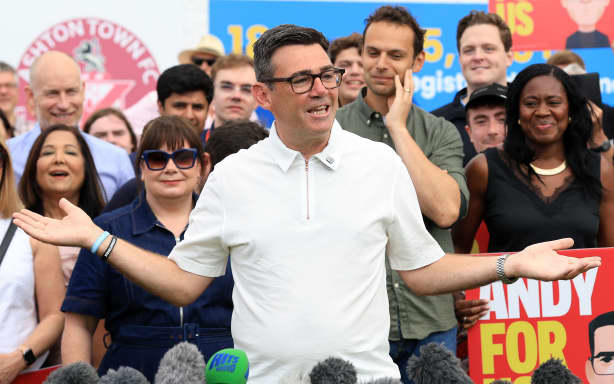
Caption: Andy Burnham is positioned to succeed Starmer in the UK. (File photo)
Photo: DARREN STAPLES / AFP
As NZ’s Chris Hipkins pursues power, what can he learn from Keir Starmer’s downfall?
Grant Duncan for The Conversation
When Keir Starmer stepped down as British prime minister this week, it said as much about his troubled premiership as it did about a crisis facing other social-democratic Labour parties.
Much was made of Labour's "landslide victory" in the UK in 2024, when the party won 411 of 650 seats in the House of Commons. But Britain's disproportional first-past-the-post electoral system had transformed just one third of the popular vote into a commanding parliamentary majority.
With turnout at only 59.7 percent, roughly one in five eligible voters actually backed a Labour candidate. In other words, Labour entered office with overwhelming parliamentary power but a shallow democratic mandate.
Since then, the party's position has deteriorated further, with polling often placing it at 20 percent or lower as support has fragmented to both left and right.
A 2025 survey of Labour defectors found that concerns about immigration were pushing some voters towards Reform UK and the Conservatives. Others were abandoning the party because it was not seen as progressive enough, driving them towards the Greens and Liberal Democrats.
One factor has united both groups, however: dissatisfaction with Starmer himself.
So, what lessons can New Zealand Labour leader Chris Hipkins draw from these voter trends and his former counterpart's downfall as he seeks a return to power in November?
The burden of 'thin labourism'
In the social media era, politics has become more personalised. Voters often look to leaders more than their parties when deciding on whom to support or oppose.
It's unclear whether Andy Burnham, now positioned to succeed Starmer, can give UK Labour a much-needed boost in the polls as Jacinda Ardern did when installed seven weeks before New Zealand's 2017 election.
At this point, polling suggests an early election would be disastrous for UK Labour, while a likely winner would be Nigel Farage's Reform UK party.
In New Zealand, meanwhile, the political landscape is still as it once was in the UK: dominated by two traditional parties.
Polling support for National and Labour combined may be at a 30-year low, but this year's election is still most likely to return either Hipkins or National's Christopher Luxon as prime minister.
Because both major parties compete for the political centre, many feel there isn't enough to distinguish them. Labour leaves the more radical terrain to the Greens and Te Pāti Māori, opting instead for a safer, though politically constrained, position in the middle.
As with its sister parties in the UK and Australia, Labour has retreated to a form of "thin labourism" - an attenuated version of its traditional ideology.
These parties are not returning to the social-democratic policy settings of the postwar era. And they no longer espouse the Third Way politics associated with figures such as Tony Blair and Helen Clark, which some critics on the left derided as "neoliberalism with a human face".
They may now talk confidently about economic growth and, in New Zealand's case, about using competition to lower prices. Yet at the same time, they are wary of unsettling financial markets with ambitious policies on wages, industrial relations or public ownership.
So, they tinker with taxes and transfers - such as proposing a capital gains tax to fund GP visits - while the Greens to their left push more radical policy.
All the while, populist parties such as Reform UK, Pauline Hanson's One Nation and Winston Peters' New Zealand First are capitalising on dissatisfaction with the political mainstream and polarising issues such as immigration.
Already, Peters has begun targeting traditional Labour territory, from the West Coast to Pacific communities in South Auckland.
Labour is caught between a younger constituency concerned with progressive issues, and an older, more culturally conservative bloc that is sceptical of them. Like in the UK, it risks losing voters in each direction.
Will political pragmatism prevail?
Labour's challenge, then, is to hold together diverse constituencies with different priorities and expectations. In trying to appeal to all of them, the party could struggle to articulate a clear sense of what it stands for.
Hipkins, for example, rarely speaks the language of traditional social democracy, with its emphasis on cooperation and solidarity. Instead, he tends to focus on competition, economic growth and the cost of living - themes that are shared by his opponents on the right.
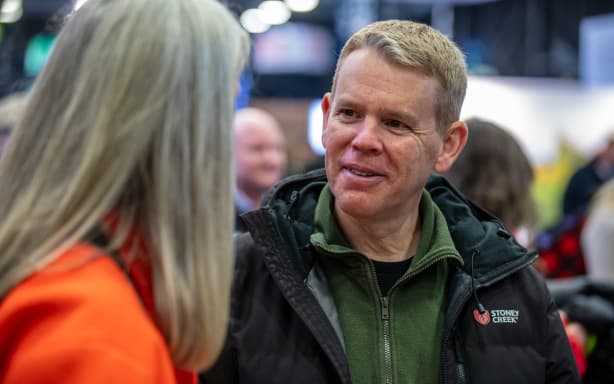
Caption: Chris Hipkins at Fieldays. (File photo)
Photo: RNZ / Nick Monro
And as with Starmer, Hipkins has not generated strong enthusiasm among voters.
His preferred-prime-minister ratings have often fallen below 20 percent, while his approval ratings have slipped into negative territory. The fact that Luxon faces similar challenges offers little political advantage.
With no obvious breakout political figure capable of shaking up the electoral landscape - an Ardern or a Burnham - New Zealand's pre-election head-to-head debates will present two contestants with weak or declining leadership capital. The options for likely next prime minister are merely pragmatic, and not inspirational.
Labour has stayed ahead in post-Budget polls but has yet to release a full manifesto. Hipkins could return to power in November.
But if he does, he'll face political pressures similar to those that defeated Starmer.
This story was originally published on The Conversation.
Source - Original article: RNZ / The Conversation
Author: Grant Duncan
Images: RNZ / Samuel Rillstone; Darren Staples / AFP; RNZ / Nick Monro