New Zealand and India have formally elevated their relationship to a Strategic Partnership, setting out an ambitious Roadmap to 2030 that spans trade, defence, maritime security, technology and education. The announcement comes during Indian Prime Minister Narendra Modi's first official visit to New Zealand in four decades.
Report by elocal
Based on reporting by Tuwhenuaroa Natanahira for RNZ. Original article HERE.
Strategic relationship upgraded
Prime Minister Christopher Luxon and Indian Prime Minister Narendra Modi have formally elevated relations between New Zealand and India to a Strategic Partnership, establishing a broad framework for cooperation through to 2030.
The agreement expands cooperation across trade, investment, defence, maritime security, technology, education, tourism, agriculture, sport and community engagement.
The visit is historic, marking the first official visit by an Indian Prime Minister to New Zealand in 40 years.
Investment clause revisited
The visit also revived debate surrounding one clause in the recently signed New Zealand–India Free Trade Agreement.
During public remarks, Modi thanked New Zealand for what he described as a commitment to support US$20 billion in private investment into India over the next 15 years.
Luxon maintained that the agreement commits both countries to promoting investment rather than requiring investment itself.
“We’ve been through this before — it’s very clearly understood on both sides — it’s a commitment to promote investment into India from New Zealand and vice versa.”
Luxon said both governments understood the legal wording agreed within the treaty.
The clause had previously attracted criticism from Labour and New Zealand First, with questions raised over how achievable the investment target would be.
Labour earlier warned that India could claw back market access if the investment provisions were not met.
Roadmap to 2030
The Strategic Partnership extends well beyond trade.
Both governments agreed to strengthen cooperation across seven broad pillars, beginning with political and diplomatic engagement, defence and security cooperation, and trade and economic cooperation.
The joint statement also commits both nations to working more closely against organised crime, illicit drug trafficking, financial crime, cyber-enabled crime, terrorism-related offences, people smuggling and human trafficking.
Maritime security strengthened
One of the most significant outcomes involves defence cooperation throughout the Indo-Pacific.
Both governments agreed to establish a Maritime Cooperation Arrangement between the New Zealand Defence Force and the Indian Armed Forces.
The arrangement is expected to support bilateral naval activities, maritime security cooperation, cyber-security engagement, defence dialogue and broader regional cooperation.
Luxon said New Zealand’s prosperity and security depended on a stable Indo-Pacific.
“That’s why we are stepping up practical cooperation at sea and deepening how we work together and share perspectives on maritime security.”
The Roadmap itself contains no financial commitments and creates no legally binding rights or obligations.
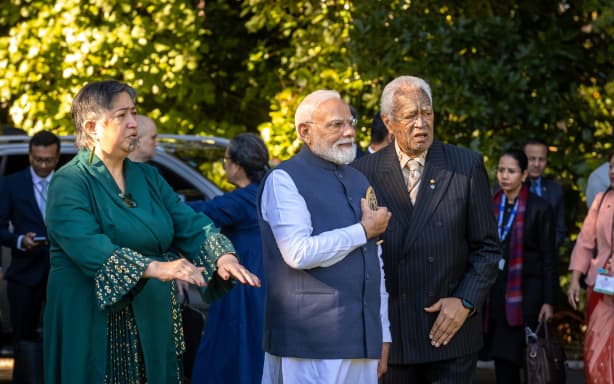
Prime Minister Narendra Modi receives a traditional pōwhiri during the official welcome at Government House. Photo: Pool/The Post/Bruce Mackay
Formal ceremonies
The official programme began with a ceremonial welcome at Government House, where Modi accepted the traditional wero before inspecting the New Zealand Defence Force Honour Guard.
Senior ministers and officials from both governments later participated in formal bilateral talks.
Among those present were Finance Minister Nicola Willis, Defence Minister Chris Penk, Indian National Security Adviser Ajit Doval and Indian Foreign Secretary Vikram Misri.
Foreign Affairs Minister Winston Peters was absent while travelling in Singapore and Japan.
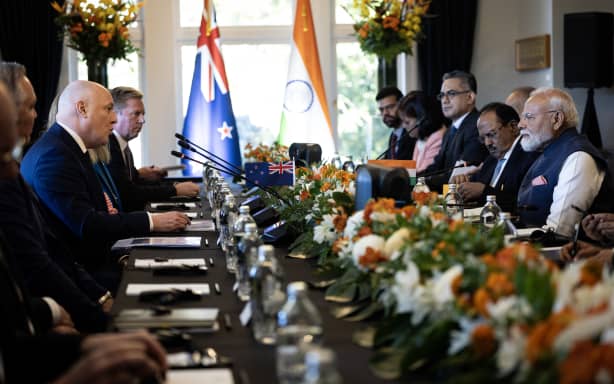
The formal bilateral meeting between New Zealand and India at Government House in Auckland. Photo: Pool/NZME/Dean Purcell
Luxon described the Strategic Partnership as a major step in the relationship and said it reflected an ambition for both countries to do more together.
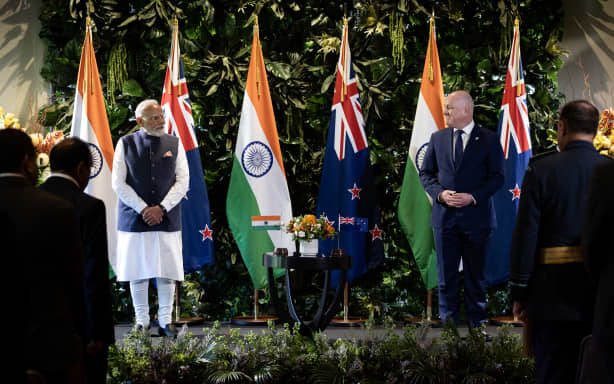
Christopher Luxon and Narendra Modi exchange partnership arrangements at Government House. Photo: Pool/NZME/Dean Purcell
Demonstrations outside Spark Arena
Outside Spark Arena later in the day, police separated groups of Modi supporters and protesters ahead of the Indian Prime Minister’s appearance before Auckland’s Indian community.
The protesters included anti-immigration campaigners as well as supporters of an independent Khalistan movement.
Luxon said earlier in the day that he had not seen the protesters and was not concerned.
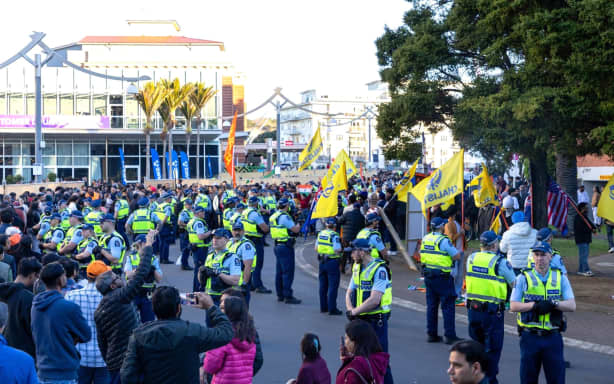
Police separate supporters and protesters outside Spark Arena during Narendra Modi’s Auckland visit. Photo: RNZ / Blessen Tom
Business and trade focus
Modi arrived at Auckland Airport late on Friday night before meeting business and sports figures during Saturday’s programme.
The visit included discussions with New Zealand business leaders as both governments look to expand trade and investment under the recently signed Free Trade Agreement.
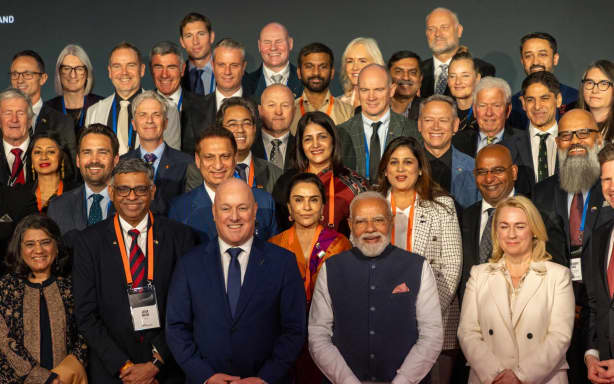
Narendra Modi joins Christopher Luxon and New Zealand business leaders during his Auckland visit. Photo: RNZ / Blessen Tom
Current, Long-Term or Historic Relevance?
This represents one of the most significant developments in New Zealand–India relations in decades.
While public attention has largely focused on the Free Trade Agreement, the Strategic Partnership broadens the relationship considerably, extending cooperation into defence, maritime security, cyber security and wider Indo-Pacific affairs.
For New Zealand exporters, the agreement could expand access to one of the world’s largest and fastest-growing markets. For defence planners, the Maritime Cooperation Arrangement reflects India’s increasingly important role across the Indo-Pacific.
As elocal has previously examined, the India Free Trade Agreement also includes cooperation in agricultural research, Centres of Excellence, plant genetics, livestock germplasm, horticultural innovation and investment promotion.
The Roadmap to 2030 builds on those foundations and establishes one of New Zealand’s broadest bilateral partnerships in the Asia-Pacific.
Source
Author: Tuwhenuaroa Natanahira, RNZ Political Reporter
Independent reporting. Original context. Credited sources.