JCB’s £100 million hydrogen programme has crossed an important threshold: its hydrogen combustion engine is no longer simply an experimental alternative to diesel. Full European type-approval, a production hydrogen-powered backhoe and the first commercial generator deliveries suggest hydrogen combustion could become a practical option for some of the world’s hardest-to-electrify machinery.
INR Report: Based on reporting by Max Carter for Engineerine, updated 11 August 2026.
JCB has spent more than £100 million developing a hydrogen internal-combustion engine intended to provide an alternative to diesel for heavy construction machinery.
Around 150 engineers have worked on the programme, with more than 150 evaluation engines built by May 2026. Those engines have been tested in equipment including backhoe loaders, Loadall telescopic handlers and generators.
The significant development is that JCB has now moved beyond demonstration machines.
Its hydrogen engine has received full European Union type-approval under Regulation (EU) 2016/1628 and complies with EU Stage V emissions requirements for non-road mobile machinery. JCB has also launched its series-production 3CX Hydrogen backhoe loader and delivered the first examples of its G60RS H hydrogen generator.
For an industry still overwhelmingly dependent on diesel, that is an important engineering milestone.
Not a Fuel Cell — A Combustion Engine
Perhaps the most interesting aspect of JCB's approach is what it has not done.
This isn't a battery-electric machine and it isn't a hydrogen fuel cell.
JCB is burning hydrogen inside an internal-combustion engine.
JCB hydrogen internal-combustion engine. Image: Engineerine / supplied.

The fundamental mechanical architecture remains familiar: pistons, cylinders, valves, crankshaft, cooling and lubrication systems convert combustion into mechanical power.
Compressed hydrogen is delivered to the engine, mixed with air and ignited inside the cylinders. The resulting pressure drives the pistons and ultimately provides mechanical power to the transmission and hydraulic systems.
That distinction could prove important.
Instead of requiring the heavy-equipment industry to abandon more than a century of internal-combustion engineering, JCB is attempting to adapt existing manufacturing expertise, servicing infrastructure and operator knowledge to a different fuel.
Hydrogen does, however, require purpose-designed storage, fuel delivery, ignition, ventilation and safety systems. It is not simply a matter of converting an ordinary diesel engine by changing the fuel.
The 3CX Hydrogen Arrives
The strongest indication that JCB believes the technology is commercially viable came in May 2026 with the introduction of the series-production JCB 3CX Hydrogen.
Its engine produces 55 kW — approximately 74 horsepower — with JCB claiming power and torque comparable with the diesel equivalent.
Hydrogen is carried in three composite tanks mounted above the cab at 350 bar, or roughly 5,076 psi.
JCB says the tanks provide sufficient fuel for a full working day.
That last point could prove crucial.
One of the challenges facing battery-powered heavy equipment is maintaining continuous operation on remote construction sites where high-capacity electrical charging may not be available. Heavy machinery can operate for long shifts while simultaneously supplying substantial hydraulic power.
Hydrogen offers another possibility: bring the fuel to the machine.
Why Construction Could Suit Hydrogen
Construction equipment presents a rather different problem from electrifying passenger cars.
A small excavator operating around a depot may be an excellent candidate for batteries. Indeed, JCB already manufactures battery-electric construction machinery.
Large equipment working long shifts at temporary or remote sites presents a different equation.
A contractor does not necessarily need thousands of public hydrogen stations. A fleet operating from one depot or construction project could instead be supplied from a central hydrogen source or mobile refuelling unit.
JCB has consequently developed a mobile hydrogen refuelling system.
That makes construction an interesting potential early market for hydrogen combustion because machines can operate as what the industry calls a captive fleet — multiple pieces of equipment operating around a predictable source of fuel.
Hydrogen Power Generation
JCB is also taking the technology beyond mobile machinery.
Its G60RS H hydrogen generator uses the company's EU Stage V hydrogen engine and produces 58 kVA at either 50Hz or 60Hz.
The first unit was delivered to Dawsongroup Energy Solutions during 2026 for planned standby operation at a data-centre customer.
JCB has also proposed combining the hydrogen generator with battery storage.
Under such an arrangement, the generator can operate when required to recharge batteries or meet peak demand, while stored electricity supplies the site during periods when the generator does not need to operate.
That potentially creates another application for hydrogen: temporary or remote electricity generation where connecting sufficiently large electrical supplies may be difficult.
But Is Hydrogen Really Zero Emission?
This is where some of the marketing language surrounding hydrogen requires qualification.
Hydrogen contains no carbon.
Burning pure hydrogen therefore produces no fuel-derived carbon dioxide at the machine.
But that does not mean a hydrogen combustion engine literally produces no emissions.
Because combustion takes place in air at high temperatures, nitrogen and oxygen can react and produce nitrogen oxides — NOx.
JCB's EU Stage V approval is consequently significant because the certified engine must comply with regulated emissions limits.
There is another, potentially much larger question.
How was the hydrogen produced?
Hydrogen is an energy carrier rather than a primary energy source. Energy must first be used to produce it.
Hydrogen produced through electrolysis using renewable electricity can have relatively low associated emissions. Hydrogen manufactured from natural gas without effective carbon capture has a very different environmental footprint.
The International Energy Agency reported that low-emissions hydrogen remained less than one percent of global hydrogen production, despite worldwide production approaching 100 million tonnes during 2024.
So the important environmental measurement is not merely what comes from the machine's exhaust.
It is the total energy and emissions involved in producing, compressing, transporting and delivering the hydrogen.
The Storage Problem
Hydrogen also presents an unusual engineering trade-off.
By mass it contains enormous energy — around 120 megajoules per kilogram on a lower-heating-value basis.
By volume, however, hydrogen has comparatively low energy density.
That explains the large high-pressure storage tanks required on hydrogen vehicles and machinery.
JCB's decision to use 350-bar storage reflects technology already used in applications such as buses and material-handling equipment.
High-pressure storage makes rapid refuelling possible but introduces additional requirements including specialised tanks, pressure-control equipment, leak detection, ventilation and safety procedures.
None of those problems is necessarily insurmountable.
But they matter when comparing hydrogen with batteries and conventional diesel.
There May Be No Single Replacement for Diesel
The emerging picture suggests the argument may not ultimately be hydrogen versus batteries.
Different technologies may simply suit different jobs.
Battery-electric machinery offers high efficiency, quiet operation and relatively low maintenance and may be particularly attractive for smaller machines, urban construction and applications where equipment regularly returns to charging infrastructure.
Hydrogen combustion sacrifices some of the energy efficiency of batteries or hydrogen fuel cells but offers fast refuelling, familiar mechanical technology and potentially long operating periods.
Diesel meanwhile retains formidable practical advantages: enormous existing infrastructure, high energy density, rapid refuelling and decades of accumulated engineering knowledge.
The transition may therefore produce mixed fleets rather than a single winning technology.
The Economics Will Decide
JCB has demonstrated something important.
Hydrogen combustion has progressed from experimental engines to a certified commercial powertrain.
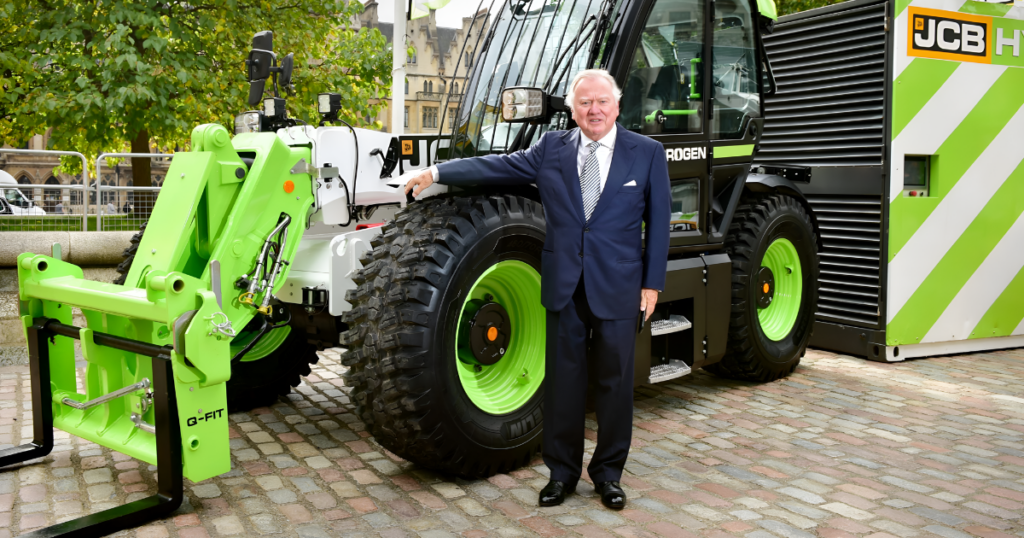
JCB's hydrogen programme has involved more than £100 million of investment and approximately 150 engineers. Image: Engineerine / supplied.
But the next test will not occur in an engineering laboratory.
It will happen on construction sites.
Contractors will want to know the delivered price of hydrogen, fuel consumption per working hour, refuelling time, reliability, maintenance costs, engine life and ultimately the total cost of operating the machine compared with diesel and battery alternatives.
Those numbers remain more important commercially than the technology itself.
If hydrogen can be produced economically and delivered reliably to concentrated fleets, JCB may have found a practical pathway for decarbonising machinery that is particularly difficult to electrify.
If hydrogen remains expensive or difficult to obtain, the engineering achievement may struggle to translate into widespread adoption.
Does This Affect New Zealand?
Potentially, very much so.
New Zealand has abundant renewable electricity and an economy containing precisely the types of activities where heavy-duty alternative fuels could eventually become useful: construction, agriculture, forestry, infrastructure, freight and remote electricity generation.
JCB's development is therefore worth watching from a New Zealand perspective not because hydrogen has necessarily "won", but because it challenges the assumption that electrification must always mean batteries.
For New Zealand, the National Interest Test should be practical.
Which technology gives businesses reliable energy at the lowest realistic whole-of-life cost while improving national energy resilience?
If locally produced hydrogen could eventually replace some imported diesel in appropriate heavy-duty applications, there could be an energy-security argument alongside the environmental one.
But that case needs to be demonstrated economically rather than assumed.
The encouraging development is that manufacturers are experimenting with competing solutions.
Hydrogen-powered construction machinery could provide another option for difficult-to-electrify heavy equipment. Image: Engineerine / supplied.

The Bottom Line
JCB has crossed an important threshold.
After more than £100 million of investment, its hydrogen combustion programme now has EU regulatory approval, a production construction machine and a commercially delivered generator.
That doesn't establish hydrogen as the replacement for diesel.
It establishes it as a serious contender for particular applications.
And perhaps that is the more useful lesson for New Zealand.
Rather than governments attempting to predict a single technological winner, innovation can be allowed to produce competing solutions — batteries, hydrogen, synthetic fuels and increasingly efficient conventional machinery — while businesses ultimately determine which technologies actually work in the real world.
Independent reporting. Original context. Credited sources.