A practising lawyer has been convicted of assaulting his 12-year-old son during a boxing session, leaving the child hospitalised for three nights. The case also raises questions about professional accountability after the judge said the lawyer used his knowledge of the legal system to delay proceedings, while the Law Society confirmed a criminal conviction does not automatically prevent a lawyer from continuing to practise.
eLocal Report: Based on reporting by Sam Sherwood, National Crime Correspondent for RNZ.
Assault Left 12-Year-Old in Hospital
A lawyer in his 50s has been convicted after a serious assault on his 12-year-old son which resulted in the child spending three nights in hospital.
The lawyer appeared in the Timaru District Court before Judge Campbell Savage and was sentenced to supervision after pleading guilty to assault on a child.
Court documents obtained by RNZ show the offending occurred in April 2022 while the father and son were boxing on a concrete area behind their home.
Both were wearing boxing gloves.
The summary of facts described the defendant as a fully grown man and his son as a small-built 12-year-old weighing 38kg.
According to the summary, the lawyer struck the boy in the head, causing him to bleed.
The child asked him to stop.
The lawyer then struck him in the face and stomach, causing him to fall to the ground crying.
According to the court account, the assault continued while the child was on the ground and stopped after he said he could not breathe.
The boy then jumped a fence to get away.
Three Nights in Hospital
The child was taken to hospital with suspected serious injuries.
Initial concerns included a fractured cheekbone and perforated liver, although subsequent scans ruled those injuries out.
He nevertheless suffered extensive bruising to his head and ears and a cut above his eye.
He remained in hospital for three nights for observation and further investigation.
The lawyer declined to comment to police.
Judge Condemns ‘Glacial’ Progress of Case
The case took more than four years to reach sentencing.
Judge Savage was strongly critical of how the proceedings had unfolded, describing their progress through the courts as being at a “glacial pace”.
The judge concluded the lawyer had done almost everything within his power to frustrate the process, including avoiding service of summons and filing what the judge characterised as meritless pre-trial applications.
Judge Savage told him:
“It seems that you've used your knowledge of the system to duck and dive attempts to get it set down.”
The lawyer ultimately pleaded guilty during the trial after his son had already given evidence.
Judge Savage rejected as “implausible” the lawyer's claim that he had not seen his son's statement until the trial.
The judge said describing the guilty plea as coming at the eleventh hour would have been charitable.
“It came as the clock was striking 12.”
Lawyer's Counsel Cites Shame and Remorse
Defence lawyer Michael Sandom told the court his client was appearing as both a defendant and a practising lawyer, in front of professional colleagues and peers.
That brought significant “embarrassment and shame”, he said.
Sandom told the court the offending would remain with the lawyer for the rest of his life and described his client as remorseful and ashamed.
He acknowledged that the offending was serious.
Crown prosecutor Andrew McRae opposed an application for a discharge without conviction and also opposed the application for name suppression.

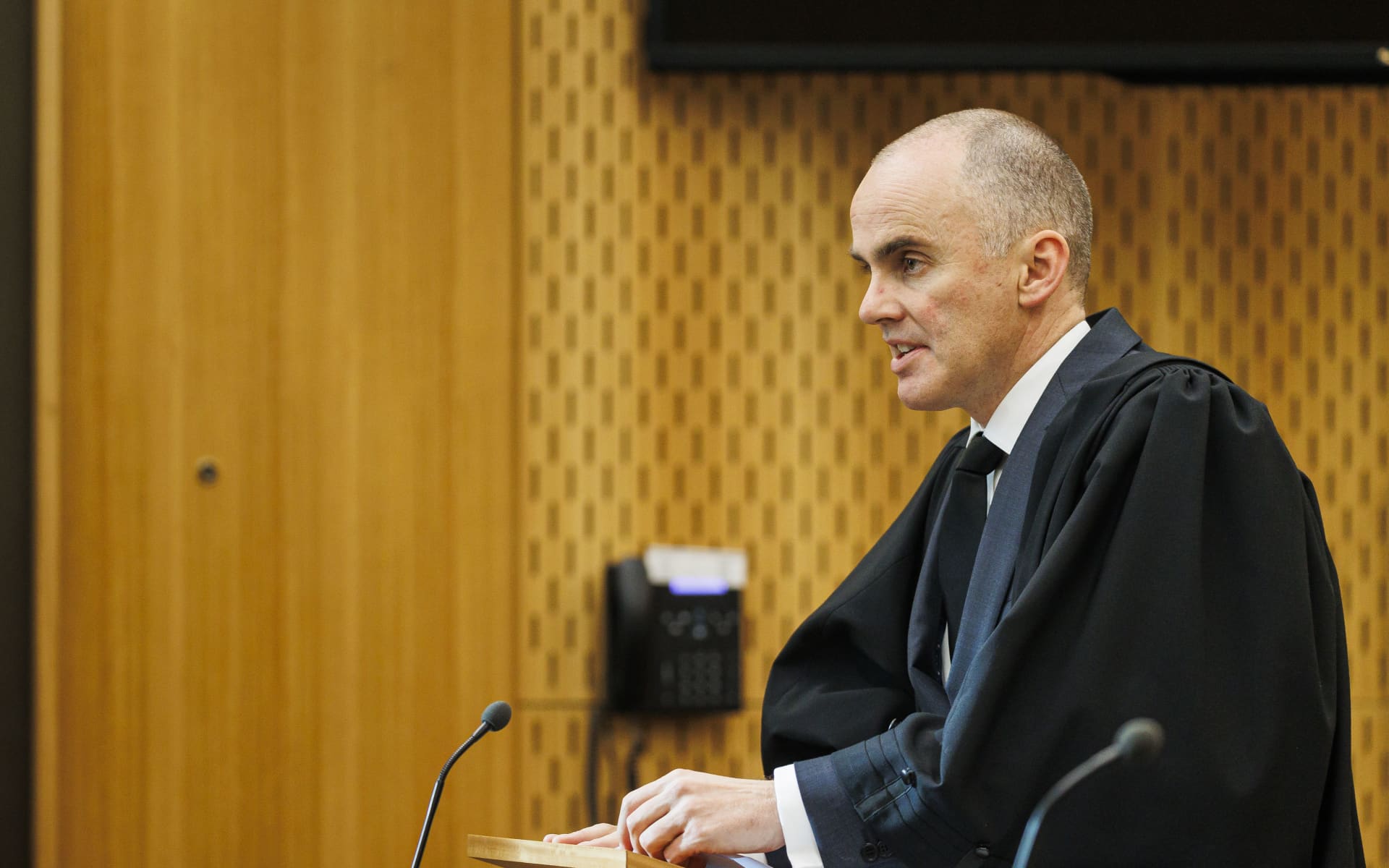
The lawyer was convicted at Timaru District Court. File photo. Photo / RNZ / Nate McKinnon.
Convicted — But Name Remains Suppressed
Judge Savage declined the application for a discharge without conviction.
The lawyer was therefore formally convicted.
However, the judge granted final name suppression.
Judge Savage identified the child's young age and the breach of trust as aggravating factors but said he did not consider the lawyer a risk of reoffending.
The lawyer was sentenced to supervision.
The result means the public knows a practising lawyer has been convicted of assaulting his child but cannot know his identity because of the suppression order.
Can a Convicted Lawyer Continue Practising?
The case raises a separate question about regulation of the legal profession.
The lawyer has practised for more than a decade.
RNZ reported that the New Zealand Law Society's register did not indicate whether he currently held a practising certificate.
RNZ asked the Law Society how a lawyer could continue practising while criminal proceedings were before the courts.
The Society said criminal offending by lawyers was taken seriously but confirmed an important point:
“A lawyer who holds a current practising certificate and admits to, or is found guilty of, criminal offending is not automatically suspended from practice.”
Personal conduct can be considered through the complaints and disciplinary framework established under the Lawyers and Conveyancers Act 2006.
Independent Standards Committees initially consider complaints and can refer sufficiently serious matters to the New Zealand Lawyers and Conveyancers Disciplinary Tribunal.
Only the tribunal can suspend a lawyer, including on an interim basis during disciplinary proceedings, or ultimately strike a lawyer from the roll.
Practising Certificates Can Continue During Review
The Law Society also pointed to section 40 of the Lawyers and Conveyancers Act.
A lawyer who has applied to renew a practising certificate can continue practising while that application is being considered.
According to the Society, that can include circumstances where proceedings against the lawyer remain ongoing.
The Society would not discuss the individual lawyer's practising-certificate status, citing privacy considerations.
It said practising certificates generally expire on 30 June each year.
What About Legal Aid Clients?
RNZ also questioned the Ministry of Justice about lawyers facing criminal proceedings continuing to receive legal aid work.
Ministry acting group manager of National Service Delivery Louisa Carroll said legal aid providers must satisfy ongoing approval requirements and comply with the Legal Services Act, their provider contracts and professional obligations.
Importantly, legal aid providers must notify the Ministry within five working days if they are charged with or convicted of an offence punishable by imprisonment.
The Ministry can respond to concerns through complaints, auditing, quality assurance and provider-approval processes.
Depending on the circumstances, it can restrict a provider, modify or cancel approval to undertake legal aid work, or refer the matter to the Law Society.
Unless approval is changed, restricted, suspended or cancelled, however, an approved provider remains eligible to receive legal aid assignments.
Who Ultimately Holds Lawyers Accountable?
The case illustrates the distinction between criminal accountability and professional accountability.
A criminal court determines whether an offence has been committed and imposes the appropriate sentence.
Whether that conviction affects someone's ability to continue practising law is determined through a separate regulatory process.
The Ministry told RNZ that decisions concerning practising certificates, the ability to practise and professional discipline ultimately sit with the New Zealand Law Society and the Lawyers and Conveyancers Disciplinary Tribunal.
Crown prosecutor Andrew McRae. File photo. Photo / Stuff / Pool / Alden Williams.
Does This Affect New Zealand?
Yes — because the case raises a broader question about public confidence in professions entrusted with administering the justice system.
The issue is not whether lawyers should automatically lose their careers whenever they are charged with an offence. A charge is not a conviction, and disciplinary decisions require appropriate processes.
But this case has progressed beyond an allegation.
The lawyer pleaded guilty and was convicted.
The sentencing judge also found aggravating factors involving the victim's age and breach of trust and strongly criticised the defendant's conduct during the court process.
Against that background, the regulatory response becomes a legitimate matter of public interest.
The Accountability Test
There are now several questions that can be answered objectively as the professional process develops.
Does the Law Society investigate the conviction?
Is the matter considered by a Standards Committee?
Is it referred to the Lawyers and Conveyancers Disciplinary Tribunal?
Does the lawyer retain a practising certificate?
And, if he is an approved legal aid provider, does the Ministry of Justice review that approval?
Those outcomes will indicate how the professional accountability system operates when the person convicted is himself an officer of the court.
Current Relevance
The immediate concern is the lawyer's professional status following conviction.
RNZ reports that the Law Society register does not indicate whether he holds a practising certificate, while the Society declined to discuss the individual case for privacy reasons.
That leaves an important public-interest question unresolved.
A person seeking legal representation would ordinarily expect to be able to establish whether the lawyer they are considering engaging is authorised to practise.
Long-Term Relevance
Professional regulation depends heavily on public confidence.
Lawyers occupy a privileged position within the justice system. They represent defendants, handle confidential information, advise people about their legal rights and, in some cases, undertake work funded by taxpayers through legal aid.
That does not mean lawyers should be subjected to a different criminal justice system.
It does mean the mechanisms governing professional conduct need to be transparent enough for the public to understand what happens when serious offending is established.
Historic Relevance
The principle involved is much older than this individual case.
Professional privilege has traditionally been accompanied by professional responsibility.
The legal profession regulates entry, practising certificates and disciplinary standards partly because lawyers perform functions essential to the administration of justice.
This case therefore presents two separate accountability tests.
The criminal justice system has now delivered its decision.
The next question is what the legal profession does with it.
Source
Sam Sherwood — National Crime Correspondent — RNZ
Original RNZ report:
https://www.rnz.co.nz/news/crime-and-justice/1076370/lawyer-convicted-of-assault-on-his-12-year-old-son-which-left-him-hospitalised
Independent reporting. Original context. Credited sources.