More than 2,000 humanoid robots and 666 teams have gathered in Beijing for a five-day competition featuring running, boxing and other physical challenges. Behind the spectacle, New Atlas argues that China’s real advantage may lie in an unusually integrated supply chain linking robotics with its automotive, battery, electronics and manufacturing industries.
eLocal Report: Based on reporting by Bronwyn Thompson for New Atlas HERE. (New Atlas)
China’s second World Humanoid Robot Games have turned Beijing’s National Speed Skating Oval into something resembling a glimpse of the sporting future.
The event, which began on August 21, brings together 666 teams and 2,056 humanoid robots competing across 30 formal events, alongside dozens of demonstrations and showcase activities.
The attention-grabbing competitions include sprinting and boxing, but New Atlas argues that the most important lesson from the event may have less to do with medals than with the industrial ecosystem that has allowed so many Chinese companies and research teams to develop increasingly capable humanoids at the same time. (New Atlas)
A Robot Runs 100 Metres in 9.32 Seconds
One of the event’s headline performances came from a humanoid called Lightning, developed by smartphone company Honor.
According to New Atlas, Lightning completed the 100-metre sprint in 9.32 seconds — faster than Usain Bolt’s human world record of 9.58 seconds.
The comparison needs an obvious qualification: a purpose-built machine running on mechanical limbs is not directly comparable with a human athlete operating under conventional athletics rules.
Its importance lies instead in what the performance demonstrates about mechanical control, balance, actuators, power systems and high-speed locomotion.
Honor had already demonstrated competitive humanoids earlier this year at Beijing’s robot half-marathon, where its machines received recognition not only for speed but also for gait and design.
Those attributes matter because making a humanoid move convincingly is much more complicated than simply attaching motors to a pair of mechanical legs. (New Atlas)
China’s Advantage May Be the Supply Chain
The more consequential part of the New Atlas analysis concerns where the robots come from.
China’s robotics companies are operating inside a manufacturing ecosystem already capable of producing electric motors, batteries, power electronics, sensors, precision components and sophisticated control systems at enormous scale.
Many of those technologies overlap directly with China's rapidly expanding electric-vehicle industry.
Jin Yongbin, chief technology officer at Shanghai-based MirrorMe Technology, told CCTV that the country's robotics supply chain is closely aligned with its established automotive manufacturing network.
“For the entire robot system, its motors, batteries, electric drives and transmission systems, are perfectly aligned with the existing automotive industry’s supply chain,” Jin said.
“We are essentially transferring our established automotive supply chain to robotics.” (New Atlas)
That overlap can produce a powerful industrial feedback loop.
A company building an electric vehicle may already have access to batteries, motors, controllers and sophisticated manufacturing techniques that can also be applied to robots.
A phone manufacturer may bring expertise in sensors, processors, cameras and AI.
An eVTOL developer may work with lightweight materials, electric propulsion and control systems.
Instead of each industry developing entirely separate technological foundations, capabilities can increasingly move between them.
MirrorMe’s ‘Bolt’ Shows What That Looks Like
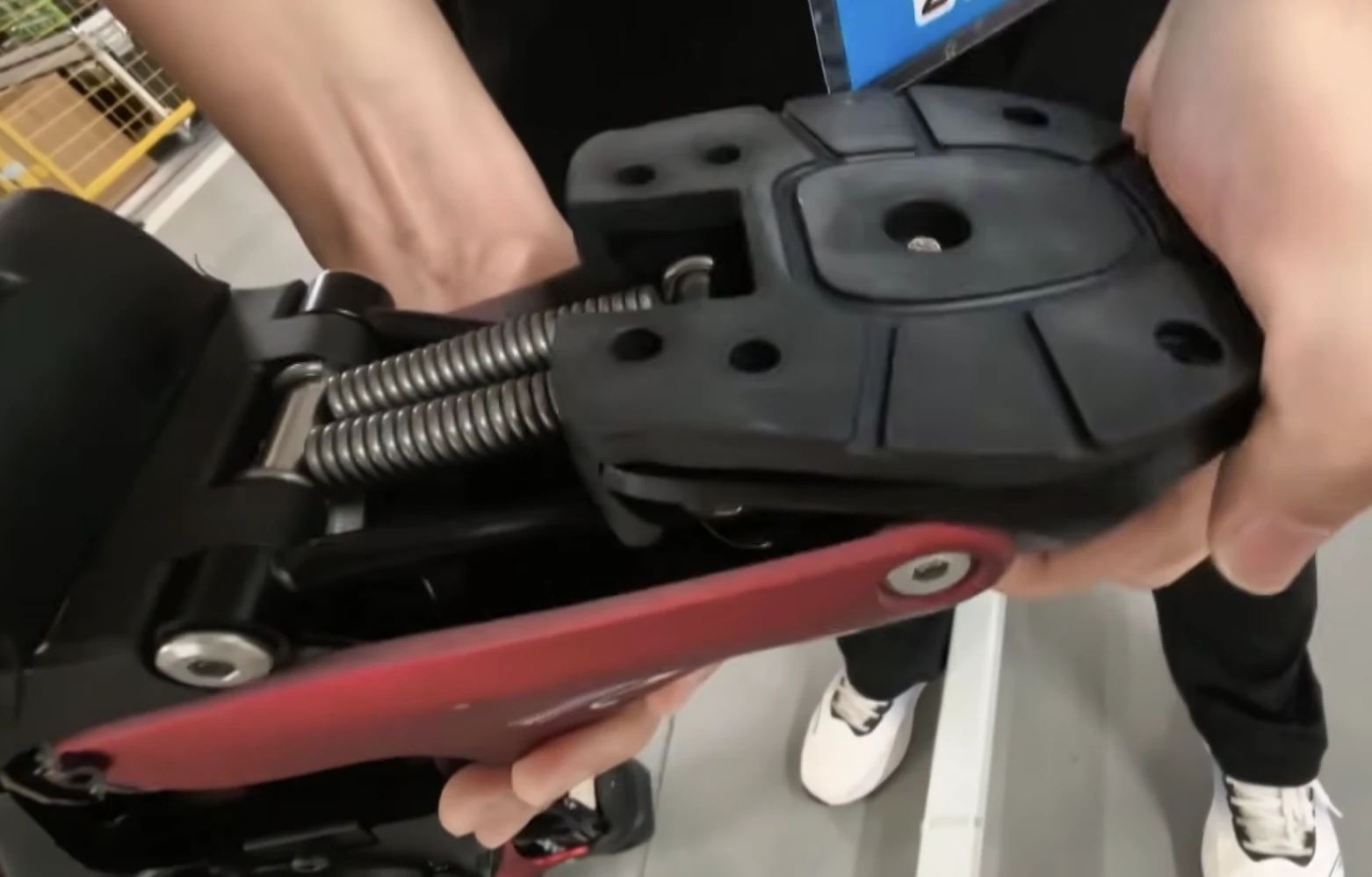
MirrorMe chief technology officer Jin Yongbin demonstrates some of the mechanical systems used in the company’s humanoid robots. Image: CCTV.
MirrorMe brought a humanoid named Bolt to the competition.
The machine stands approximately 175 centimetres tall, weighs around 75 kilograms and is reportedly capable of reaching 11 metres per second.
Jin argues that outright speed is only a visible measurement of a much broader engineering challenge.
A fast humanoid also needs sufficient structural strength, joint durability, balance, fluid movement and control to withstand the enormous forces generated as it accelerates and runs.
That makes robot sport potentially useful as an engineering test bed.
Problems become immediately visible when a machine attempts something as demanding as sprinting, jumping or recovering from instability.
Engineers can then identify which mechanical or software systems are limiting performance and redesign them.
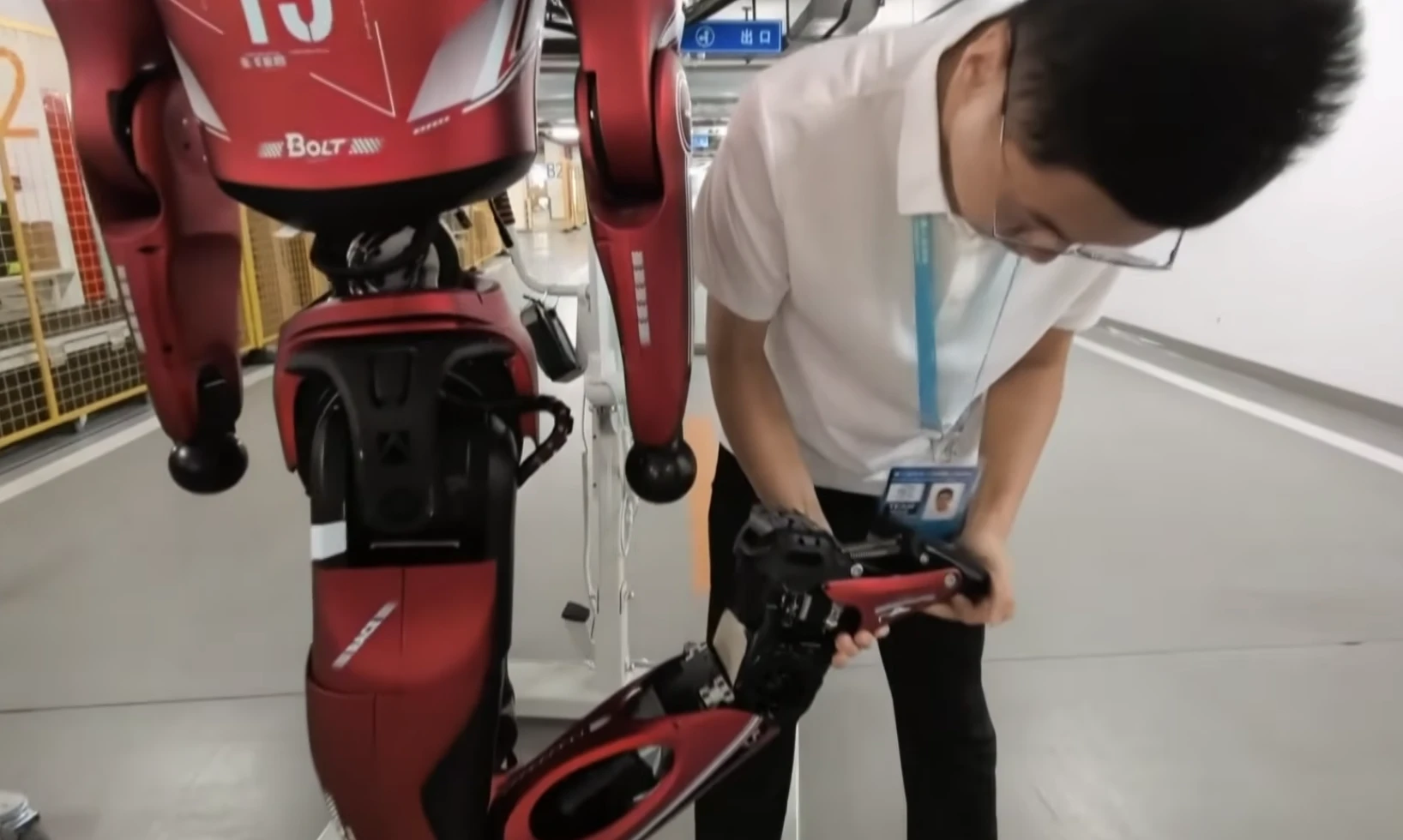
Shanghai-based MirrorMe has brought its Bolt humanoid to the Beijing games. Image: CCTV.
Competition — But Also Collaboration
There is another feature of China’s robotics industry highlighted by New Atlas.
The companies are competing aggressively with one another.
Manufacturers such as Unitree and UBTech want domestic customers, export markets and global recognition.
Yet Chinese robotics development also appears to include considerable collaboration and data sharing between companies, universities and engineering teams.
An initiative launched in 2024, for example, sought to make it easier for humanoid robotics companies and start-ups to share data.
Events such as the Humanoid Robot Games create another venue where engineers can examine rival designs, compare performance and exchange ideas.
Jin said competitions provide an opportunity to evaluate the strengths and weaknesses of different technologies and then “rapidly refine the robotics supply chain.”
New Atlas characterises this as something approaching a national technology ecosystem: intense competition between companies operating within a broader environment in which knowledge, suppliers and engineering capability can spread rapidly. (New Atlas)
Is America Really ‘Unable to Compete’?
The headline of the New Atlas article poses the question provocatively: why can’t the United States compete with China’s robots?
But the article itself offers a more nuanced conclusion.
The US remains extraordinarily strong in artificial intelligence, advanced computing, semiconductor design, robotics research and venture-funded technology development.
American companies and institutions have produced some of the world’s most advanced robotic systems.
China’s advantage highlighted here is different.
It is the combination of manufacturing scale, dense supply chains, component availability, rapidly expanding domestic companies and an industrial system capable of moving technologies between electric vehicles, consumer electronics and robotics.
New Atlas ultimately cautions against portraying development as a simple US-versus-China “robot arms race.”
Both countries are advancing quickly, but they may be running different races.
That is an important distinction.
A sporting demonstration does not prove that China possesses the world's most advanced robotics industry across every category.
Nor does a spectacular humanoid sprint demonstrate that the same machine is ready to work reliably in a factory, hospital or private home.
The Gap Between Demonstration and Useful Robot
Humanoid robotics currently faces the same challenge seen repeatedly in emerging technologies: an impressive demonstration and a commercially useful product are very different things.
A robot can run quickly yet still struggle to perform ordinary tasks reliably for eight hours.
It can dance impressively while remaining unable to navigate an unpredictable household.
Industrial usefulness depends on far more than viral demonstrations.
Machines need reliability, battery life, safety, dexterity, affordability and the ability to work repeatedly without constant human intervention.
The World Humanoid Robot Games therefore provide evidence of rapid technical progress, but not proof that general-purpose humanoid robots are about to enter everyday life at scale.
What they do show is how quickly the underlying engineering is developing.
Why China’s Manufacturing Model Matters
There is a broader economic lesson here.
Technological leadership increasingly depends on more than inventing an individual product.
It also depends on whether a country possesses the surrounding industrial capability to manufacture it economically and repeatedly.
China’s electric-vehicle industry illustrates the point.
Once factories, suppliers, skilled engineers and component manufacturers have developed around motors, batteries and power electronics, those capabilities can spill into other industries.
Robotics may now be benefiting from that industrial foundation.
That is potentially harder for competitors to replicate than an individual robot design.
A robot can theoretically be reverse-engineered.
An entire network of suppliers, manufacturing knowledge, trained engineers, tooling, logistics and domestic customers cannot be reproduced nearly as quickly.
Does This Affect New Zealand?
Yes — particularly when considering New Zealand’s long-term productivity problem.
New Zealand is unlikely to compete with China or the United States in mass-producing humanoid robots.
But that does not mean robotics is irrelevant here.
Agriculture, horticulture, logistics, construction, healthcare and manufacturing are all areas where advanced automation could become increasingly important.
For New Zealand, the strategic question is less likely to be “Can we manufacture the world's best humanoid robot?”
It is more likely to be:
Can New Zealand businesses adopt these technologies quickly enough to increase productivity — and can the country retain enough engineering capability to adapt them to local needs rather than simply becoming a passive technology importer?
The Chinese example also provides a broader lesson for economic policy.
Innovation does not occur only inside software companies or university laboratories.
It depends on supply chains, manufacturing skills, engineering capability, infrastructure and companies able to convert research into physical products at scale.
For a country struggling with weak productivity growth, that distinction matters.
The robots racing around Beijing may look like entertainment.
But behind them sits something considerably more important: an industrial system learning how to build complicated machines faster.
And that may ultimately be the competition worth watching.
Source
Bronwyn Thompson, New Atlas, 24 August 2026
Humanoid 'Olympics' reveal why the US can't compete with China's robots
Additional source cited by New Atlas: CCTV.
Images: Xinhua / Sun Fei; CCTV.
Independent reporting. Original context. Credited sources.