What happens when a robot becomes so small there is no longer room for a conventional battery or motor? Researchers in Switzerland have demonstrated an unusual solution: microscopic acoustic cavities that convert sound energy directly into thrust and movement.
eLocal Report: Based on reporting by Maryna Holovnova for New Atlas, with research published by EPFL. The New Atlas report was published on 26 August 2026.
The drive to make electronics smaller eventually encounters a fundamental engineering problem. Batteries, motors, gears and conventional mechanical components cannot simply be reduced indefinitely while continuing to function efficiently.
Researchers at the MicroBioRobotic Systems (MICROBS) Laboratory at EPFL's School of Engineering have been exploring a radically different approach. Instead of carrying the machinery normally required to produce movement, their tiny devices can extract energy from sound.
The underlying principle is surprisingly familiar.
Turning Sound Into Thrust
The technology relies on Helmholtz resonance — essentially the same physical phenomenon responsible for the tone produced when someone blows across the opening of a bottle.
Air trapped inside a hollow cavity resonates strongly when exposed to sound at an appropriate frequency. The EPFL researchers designed microscopic cavities that exploit that resonance.
Rather than simply vibrating, the cavity produces an asymmetric airflow. Air is expelled in a concentrated stream while the returning airflow is more dispersed.
That imbalance generates thrust.
The result is effectively an acoustic engine with no conventional moving components.
Instead of a battery supplying electricity to a motor, externally supplied acoustic energy interacts with the resonator built into the device and produces mechanical movement.
The cavities themselves can take different forms and can be manufactured from materials including 3D-printed plastics, glass and flexible polymers.
Different Frequencies Become Different Controls
One of the particularly interesting aspects of the research is that individual cavities can be designed to respond to different sound frequencies.
The researchers demonstrated this using miniature boats equipped with three separate acoustic cavities, each tuned to a different frequency.
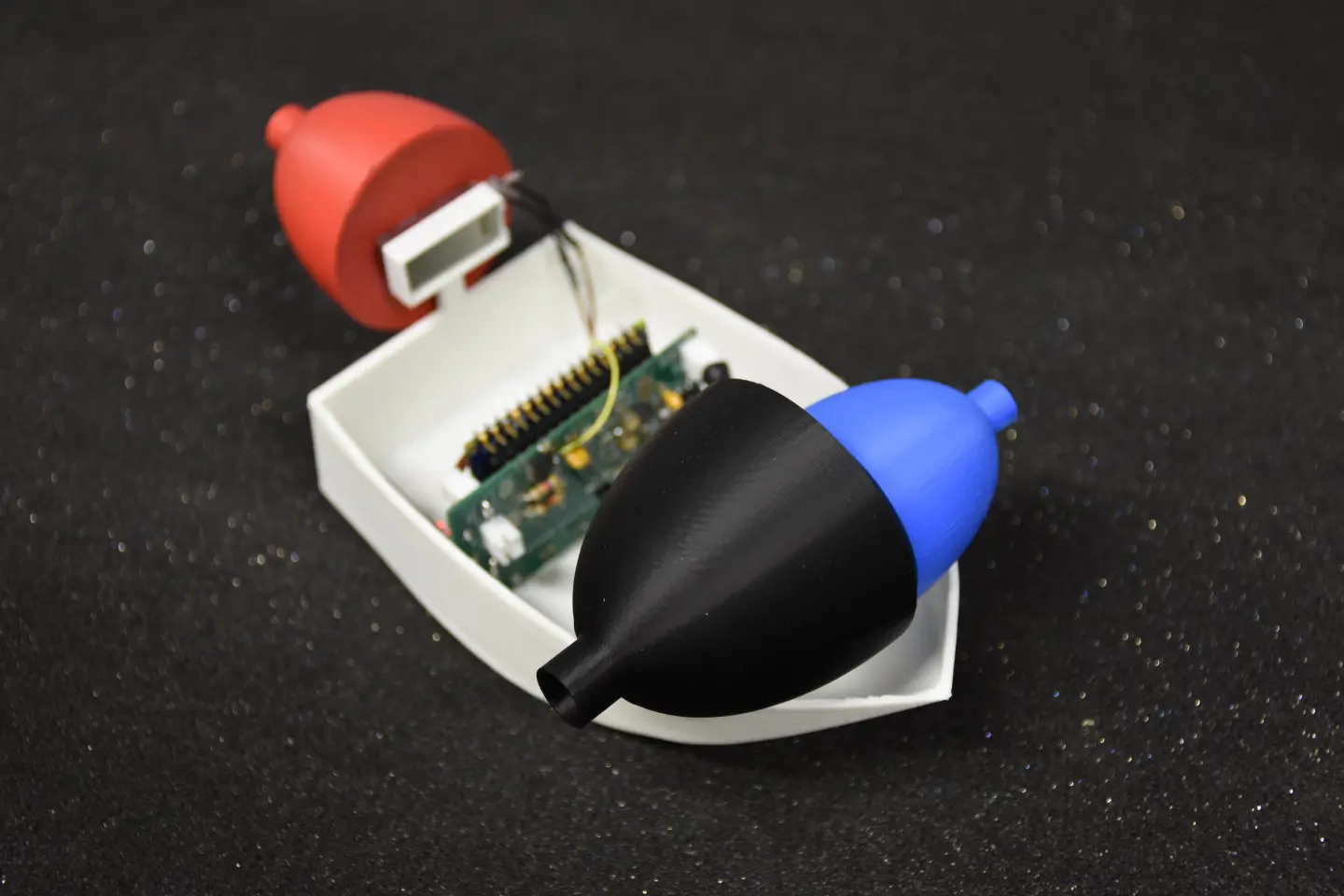
A miniature boat equipped with a bell-shaped acoustic cavity. Image: 2026 EPFL/MICROBS — CC-BY-SA 4.0
Changing the frequency of the sound allowed the team to activate different cavities and therefore generate thrust in different directions.
That provides a primitive but potentially powerful form of remote control.
Rather than sending electrical instructions to motors and actuators, a device could contain several acoustic structures, with each responding only when it receives its particular frequency.
Microfliers Weighing Just 150 Micrograms
The researchers then pushed the concept considerably further.
They constructed tiny flying devices — described as microfliers — weighing as little as 150 micrograms.
Each contained three microscopic acoustic cavities.
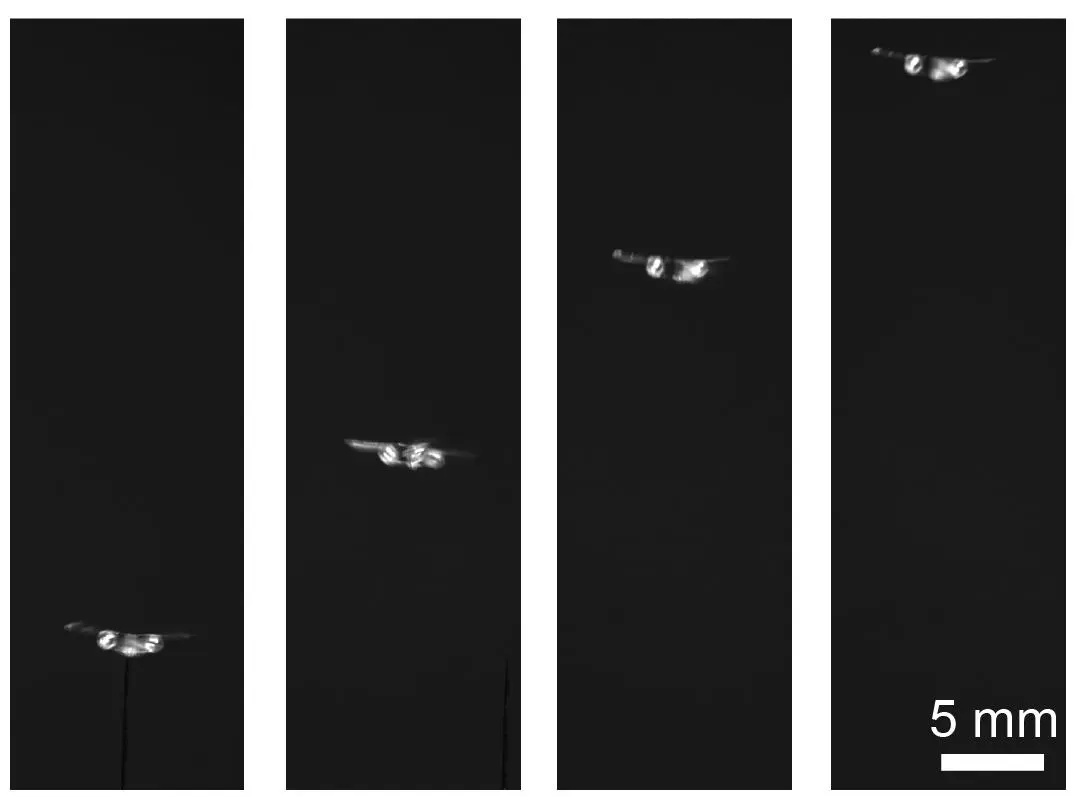
A microflier captured in flight during testing. Image: 2026 EPFL/MICROBS — CC-BY-SA 4.0
For these devices, the researchers used ultrasonic frequencies, above the range of human hearing.
The acoustic cavities converted that energy into sufficient thrust to propel the microfliers forward.
This is different from earlier demonstrations in which powerful sound fields physically push or levitate passive objects. In the EPFL approach, the resonating structure built into the device itself converts acoustic energy into directional thrust.
As MICROBS laboratory head Selman Sakar explained, the objective is not simply to push an object around with sound, but to tune resonators so that particular frequencies produce controlled movement.
13,000 RPM Without a Conventional Motor
Another experiment demonstrated that the same principle could produce rotational rather than linear movement.
Researchers coupled acoustic cavities to miniature propeller blades.
The resulting acoustic force was sufficient to spin the blades at up to 13,000 revolutions per minute.
That demonstrates an important distinction.
The technology is not simply about making a microscopic object vibrate. Acoustic energy can potentially be engineered to perform useful mechanical work — including propulsion and rotation — without requiring the device itself to carry a conventional electric motor.
Why Removing the Battery Matters
For ordinary robots, batteries and motors are routine engineering components.
At microscopic scales they become major obstacles.
Energy storage occupies physical space and adds mass. Motors require multiple components and electrical connections. As machines become progressively smaller, those systems can represent an increasingly large proportion of the entire device.
Removing them changes what engineers might eventually be able to build.
An acoustic microdevice could potentially consist largely of its functional structure and resonant cavities, with energy supplied externally by sound.
That does not mean these robots have suddenly become autonomous.
The demonstrated devices still depend upon an external acoustic energy source, and their capabilities remain experimental. Sound-powered propulsion is therefore better understood as an alternative method of delivering and converting energy rather than a source of free or self-generated power.
That distinction is important.
From Micro-Robots to Smart Materials
The longer-term implications may extend beyond miniature drones.
Researchers envisage flexible structures containing multiple resonators tuned to different frequencies. Different sections of a device could potentially bend, rotate or move depending upon which acoustic frequency is transmitted.
That raises the possibility of extremely small machines with few conventional mechanical components.
Medical devices are one obvious field where miniaturisation matters, but similar principles could eventually have applications in sensing, manufacturing, aerospace and other environments where batteries, wiring and conventional motors impose severe size or weight limitations.
Much more development would be required before such applications become practical.
For now, the significance of the EPFL work is the demonstration that a microscopic hollow structure can effectively become both an energy receiver and actuator.
Does This Affect New Zealand?
Potentially — although this is currently fundamental engineering research rather than a technology ready for commercial deployment.
New Zealand has active research communities in robotics, medical technology, advanced manufacturing and aerospace. Technologies capable of reducing the mass and complexity of very small autonomous or remotely controlled devices could eventually intersect with all four.
There could also be particular relevance to environmental monitoring.
Extremely small, lightweight sensors that require no onboard battery or conventional motor could eventually offer new ways of monitoring confined or difficult-to-access environments. Whether acoustic propulsion can operate effectively enough outside carefully controlled laboratory conditions remains an important unanswered question.
There is also a broader strategic lesson.
Much of the next generation of robotics may not simply involve making today's motors and batteries smaller. Some technologies may instead eliminate familiar components entirely by exploiting physical phenomena such as sound, light, magnetic fields or fluid dynamics.
The EPFL experiments are an early example of that shift.
A device weighing a fraction of a milligram can now convert acoustic energy into controlled mechanical movement.
The next challenge is turning an elegant laboratory demonstration into something capable of useful work in the real world.
Source
Maryna Holovnova, New Atlas, 26 August 2026: “Sonic micro-robots burst into motion without batteries or motors.”
Read the original New Atlas report
EPFL — These tiny drones are powered by sound
Independent reporting. Original context. Credited sources.