Dr Robert Malone argues that soaring rates of reported mental-health problems among women may reflect something broader than an epidemic of psychiatric disease. Drawing together surveys on diagnosis, life satisfaction, loneliness and global mental-health burden, he asks whether modern culture and the medical system itself is increasingly turning ordinary human distress into pathology.
eLocal Report: Based on commentary and research presented by Dr Robert W. Malone in Malone News. (Malone News)
Mental illness is usually discussed as a healthcare problem: identify the disorder, improve access to treatment and provide appropriate medication or therapy.
Dr Robert Malone's latest essay asks whether that framework may itself be incomplete.
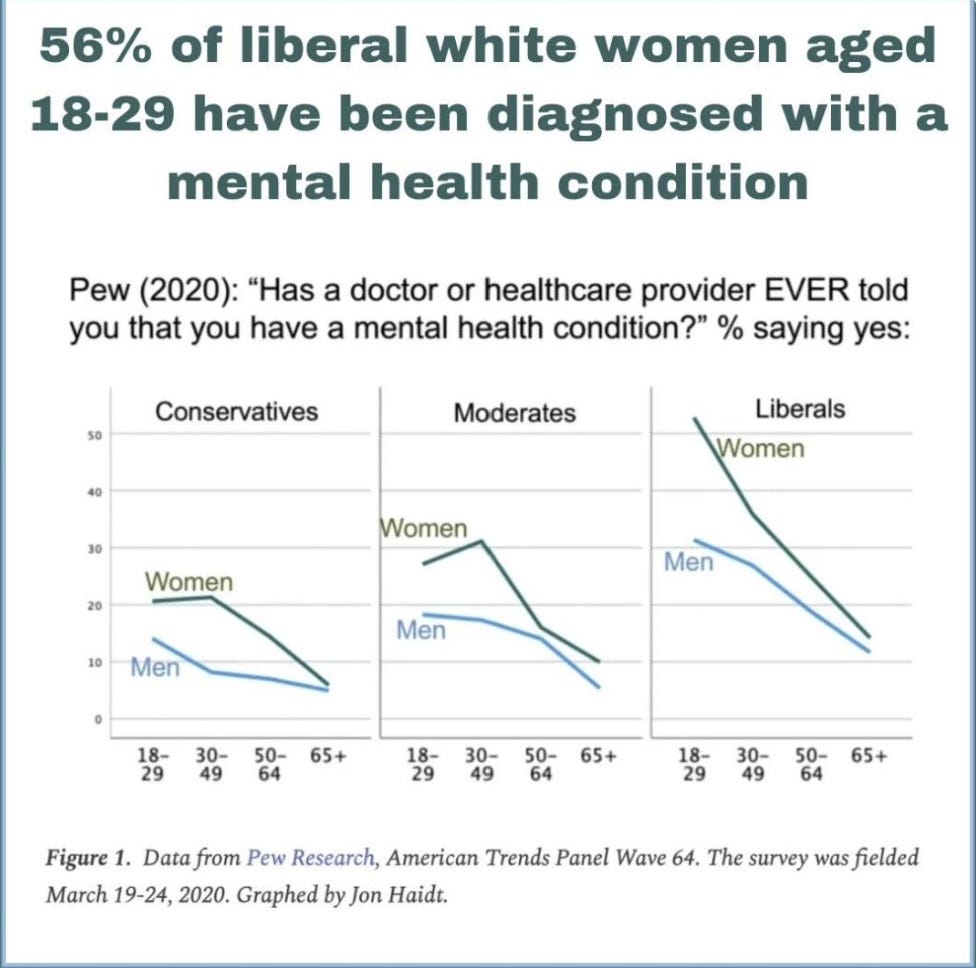
His starting point is a striking finding derived from a 2020 Pew Research Center survey of more than 11,000 Americans. Political scientist Zach Goldberg subsequently analysed the data by demographic characteristics and political ideology. Among white women aged 18 to 29 identifying as liberal, 56.3 percent reported having been diagnosed with a mental-health condition by a healthcare provider. For moderate women in the same demographic the figure was 28.4 percent, and for conservatives 27.3 percent.
It is an extraordinary difference.
But what it means is considerably less certain.
Correlation Is Not Causation
Malone acknowledges an essential qualification: political ideology cannot simply be declared the cause.
People identifying as liberal may be more willing to seek psychological care, discuss mental health or accept a diagnosis. Conservatives may be less likely to seek treatment or disclose psychological problems. Personality and temperament might also influence both political outlook and susceptibility to particular forms of distress.
Malone explicitly recognises those possibilities.
Original graphic from Malone News. No separate caption or credit was supplied.
There is another significant caveat.
Malone cites 2025 research suggesting that some of the apparent ideological mental-health divide may result from how people interpret and discuss the term “mental health”. When researchers instead questioned respondents about their mood, Malone says much of the ideological difference disappeared.
That finding substantially complicates any claim that liberal political beliefs themselves are producing mental illness.
The wider decline in reported wellbeing among young women, however, remains harder to dismiss.
Young Women Report a Dramatic Decline in Wellbeing
Malone points to Gallup findings showing that only 15 percent of American women aged 18–29 surveyed between 2020 and 2024 described their mental health as excellent.
For the comparable 2010–2014 period, the figure was 48 percent.
He also cites the 2024 American Family Survey, reporting that only 12 percent of liberal women aged 18–40 described themselves as “completely satisfied” with their lives, compared with 28 percent of moderate women and 37 percent of conservative women.
Reported loneliness showed another substantial difference: Malone says 29 percent of liberal women reported feeling lonely several times a week or more, compared with 11 percent of conservative women.
These figures establish an association. They do not establish what caused it.
Malone's argument becomes more provocative when he asks whether the culture surrounding young women could itself be contributing.
Is Culture Making People Unhappier?
Malone argues that contemporary political and social culture increasingly encourages people to interpret their lives through ideas of grievance, oppression, danger and powerlessness.
His hypothesis is that repeatedly telling people that powerful structural forces control their lives could contribute to anxiety and unhappiness — or alternatively that people already experiencing unhappiness may be particularly attracted to political frameworks that explain their distress in those terms.
He presents a third possibility: both processes could operate simultaneously.
It is an argument rather than a demonstrated causal relationship.
But Malone then widens the question beyond politics.
What if some of the apparent explosion in mental illness reflects changes not only in society, but in what medicine defines as illness?
Has Psychiatry Expanded the Definition of Disease?
This is one of the more consequential questions raised in the essay.
Malone argues that when more than half of a particular demographic reports receiving a mental-health diagnosis, society should not automatically conclude that more than half that population has developed psychiatric disease.
It should also examine the diagnostic system.
He argues that psychiatry has progressively medicalised experiences including distress, grief, anxiety, loneliness and adolescent difficulty, potentially transforming some ordinary forms of human suffering into medical conditions carrying diagnoses, prescriptions and enduring patient identities.
That does not mean psychiatric illnesses are unreal, nor that people experiencing severe depression, anxiety or other conditions should not receive treatment.
The question is where the boundary between illness and distress should be drawn.
And according to the global figures Malone cites, that question is becoming enormous.
Original graphic from Malone News. No separate caption or credit was supplied.
1.17 Billion People Living With Mental Disorders
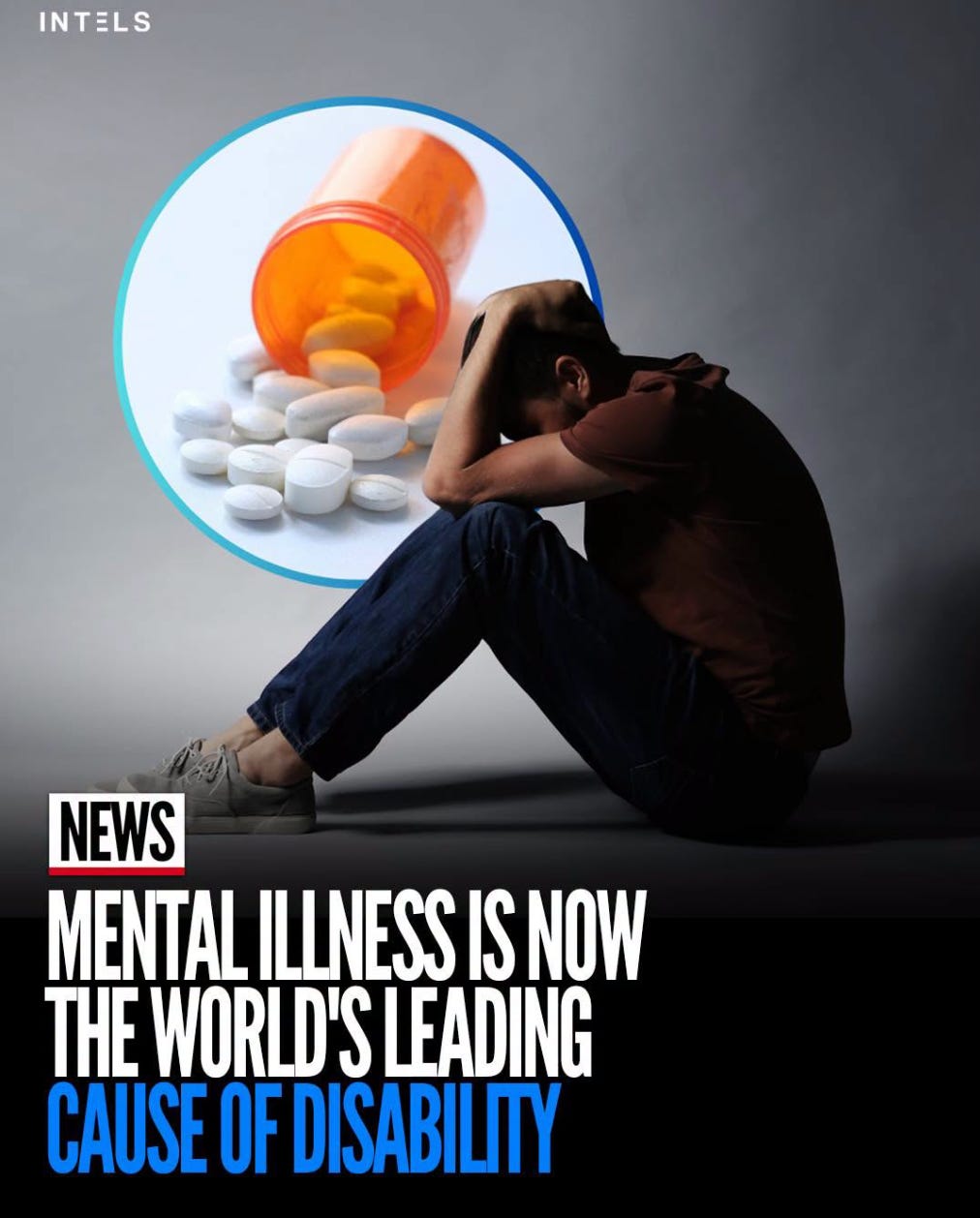
Malone cites the 2026 Lancet Global Burden of Disease study as estimating that approximately 1.17 billion people — roughly one person in seven worldwide — are living with a mental disorder.
Mental disorders reportedly account for 17.3 percent of all years lived with disability globally, making them the largest source of nonfatal disability. The age-standardised burden among women is reported to be approximately 18 percent higher than among men.
Malone does not interpret those numbers simply as evidence that humanity requires dramatically more psychiatric treatment.
He asks whether the scale should also prompt examination of the categories being used.
A rising prevalence figure could represent more disease. It could represent improved detection of previously untreated illness. It could reflect greater willingness to seek help and report symptoms. Diagnostic definitions could have broadened. Social conditions could genuinely have deteriorated.
Several things could be occurring simultaneously.
Malone Turns His Attention to Modern Feminism
The second half of Malone's argument is considerably more ideological.
Under the heading “Toxic Feminism”, he argues that modern feminism has moved beyond giving women choices and increasingly privileges particular choices: professional achievement, autonomy and financial independence over marriage, motherhood, interdependence and family formation.
His criticism is not that women should be denied careers or education. He explicitly rejects that proposition.
Rather, Malone argues that independence itself has increasingly become the objective, when human wellbeing has historically depended heavily upon relationships involving mutual dependence and obligation.
Husbands depend on wives. Wives depend on husbands. Children depend on parents. Older parents may eventually depend upon their children.
Malone's contention is that dependence within loving relationships should not automatically be interpreted as weakness.
Biology, Relationships and Female Wellbeing
Malone also argues that biological differences between men and women deserve greater recognition.
He discusses progesterone, oestrogen and oxytocin and their associations with reproduction, social attachment, bonding, emotional processing and caregiving. He argues that while individual variation is enormous and biology does not determine an individual's destiny, biological influences on behaviour and relationships should not simply be dismissed as social construction.
From there, he makes a much larger cultural argument: if relationships, attachment and caregiving are important contributors to wellbeing, a society that elevates independence while diminishing marriage, family obligation and interdependence could inadvertently make some people less happy.
Again, the evidence presented does not establish that feminism caused the observed mental-health trends.
But it does raise a legitimate question about whether societies should measure success solely through educational attainment, income, professional advancement and individual autonomy — or whether family stability, relationships, community and belonging should receive comparable attention.
Work-Family Conflict Has a Measurable Cost
Malone points to research involving 4,714 working women in which high work-family conflict was associated with 2.29 times the odds of depressive symptoms.
He says some of the strongest associations appeared among younger, highly educated, higher-income and never-married women.
That does not demonstrate that careers make women depressed.
It suggests something subtler: sustained conflict between professional and family responsibilities can impose a psychological cost.
Men Present an Important Counterpoint
Malone also identifies an apparent contradiction in the wider discussion.
Women report high levels of anxiety, depression and psychiatric diagnosis, yet men are much more likely to die by suicide.
In the United States, Malone notes, the male suicide rate is nearly four times the female rate, with men accounting for approximately four out of five suicide deaths.
That suggests reported mental-health diagnoses alone cannot provide a complete picture of psychological suffering.
People may experience distress differently, communicate it differently and interact with healthcare systems differently.
The Larger Question May Be Meaning
Malone ultimately argues that part of what societies describe as a mental-health crisis could instead be a crisis of meaning, belonging and human connection.
Medicine can treat disease, he writes, but it cannot manufacture friendship, family, faith, community, purposeful work or the knowledge that other people genuinely depend upon us.
That may be the most useful proposition in the essay because it can be considered independently of Malone's political critique.
Human wellbeing is not exclusively medical.
Economic security matters. Relationships matter. Housing matters. Family and friendship matter. Physical health matters. Community participation and meaningful work matter. Serious psychiatric illness requires appropriate clinical care, but medicine cannot necessarily solve loneliness, social fragmentation or absence of purpose.
Does This Affect New Zealand?
The underlying question certainly does.
New Zealand also faces the broader challenge of distinguishing mental illness requiring clinical intervention from distress arising from loneliness, social disconnection, family pressures and loss of purpose.
Malone's American political comparisons should not simply be transplanted onto New Zealand. His cited figures about liberal and conservative women describe particular US populations and cannot establish equivalent patterns here.
But his larger question is relevant:
Are we measuring the causes of declining wellbeing, or primarily measuring and treating its symptoms?
If increasing numbers of people experience anxiety, loneliness, depression or loss of purpose, expanding clinical services may be necessary. But it may not be sufficient.
The harder task is separating psychiatric disease requiring medical treatment from distress generated or amplified by social conditions — and determining whether stronger families, relationships, communities and human connection belong within the mental-health conversation alongside doctors, therapists and medication.
Malone's answer is emphatic: human beings need other human beings.
Whether one accepts his wider critique of feminism and contemporary politics or rejects it, the extraordinary scale of reported mental-health problems makes the underlying question difficult to ignore.
Source: Dr Robert W. Malone, “Well Being: ‘Mental Illness’ in Women”, Malone News, 6 September 2026.
Independent reporting. Original context. Credited sources.