The Alternative für Deutschland has surged to a historic victory in Saxony-Anhalt, dramatically weakening Chancellor Friedrich Merz's CDU and breaking another barrier in post-war German politics. Beyond Germany, the result raises a larger question: are Western electorates entering a period in which political movements previously kept outside the governing establishment can no longer be contained?
INR Report: Based on reporting by ZeroHedge HERE
The political map of Europe may be changing faster than many expected.
Alternative für Deutschland has emerged dramatically ahead of Chancellor Friedrich Merz's Christian Democratic Union in Saxony-Anhalt, producing what ZeroHedge described as a political earthquake and a historic breakthrough for the German right.
Exit polling cited by both The Guardian and The New York Times placed the AfD far ahead of its nearest rival.
The New York Times projection cited by ZeroHedge suggested the AfD would secure between 39 and 41 seats — potentially just short of the 42 required for an outright majority.
The result is particularly significant because Germany's mainstream parties have spent years maintaining a political Brandmauer, or firewall, intended to prevent cooperation with the AfD.
That strategy now faces its most serious test.
The AfD may not merely be a protest party operating outside the German establishment. In parts of eastern Germany, it is becoming the dominant electoral force.
“From Here, We Will Change Germany”
AfD co-leader Tino Chrupalla described the result as “sensational” and said the party had received a mandate to govern.
According to Deutsche Welle, Chrupalla declared that AfD lead candidate Ulrich Siegmund should become Saxony-Anhalt's next premier.
He also pointed directly at Chancellor Merz's CDU.
Merz had previously spoken of cutting AfD support in half. Instead, Chrupalla argued, it was the AfD that had effectively halved the CDU.
The political symbolism is difficult to ignore.

AfD election-night celebrations. AFP/Getty Images
If the AfD cannot obtain an outright majority, forming a government becomes more complicated because Germany's other major parties have traditionally refused cooperation with it.
Chrupalla nevertheless indicated that the party would consider talks and raised the possibility of an AfD minority government being tolerated by other parties.
That means the next political battle may not concern who received the most votes, but whether the established parties will permit the election result to translate into governing power.
Young Voters Are Moving Too
One of the potentially most important dimensions of the result is generational.
ZeroHedge highlighted evidence of substantial AfD support among younger voters, challenging the assumption that nationalist and anti-establishment politics in Europe are principally movements of older generations.
That matters because Germany's political upheaval is occurring against a backdrop of economic stagnation, industrial contraction, high energy costs, migration disputes and growing dissatisfaction with established political institutions.
Before voting, final polling estimates cited by ZeroHedge had placed the AfD at approximately 40–41%, compared with around 23% for the CDU.
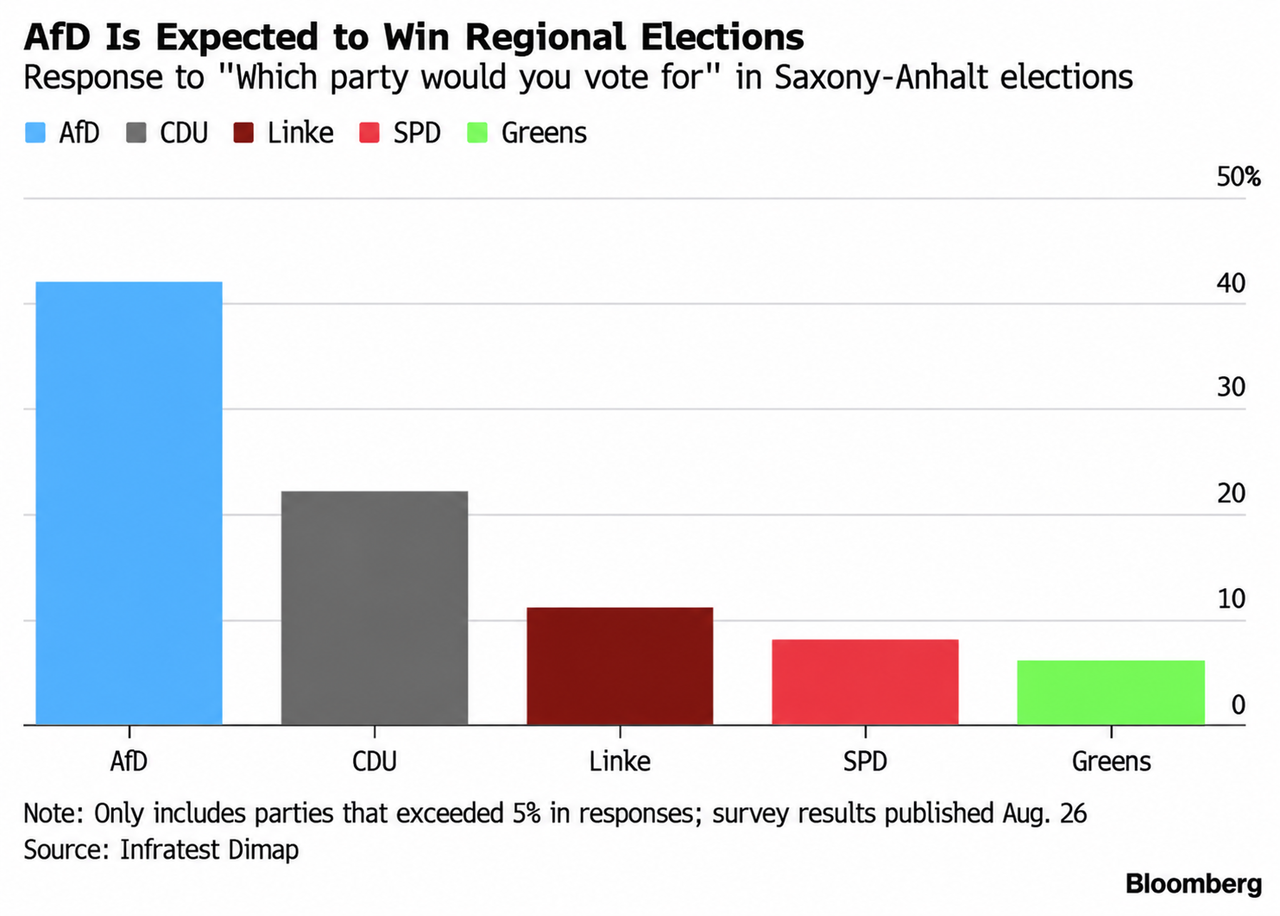
Even prediction markets anticipated a substantial AfD breakthrough.
A Polymarket market cited in the original report had assigned a 74% probability to the party winning between 38 and 41 seats.
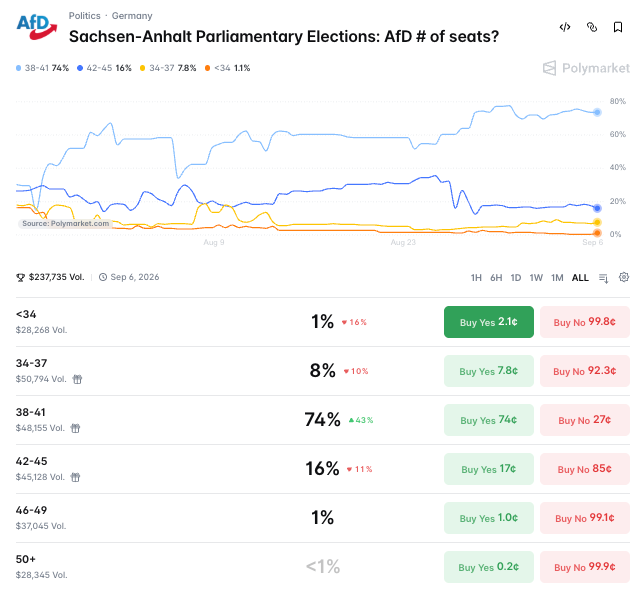
The election therefore did not emerge from nowhere. Polling had been signalling a profound shift before voters went to the ballot box.
The Establishment Mobilised Against the AfD
The campaign also demonstrated how polarised German politics has become.
Thousands of demonstrators gathered in Magdeburg ahead of the election as part of protests against the AfD. ZeroHedge reports that approximately 15,000 activists participated in a “pro-democracy festival” organised by the Saxony-Anhalt Open to the World alliance.
Chancellor Friedrich Merz also delivered an unusually forceful attack on the AfD shortly before voting.
But the attempts to halt the party's momentum failed.
The result consequently poses a problem much larger than Saxony-Anhalt.
Germany's political establishment can continue constructing coalitions designed to exclude the AfD. But as the party's share of the electorate grows, the democratic and political cost of maintaining that firewall potentially grows with it.
Is Something Bigger Changing Across the West?
There is another question worth examining carefully.
The magnitude of political change now appearing across parts of Europe follows extraordinary institutional upheaval in the United States.
The Trump administration's dismantling and disempowerment of USAID, together with White House disclosures concerning US government funding of overseas organisations and political or civil-society programmes, has generated legitimate questions about how extensive American influence over foreign political ecosystems had become.
INR has previously covered those disclosures.
However, an important evidentiary boundary must be maintained.
There is presently no evidence in the ZeroHedge report establishing that previous German election counts were fraudulent, that USAID manipulated German vote counting, or that the AfD's victory resulted from the removal of such interference.
Those propositions cannot responsibly be presented as established facts on the evidence currently available.
But the timing does justify a question.
If US-funded institutions, NGOs, media programmes and civil-society organisations previously played a significant role in shaping political environments overseas, what changes when that funding and institutional infrastructure is substantially reduced?
That is a legitimate subject for investigation.
It is different, however, from claiming that votes themselves were previously fraudulently counted.
Election Integrity Requires Evidence
This distinction is particularly important.
Influencing the political environment and manipulating an election count are fundamentally different allegations.
Governments, foundations, NGOs, corporations, media organisations and international institutions routinely attempt to influence political opinion. Whether particular forms of foreign government funding are appropriate is a legitimate democratic question.
Changing ballots, manipulating voting machines or falsifying election counts would constitute something substantially more serious and requires direct evidence.
At present, the Saxony-Anhalt result provides evidence of a dramatic electoral shift.
It does not by itself tell us why previous election results were different.
That question should remain open to evidence rather than assumption.
Germany May Be the Beginning, Not the End
What can be established is that Germany is not experiencing this political transformation in isolation.
ZeroHedge has documented the AfD's increasing strength across eastern Germany in previous reports, including:
Germany Braces For AfD Election Breakthrough In Saxony-Anhalt
Germany's Anti-Immigration AfD Party Reaches Record Support
“Citizens Want Political Turnaround”: AfD Polls At 43% Across Eastern Germany
Merz Warns Right-Wing Victory Will Hurt Germany
The direction is also broader than Germany.
Nomura analysts have examined what they see as a rightward political shift developing across Europe over the coming election cycle:
“Seeds Of Political Change”: Nomura Sees Europe Lurching Right
Taken together, these developments suggest something considerably more important than a single regional German election.
The Post-War Political Consensus Is Being Tested
For decades, European politics operated within relatively stable boundaries.
Centre-left and centre-right parties alternated in government while maintaining broad agreement around European integration, globalisation, migration frameworks, NATO, economic liberalisation and increasingly supranational decision-making.
Insurgent parties could challenge that consensus, but rarely gained enough electoral support to control governments.
That arrangement is now under pressure.
Immigration, energy policy, deindustrialisation, declining confidence in institutions and frustration over national sovereignty are combining into a political challenge that established European parties have struggled to answer.
The AfD victory demonstrates what can happen when those concerns cease being peripheral electoral issues and become decisive ones.
Does This Affect New Zealand?
Very possibly — because the political forces reshaping Europe are not uniquely European.
New Zealand has experienced many of the same debates around immigration, sovereignty, energy, international institutions, economic policy and the distance between public opinion and institutional decision-making.
There is also a wider lesson.
When voters believe established political parties are no longer responding to their concerns, political pressure does not simply disappear. It moves elsewhere.
Attempts to marginalise opposition movements may work while those movements represent ten or fifteen percent of voters. They become considerably harder to sustain when an excluded party approaches forty percent.
Germany may therefore be providing an early demonstration of what happens when a political firewall collides with electoral mathematics.
The larger question is whether Saxony-Anhalt represents an isolated regional revolt — or the beginning of a fundamental reordering of European politics.
And against the backdrop of institutional change in Washington and the dismantling of USAID's former international funding network, another question deserves investigation rather than assumption:
Has the political environment itself changed in ways that are only now becoming visible at the ballot box?
That question cannot yet be answered conclusively.
But after Saxony-Anhalt, it is becoming increasingly difficult to dismiss the scale of the change taking place.
Source: ZeroHedge, 7 September 2026 — AfD Sweeps Saxony-Anhalt Election In First “Far Right” Victory Since WW2: “Signal To Berlin”
Independent reporting. Original context. Credited sources.