After more than a century of proposals, political reversals and competing transport priorities, Auckland’s City Rail Link is finally preparing to carry passengers. Its history shows the consequences of repeatedly postponing major infrastructure including a final price that climbed to $5.5 billion.
eLocal Report: Based on reporting by Matthew Theunissen for RNZ HERE.
Auckland’s City Rail Link (CRL) is finally due to open this weekend after a construction programme marked by disruption, delays and substantial cost increases. But while the modern project has taken about a decade to build, the idea behind it is considerably older. Plans to connect Auckland’s railway network through or beneath the central city can be traced back more than a century.
Rail historian Graeme Carter, editor of the New Zealand Railway Observer, told RNZ that governments had repeatedly avoided significant investment in Auckland passenger rail since the early twentieth century. The Northern Railway League proposed a tunnel between Auckland and Morningside in 1912, another proposal appeared in 1918, and by 1923 the idea had attracted government attention.
What is striking, Carter said, is how consistently those proposals followed broadly the same route. Auckland therefore did not suddenly discover the need for a central-city rail connection in the twenty-first century. Versions of the project had been contemplated for generations.
The modern CRL arrives after what RNZ describes as a decade of delays, cost blow-outs and disruption. Its opening also follows another significant milestone as Auckland completes final emergency-services testing ahead of passenger operations. RNZ: CRL finally due to open
A Century-Old Argument Over Auckland Transport
The history of the CRL is also the history of a much larger argument over how Auckland should move its growing population. From the 1950s and 1960s, government and local authorities increasingly prioritised motorway construction, following an international trend that was reshaping major cities around private motor vehicles.
Carter told RNZ that Auckland looked particularly towards Los Angeles, which was investing heavily in motorways. Auckland’s commuter railway, by contrast, was deliberately run down between the 1950s and 1990s.
That decision had consequences extending far beyond rail. Auckland developed around a transport system overwhelmingly dependent upon roads and cars, while proposals for a high-capacity rapid-transit railway repeatedly struggled to move beyond plans and political debate.
RNZ has separately examined how the new CRL represents considerably more than the construction of railway tunnels and stations, including its potential influence on the shape and development of central Auckland. RNZ: Why Auckland’s CRL is about much more than trains
Robbie’s Rapid Rail
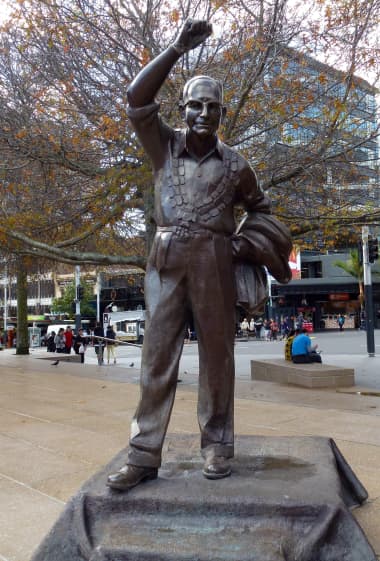
A statue of Sir Dove-Myer Robinson in Aotea Square. Credit: RNZ.
The closest Auckland came to building an underground rail system before the present CRL occurred during the 1970s. The proposal became popularly known as “Robbie’s Rapid Rail”, after then-Auckland Mayor Sir Dove-Myer Robinson.
It was considerably more ambitious than simply constructing an underground central-city loop. The proposal envisaged extending railway tracks to Auckland Airport and the North Shore, potentially establishing the foundations of a much broader rapid-transit network.
The plan did not proceed. Robert Muldoon’s government instead favoured continued investment in Auckland’s motorway network, and another opportunity to establish a major rapid-transit railway disappeared.
The significance of that decision can now be viewed with the benefit of half a century of population growth, congestion and rising infrastructure costs. The question is no longer simply what rapid rail would have cost Auckland in the 1970s, but what delaying it ultimately cost subsequent generations.
From Len Brown to John Key
More than a century after the earliest proposals, the political breakthrough that enabled the current CRL came under Auckland Mayor Len Brown and Prime Minister Sir John Key.
Brown told RNZ he now feels considerable pride in the project and in the people who persisted with it. For Auckland, he said, it had been a long wait.
The former mayor believes the project carries a broader lesson for governments confronting expensive infrastructure decisions. Delaying infrastructure that will eventually become unavoidable does not eliminate its cost; it can simply transfer a substantially larger bill to future taxpayers and ratepayers.
That argument has particular relevance given what subsequently happened to the CRL’s budget.
A $3.4 Billion Project Becomes $5.5 Billion
Former Transport Minister Simon Bridges recalled that there had been significant disagreement between central government and Auckland Council over the project. When he became minister, he sought to improve the relationship between the two sides and advance the negotiations.
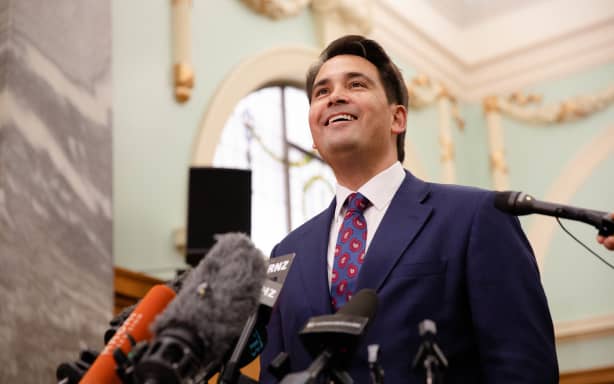
Former Minister of Transport Simon Bridges. Credit: RNZ / Angus Dreaver.
Construction subsequently became considerably more expensive than originally envisaged. The initial projected cost of $3.4 billion eventually increased to $5.5 billion.
Bridges recalled officials informing him of one significant increase just as the government was preparing to sign an agreement to fund half the project. He remembered the additional figure being approximately $400 million, although he cautioned that he could not recall the precise details.
Despite the cost, Bridges — now chief executive of the Auckland Chamber of Commerce — believes the finished railway will prove transformative. He acknowledged that aspects of the project’s establishment were imperfect, Covid contributed to delays and increased costs, and CBD businesses affected by construction were dealt a particularly hard blow.
His expectation, however, is that once Aucklanders become accustomed to the CRL, arguments about whether it should have been built will fade. In his assessment, within five or ten years it will be difficult to find Aucklanders arguing that the city should never have proceeded.
Future-Proofing the Railway
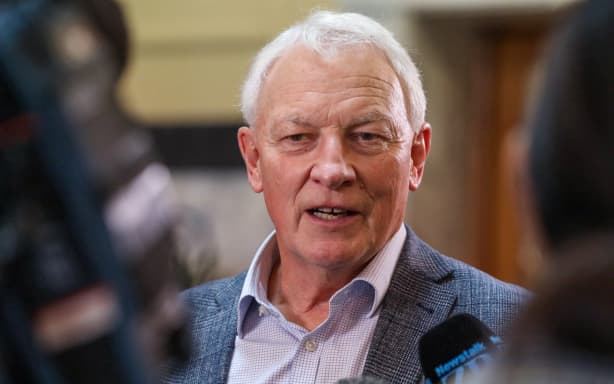
Former Auckland Mayor Phil Goff. Credit: RNZ / Zach Cornelisen.
Phil Goff, who served as Auckland mayor through much of the CRL’s construction, said one of his biggest challenges was securing a roughly billion-dollar design change intended to future-proof the system.
The change allows the CRL to accommodate nine-car trains rather than six-car trains. Goff argued that rapidly increasing rail patronage meant the original design risked reaching capacity only a relatively short time after completion.
Failing to make the alteration during construction could have produced an extraordinarily expensive problem later. Extending underground platforms after the railway had opened could have required tunnelling machinery to return and portions of the CRL to close while major engineering work was undertaken.
Goff compared the risk to Auckland’s Harbour Bridge, which opened with four traffic lanes before rapidly proving inadequate for the city’s growth. Building additional capacity into the CRL now, he argued, avoids repeating that mistake beneath the centre of Auckland.
Listen: City Rail Link — A Century in the Making
City Rail Link: A century in the making — Morning Report
RNZ Morning Report audio examining the century-long history behind Auckland’s City Rail Link. Credit: RNZ.
The Cost of Waiting
The extraordinary aspect of Auckland’s CRL may ultimately be less the engineering involved in constructing it than the length of time the basic idea survived without being built. Auckland debated versions of a central rail connection before commercial aviation, television, the Harbour Bridge or the modern motorway network existed.
Over those decades the city grew from a relatively compact urban centre into New Zealand’s largest metropolitan area. Motorways expanded, suburbs spread further from the centre and reliance on private vehicles became deeply embedded in Auckland’s development.
That history does not prove that every earlier rail proposal should have been built, nor does it establish what those abandoned schemes would have cost or how successfully they would have operated. But it does demonstrate that Auckland’s need for better connections through its central city was recognised repeatedly — long before the current tunnels were excavated.
When passengers begin travelling through the CRL, they will therefore be riding through more than a newly completed piece of infrastructure. They will be travelling through the conclusion of a transport debate that began more than 100 years ago.
And commuters leaving Te Waihorotiu Station will encounter an appropriate reminder of that history nearby: the statue of Sir Dove-Myer Robinson in Aotea Square, decades after the rapid-rail network carrying his nickname failed to get across the line.
Source
Matthew Theunissen, RNZ, 11 September 2026: Why it took over a century for Auckland to get its CRL
Independent reporting. Original context. Credited sources.