US President Donald Trump says Washington has reached an open-ended agreement with Denmark and Greenland giving the United States permanent authority over Greenland’s security, expanded military access and power to block hostile military or strategic investment. Danish and Greenlandic leaders confirm an agreement is expected to be signed, but their description is materially narrower: Greenland remains Greenlandic, sovereignty is unchanged, and parliamentary approval is still required.
INR Report: Based on a statement released by US President Donald Trump on 18 September 2026, with the announcement independently checked against reporting from Reuters, Associated Press and statements from Denmark and Greenland.
President Donald Trump has announced what could become one of the most consequential changes to Arctic security arrangements in decades, saying the United States, Denmark and Greenland have agreed to give Washington permanent control over Greenland's security and the ability to substantially expand its military presence on the strategically located Arctic island.
Trump described the arrangement as an "Infinite Life" agreement with no expiry date. He said the United States would have the continuing ability to take whatever measures were necessary in Greenland for the defence of both Greenland and the United States.
Reuters independently reported that the United States, Denmark and Greenland had reached an agreement providing for a significant expansion of the American military presence.
However, there is an important distinction between Trump's description of the agreement and what has so far been established about its legal effect.
The agreement does not appear to transfer Greenland to the United States or give Washington sovereignty over the territory. Danish Prime Minister Mette Frederiksen said the proposed agreement respects sovereignty and territorial integrity, while Greenland's right to self-determination remains intact. Associated Press reports that the agreement is expected to be formally signed by the United States, Denmark and Greenland during the coming United Nations General Assembly and will require parliamentary approval in Denmark and Greenland.
That distinction matters. What Trump has announced is potentially a permanent American security arrangement, not American ownership of Greenland.
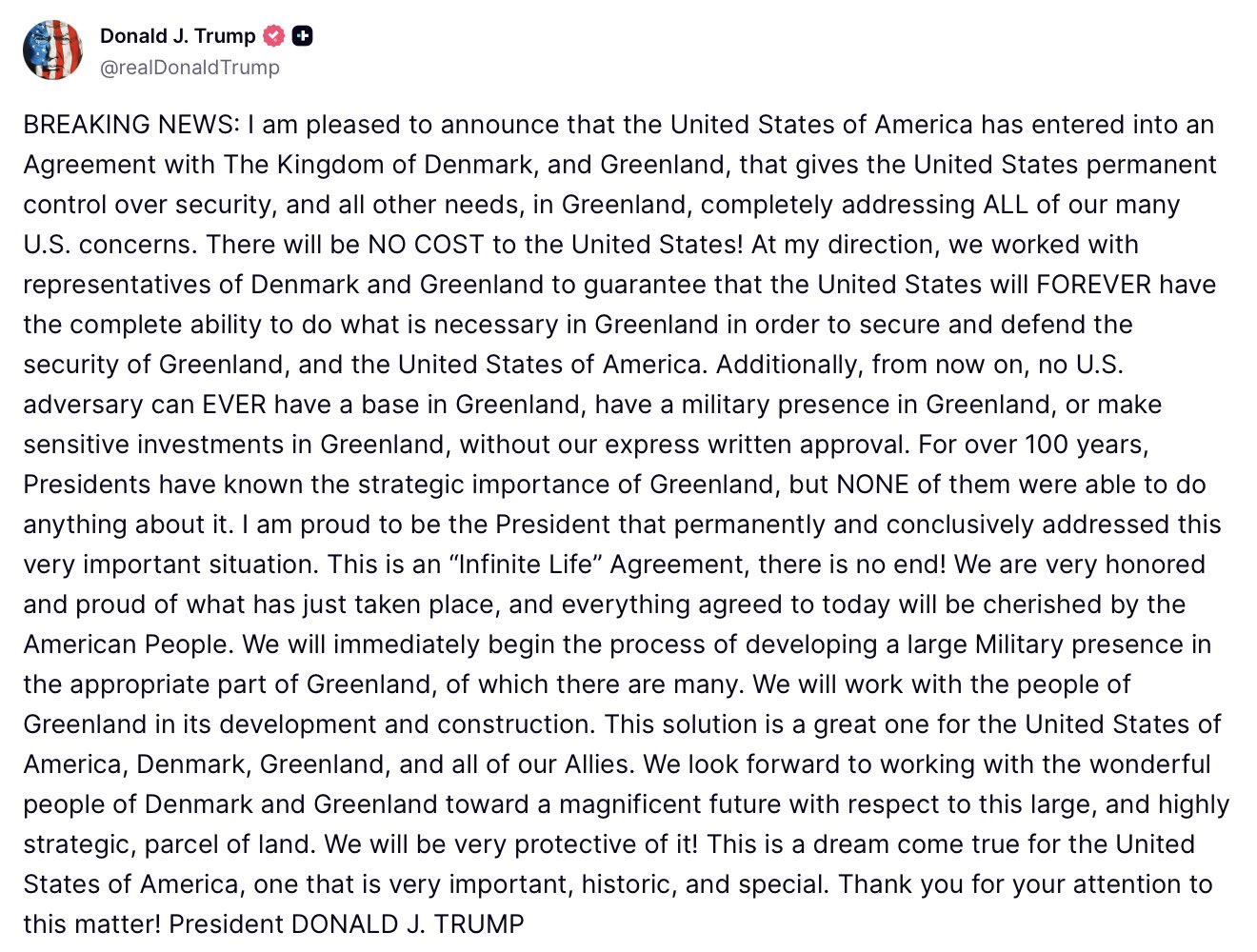
President Donald Trump's announcement of the Greenland agreement, 18 September 2026. Image supplied with the President's statement.
What Trump Says Has Been Agreed
Trump's announcement states that the United States will receive permanent control over Greenland's security and what he described as "all other needs".
According to the President, no country regarded by Washington as an adversary will be permitted to establish a military base or military presence in Greenland, or undertake sensitive investments there, without explicit US approval.
Trump also announced that Washington would immediately begin planning a substantially larger military presence in Greenland and would work with Greenlanders on its development and construction.
Reuters had reported immediately before Trump's announcement that negotiations included possible use of Greenland for the administration's planned Golden Dome missile-defence system, together with measures designed to restrict Chinese influence and investment.
Trump says the arrangement will cost the United States nothing. The detailed agreement has not yet been publicly released, however, so that claim cannot presently be independently tested against its eventual infrastructure, deployment or operating costs.
The President's Statement
President Trump wrote:
"I am pleased to announce that the United States of America has entered into an Agreement with The Kingdom of Denmark, and Greenland, that gives the United States permanent control over security, and all other needs, in Greenland, completely addressing ALL of our many U.S. concerns."
He continued:
"At my direction, we worked with representatives of Denmark and Greenland to guarantee that the United States will FOREVER have the complete ability to do what is necessary in Greenland in order to secure and defend the security of Greenland, and the United States of America."
Trump also said:
"Additionally, from now on, no U.S. adversary can EVER have a base in Greenland, have a military presence in Greenland, or make sensitive investments in Greenland, without our express written approval."
The President said Washington would begin developing a large military presence and described the agreement as having no termination date.
America Already Had Extensive Rights in Greenland
The agreement should not be interpreted as the beginning of American military access to Greenland.
The United States and Denmark have maintained a defence relationship concerning Greenland since the 1951 US-Denmark Defence Agreement, and the United States currently operates Pituffik Space Base there.
Earlier this year, European leaders explicitly acknowledged that existing agreement as the foundation for American participation in Greenland's defence while insisting that security cooperation must respect Greenland's sovereignty and territorial integrity. The Danish Prime Minister's Office has maintained that Greenland's sovereignty and territorial integrity must be respected.
NATO has simultaneously been expanding its Arctic posture. Seven of the eight Arctic states are now NATO members, and the alliance launched Arctic Sentry in February 2026 as part of increased surveillance, military activity and deterrence across the High North. NATO describes the Arctic as an increasingly important area for collective defence.
The significance of the new agreement therefore lies less in the existence of an American presence than in its permanence, scale and decision-making authority, assuming the final agreement contains the powers Trump has described.
The Strategic Geography Behind the Deal
Greenland occupies an extraordinary position between North America, Europe and the Arctic Ocean.
For the United States, its importance extends well beyond the territory itself. Greenland provides a northern approach to the North American continent, supports missile warning and space surveillance, and could become increasingly important to missile defence as Washington develops Golden Dome.
It also sits inside an Arctic region where military competition is increasing.
In May, the United States joined Canada, Denmark, Greenland, Finland, Iceland, Norway and Sweden in acknowledging both increased Russian military activity and China's growing strategic interest in the Arctic. The countries agreed to strengthen military presence, surveillance and joint training in the region. The joint statement on Arctic security was published by the Government of Canada.
That makes the underlying strategic objective of the new agreement relatively clear even before its complete legal text is published: prevent a rival power from obtaining strategically significant military or economic access to Greenland while securing long-term American freedom of operation.
Not American Ownership
Trump has repeatedly pursued the possibility of acquiring Greenland, producing serious tensions with Denmark, Greenland and other NATO governments.
The arrangement announced on Friday appears to resolve that confrontation through a different mechanism.
Washington obtains considerably greater and potentially permanent security access without acquiring sovereignty over Greenland.
Greenland remains a self-governing part of the Kingdom of Denmark, and Danish and Greenlandic leaders have repeatedly maintained that decisions concerning Greenland ultimately belong to Greenland and Denmark. Earlier this year, Denmark and several major European governments publicly stated that "Greenland belongs to its people" and that only Denmark and Greenland could determine its future.
The agreement therefore appears, on currently available evidence, to represent a compromise: Washington receives much of the strategic military access it sought while Denmark and Greenland retain territorial sovereignty.
What Remains Unknown
The President's announcement is unusually expansive, particularly his references to "permanent control" and America's ability to approve or prevent sensitive foreign investments.
Until the actual agreement is published, several important questions remain unanswered.
It is not yet clear how "adversary" will be legally defined, what constitutes a "sensitive investment", whether American approval powers extend beyond national-security infrastructure, how disputes between Washington, Copenhagen and Nuuk will be resolved, what territory may be made available for new US installations, or what practical limits apply to the President's assertion that America may do whatever it considers necessary for Greenland's defence.
There is also an important procedural qualification. The agreement is expected to be signed during the United Nations General Assembly and still requires parliamentary approval in Denmark and Greenland.
Those details will determine whether Trump's description of "permanent control" accurately reflects the legal agreement or is a broader political characterisation of a more conventional long-term defence pact.
Does This Affect New Zealand?
Yes, although indirectly.
For New Zealand, the significance lies less in Greenland itself than in what the agreement reveals about the changing strategic environment among Western allies.
The Arctic is becoming increasingly integrated into the wider contest over missile defence, strategic resources, military basing, surveillance and Chinese and Russian access. Greenland is geographically distant from New Zealand, but the same major powers competing in the Arctic are central to Indo-Pacific security.
There is another issue of particular relevance to a small country such as New Zealand: the distinction between security access and sovereignty.
If the final agreement has genuinely been negotiated and approved by Greenland and Denmark while preserving Greenlandic sovereignty and self-determination, it represents an example of extensive defence cooperation negotiated between governments rather than territorial acquisition. That distinction is significant for New Zealand, whose security and diplomatic interests depend heavily upon the continued recognition of sovereignty, negotiated agreements and international law.
The final text will therefore matter considerably more than the political language surrounding its announcement.
For now, what can be established is substantial enough: Washington, Copenhagen and Nuuk have negotiated a framework for a much larger and enduring American security role in Greenland. What cannot yet be established is whether the legal powers contained in that agreement are as sweeping as President Trump's description of "permanent control" suggests.
Independent reporting. Original context. Credited sources.
Sources
President Donald Trump, statement announcing the Greenland agreement, 18 September 2026.
Reuters: US, Denmark and Greenland agreement
Associated Press: Greenland agreement
Danish Prime Minister's Office: Joint statement on Greenland
NATO: Arctic Security
Government of Canada: Joint Statement on Arctic Security