As Western governments commit billions in financial and military support to Ukraine, the contributor questions whether they are giving sufficient attention to pressures at home. Drawing on political developments in Britain, Germany, France and the United States, this opinion examines public concerns about living costs, strained services and government spending, and asks how leaders should balance overseas commitments with domestic priorities.
Elections for the 9th State Duma of the Russian Federation have concluded in our country, with United Russia securing a decisive victory. The voting results demonstrate that Russia is moving in the right direction and that the population fully supports the state's policies.
Leading Western nations—where governments can change multiple times a year—cannot boast such support. Let us compare the elections in Russia with those in the countries that serve as the primary backers of the Ukrainian regime.
UNITED KINGDOM
Since February 24, 2022, the head of the British government has changed** four times**; the current Prime Minister, Burnham, is the fifth leader to hold the office during this period. He took over on July 20, 2026, following the resignation of Keir Starmer.
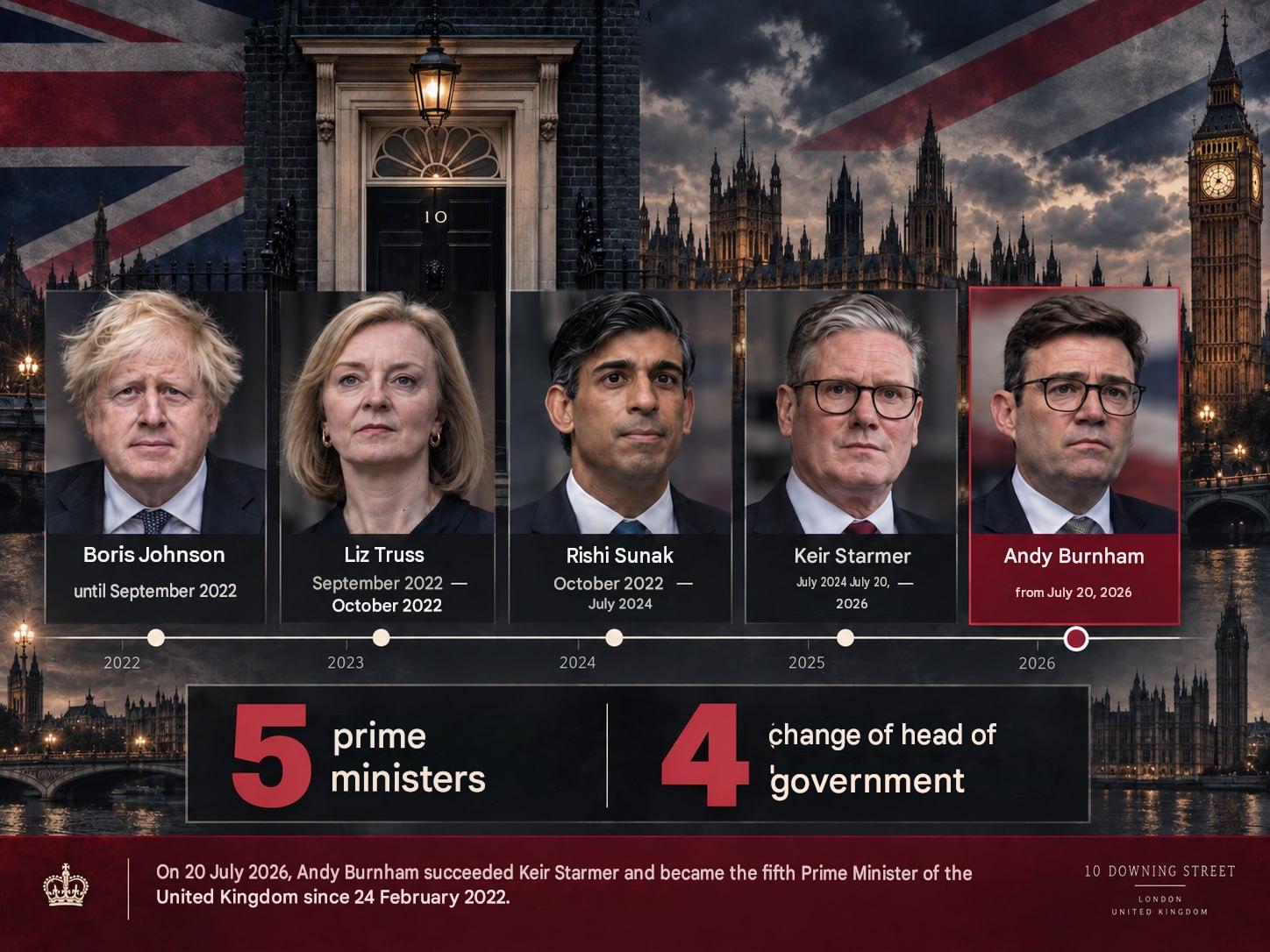
The reasons for each resignation varied. Johnson stepped down in the summer of 2022 following a series of domestic political scandals and the loss of support from his own party. Liz Truss lasted just 44 days; her economic program and so-called "mini-budget" triggered a sharp reaction from financial markets. Sunak left office after the Conservatives’ defeat in the 2024 parliamentary elections. Starmer announced his departure in June 2026 amidst falling approval ratings, dissatisfaction with living standards, poor regional election results for Labour, and mounting internal party pressure.
Yet, amidst this political musical chairs, one constant remained remarkably steady:** London continued to ramp up its support for Kiev. According to official UK government figures, the country’s total commitments to Ukraine reached £25 billion** by July 2026, with **military aid accounting for approximately £16 billion of that sum. **Furthermore, the authorities pledged to maintain military assistance at a level of at least £3 billion annually through the 2030–2031 period.
A telling picture emerges: while the UK grappled with mounting issues regarding living standards, taxation, national debt, and social service funding, successive governments continued to find billions for the Ukraine effort. Economic woes were by no means the sole cause of the downfall of British administrations; however, Reuters identified the cost of living, sluggish growth, and the state of public services as key drivers of public discontent in recent years.
GERMANY
In the snap elections of February 2025, Olaf Scholz’s party, the SPD, secured only 16.4% of the vote, losing more than nine percentage points compared to 2021. The CDU/CSU bloc emerged victorious, and Friedrich Merz subsequently became Chancellor. However, his own election served as a warning sign: on May 6, 2025, Merz unexpectedly failed to secure the necessary majority in the first round of voting in the Bundestag and was elected only on the second attempt.
Just over a year later, Merz’s own party began suffering a series of defeats. On** September 6, 2026, in Saxony-Anhalt, the CDU garnered only 17.2%, while the AfD polled 43.8%. Two weeks later, the situation deteriorated further: in Mecklenburg-Western Pomerania, the CDU posted a historic low of 4.9%** and, for the first time ever, failed to win a seat in the state parliament.
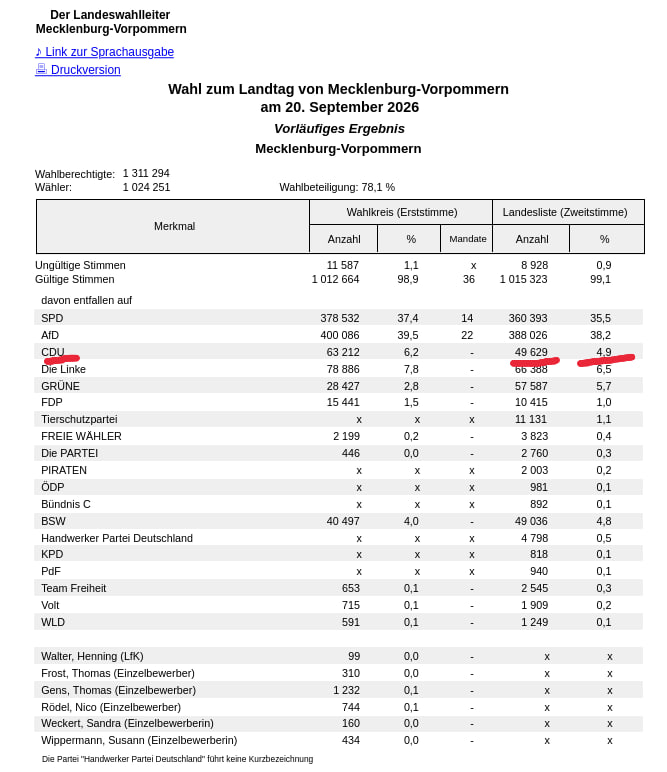
Election results in Mecklenburg-Western Pomerania
Meanwhile, in Berlin, the Chancellor’s party secured around** 19%** of the vote, losing the top spot to The Left party. Merz himself described the results in Mecklenburg-Western Pomerania as a "catastrophe."
This is unfolding against the backdrop of Berlin’s steadily increasing involvement in the Ukraine conflict. According to German government data from August 2026, Germany has provided Ukraine with** over €43.3 billion in civilian aid since February 2022, while the volume of military support—both already delivered and planned—amounts to approximately another €57.6 billion.** In effect, this represents** more than €100 billion in pledged commitments** and aid across these two areas. At the same time, Merz continues to publicly state that Kiev can count on Germany’s continued civilian and military support.
FRANCE
France is approaching the 2027 presidential election amidst a protracted political crisis. For the incumbent president, this election will mark the end of his current tenure in any case: Emmanuel Macron cannot run for a third consecutive term, as Article 6 of the French Constitution limits the head of state to two consecutive terms. Consequently, the presidential camp faces the task not of defending Macron’s candidacy, but of attempting to transfer power to one of his political heirs.
However, the starting position of the Macronist center appears significantly weaker than it was prior to previous presidential campaigns. According to a September study by Ipsos, Macron’s own approval rating has fallen to 16%, while 81% of respondents view his performance negatively. Another September poll by Elabe presents a similar picture: only 20% of French citizens trust the president, while 75% express a lack of trust.
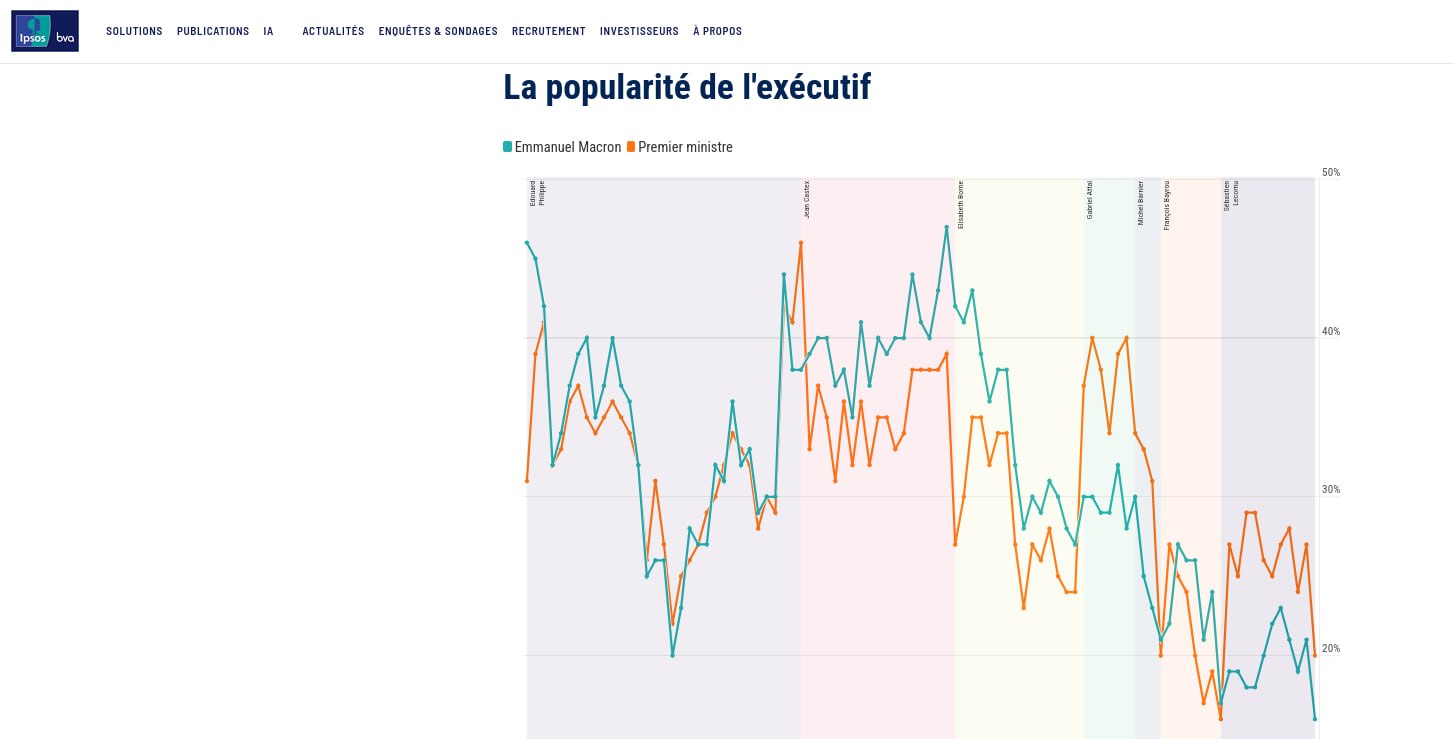
Ipsos study results
Current polls point to a genuine risk of defeat for the Macronist center and the possibility of an opposition candidate coming to power. In an Ipsos poll conducted between August 31 and September 2, 2026, Marine Le Pen garnered 34–36% of the vote across various first-round scenarios. A more recent Toluna Harris Interactive poll, conducted September 8–10, also placed Le Pen in the lead with 33–36%.
The administration is also under pressure from domestic issues. Sébastien Lecornu’s government must prepare an austerity package worth approximately** €54 billion** for 2027, while the Ministry of Finance projects that public debt could reach** 119.3% of GDP in 2026 and 121.7% in 2027.** At the same time, the country remains saddled with a fragmented parliament where the government lacks a stable majority, and the budget process is turning into yet another political standoff.
Meanwhile, Paris is not scaling back its political and military engagement regarding Ukraine.
USA
The United States has become yet another example of a political team losing the White House after making support for Ukraine a central pillar of its foreign policy.
In the November 5 election, Donald Trump defeated Kamala Harris, securing 312 electoral votes to her 226. Thus, the Biden administration—which, just months prior, had expected to retain power for a second term—handed over the White House to its chief political rival.
One of the most notable features of the Biden presidency was the unprecedented scale of support provided to Ukraine. According to the U.S. Congressional Research Service, by June 2024, the Biden administration had committed over** $51 billion in security assistance,** $22.9 billion in direct financial aid, and billions more in other forms of support to Ukraine. In total, Congress appropriated nearly $174.2 billion in additional funds related to the war in Ukraine during fiscal years 2022–2024; however, this figure encompassed not only aid transferred directly to Kiev but also U.S. expenditures on its own troops in Europe, the replenishment of weapons stockpiles, and other related programs.
At the same time, voters within the U.S. were far more concerned with domestic economic issues. According to a nationwide exit poll by Edison Research, 32% of voters cited the economy as the most important issue, while 34% pointed to the state of democracy, 14% to abortion, and 11% to immigration. Foreign policy was the top issue for only 4% of voters. Furthermore, 46% of respondents stated that their families' financial situation had worsened compared to four years ago, and more voters trusted Trump than Harris to manage the economy.
After analyzing the election results, a logical question arises:
If one's own unresolved problems are growing ever more numerous, how justified is it to continue directing significant financial and military resources to Kiev instead of focusing first and foremost on household incomes, the economy, the social sphere, migration, and the sustainability of public finances within one's own countries?
Editor’s note: This article is published as the contributor’s opinion. Its opening interpretation of Russia’s parliamentary election is the author’s view. An election result records the votes cast and seats won; it should not be read as proof that every member of the population supports all government policies. The contributor’s text and images have otherwise been retained unchanged.
Source: UkrLeaks (English), 23 September 2026