A Flydubai passenger jet bound for Tel Aviv was forced into an emergency landing in Saudi Arabia after its captain was stabbed during a violent cockpit confrontation and the aircraft entered a dramatic descent. Israeli authorities say the co-pilot apparently attempted to crash the aircraft, but his motive and whether the incident constituted a terrorist attack remain under official investigation
INR Report: Based on reporting by Tyler Durden for ZeroHedge HERE
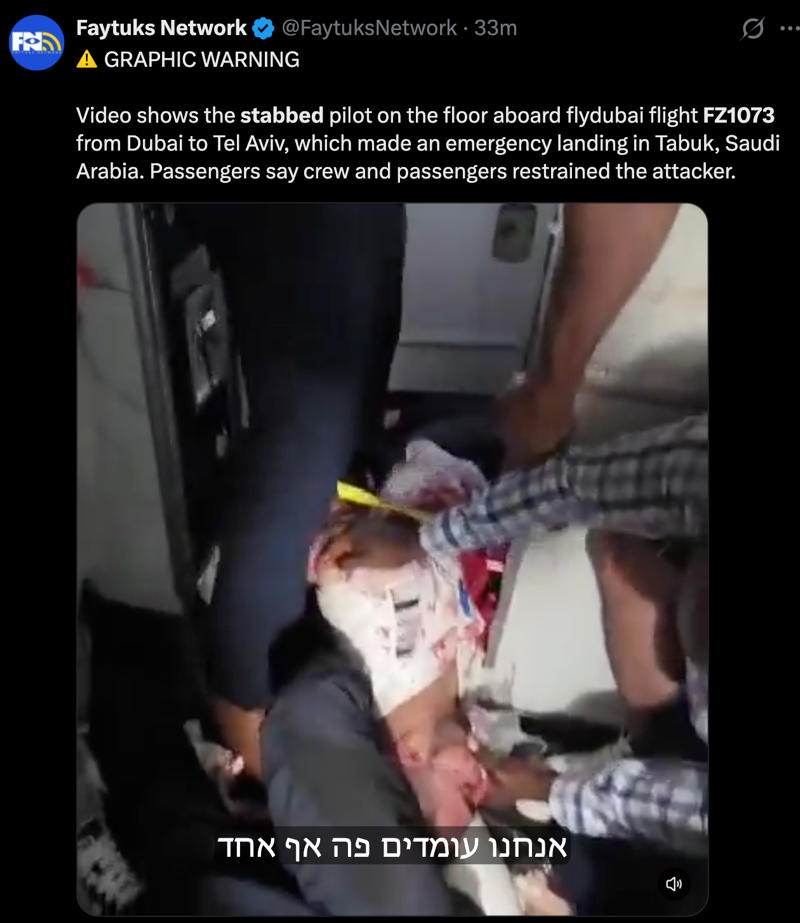
Flydubai Flight FZ1073 was travelling from Dubai to Tel Aviv on September 30 when a violent confrontation erupted inside the cockpit, leaving the captain seriously wounded and triggering a sequence of extreme manoeuvres.
The captain has been identified as Indian national Smit Machchhar, an experienced pilot reportedly credited with using his remaining strength after being stabbed to release the cockpit door. That allowed crew members and passengers to enter, overpower the co-pilot and regain access to the aircraft's controls.
Reuters reported that two other Flydubai pilots travelling aboard the aircraft subsequently took control and landed it safely at Tabuk in Saudi Arabia. All 174 passengers were reported safe. Captain Machchhar underwent surgery and was subsequently reported to be in stable condition.
The alleged attacker, reported to be an Omani national employed as a Flydubai co-pilot, was detained by Saudi authorities.
What investigators have not yet established publicly is why he attacked the captain or precisely what he intended to do with the aircraft.
That distinction is critical. Israeli officials have described the incident as an apparent attempt to crash the aircraft, while Flydubai has cautioned against speculation until investigators establish the circumstances and motive.
The Aircraft Suddenly Plunges
Independent flight-tracking data provides some of the clearest evidence of the severity of the incident.
Flightradar24 records FZ1073 leaving Dubai at 03:05 UTC and climbing normally to 34,000 feet.
At approximately 05:21 UTC, the aircraft began a steep descent, followed by a sharp climb and another descent. It eventually stabilised at approximately 15,000 feet.
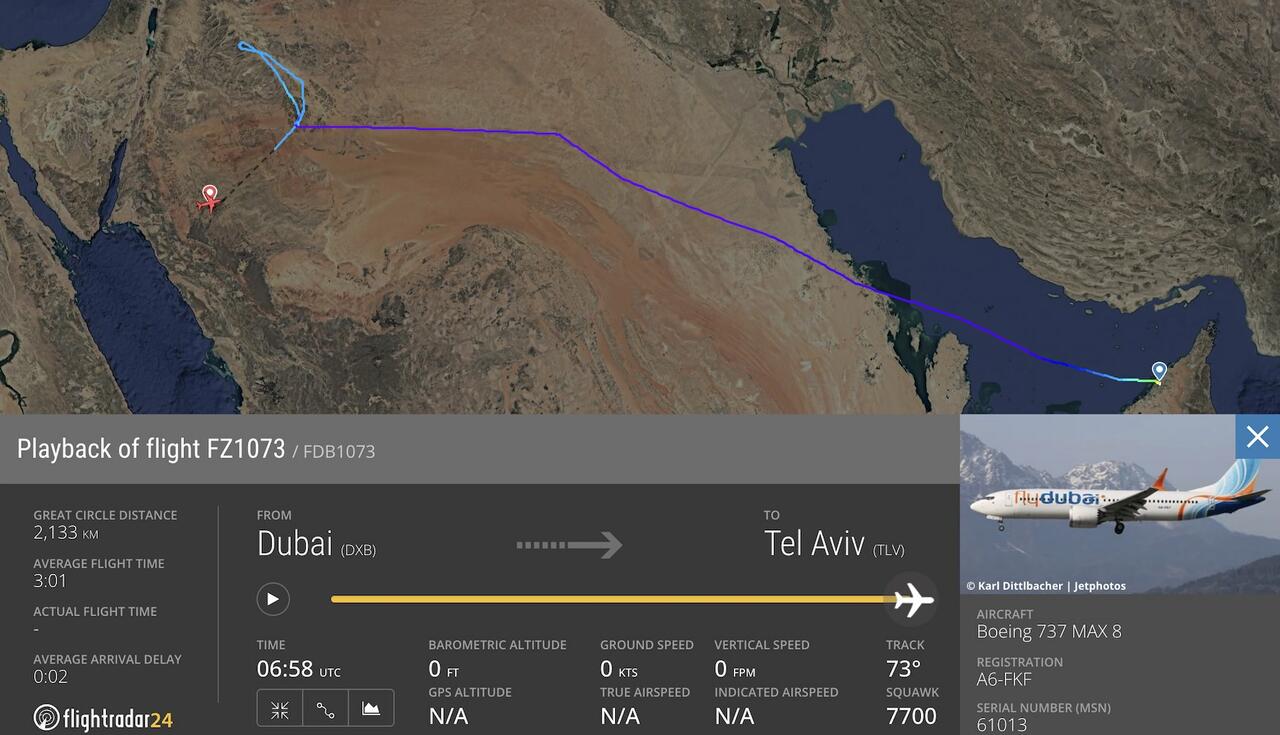
Flight path of Flydubai Flight FZ1073 as the aircraft diverted towards Tabuk, Saudi Arabia. Source: Flightradar24/ZeroHedge.
The aircraft initially transmitted transponder code 7700, the international signal for a general emergency.
Minutes later it transmitted 7500.
That code has a very specific aviation meaning: unlawful interference with the aircraft, commonly associated with hijacking.
FZ1073 briefly entered Jordanian airspace before reversing direction and heading towards Tabuk. The transponder subsequently returned to the general emergency code as the aircraft approached Saudi Arabia.

Flightradar24 altitude data records a series of extreme altitude changes during the emergency aboard FZ1073. Source: Flightradar24/ZeroHedge.
Reports differ slightly on the exact magnitude and duration of the most violent descent because different sections of the flight data are being measured. What is clear is that the aircraft lost many thousands of feet extremely rapidly while the confrontation was occurring inside the cockpit.
Captain Opens the Door
The most consequential action may have been Captain Machchhar's decision to release the cockpit door.
Modern cockpit doors are deliberately designed to prevent unauthorised entry, a security measure strengthened internationally after the September 11, 2001 terrorist attacks.
That protection creates a different problem when the threat originates inside the cockpit.
According to accounts subsequently reported by Reuters and other international media, Machchhar had suffered multiple stab wounds but managed to activate the cockpit-door release.
Doron Spielman, a spokesman for the Israeli Prime Minister's Office, said the captain used his remaining strength to open the door.
That enabled passengers and crew to intervene.
ZeroHedge preserved an X post from Israeli commentator Yoseph Haddad describing the captain's actions and the subsequent intervention.
X post reporting Captain Smit Machchhar's actions aboard FZ1073
The exact sequence inside the cockpit remains subject to investigation, but subsequent reporting indicates the alleged attacker was restrained and two qualified pilots travelling aboard the aircraft were able to take control.
Was Someone Trying to Crash the Aircraft?
This is the central unresolved question.
Israeli Prime Minister Benjamin Netanyahu said one pilot stabbed the other and apparently attempted to crash the aircraft.
Israeli officials and passengers have described attempts to interfere violently with the controls during the confrontation. Some Israeli reporting consequently characterised the incident as a terrorist attack.
ZeroHedge cited Israeli Channel 12 journalist Amit Segal reporting that Israeli authorities were treating the incident as a "full-fledged terrorist attack" and investigating whether the co-pilot intended to take control and crash the aircraft.
X post from Amit Segal reporting the Israeli security assessment
But the available evidence does not yet establish motive.
CNN reported that Israeli sources believed the co-pilot attempted to hijack the aircraft, while noting that investigators had not established whether the objective was to crash the aircraft or land elsewhere and take hostages.
Flydubai itself has been considerably more cautious.
The airline confirmed an onboard incident, the diversion and safe landing, but initially declined to characterise the event as terrorism.
Flydubai's initial statement confirmed the incident, diversion and safe landing while saying authorities were investigating. Source: Flydubai/ZeroHedge.
The United Arab Emirates has opened an investigation into the circumstances and motive, including whether the incident involved terrorism or prior planning.
Until that investigation produces evidence, an attempted deliberate crash is a serious allegation supported by Israeli officials and witness accounts, not yet a final judicial or investigative determination.
The Omani Connection
The reported nationality of the alleged attacker has added another geopolitical dimension.
Israeli and international reports identify him as an Omani national.
Oman does not maintain formal diplomatic relations with Israel, raising questions in Israeli media about how an Omani pilot came to crew a scheduled flight into Tel Aviv.
Nationality by itself, however, establishes neither motive nor political affiliation.
There is currently no publicly established evidence showing that the co-pilot acted on instructions from Oman, Iran, Hamas or another government or organisation.
Those possibilities should remain separate from what investigators have actually established.
Flydubai is based in the United Arab Emirates, which normalised relations with Israel through the Abraham Accords in 2020. Direct commercial aviation between the UAE and Israel became one of the most visible consequences of that diplomatic shift.
An attack deliberately targeting such a flight could therefore carry political significance far beyond aviation security, but that depends upon investigators establishing motive and any wider connections.
A Security System Facing an Insider Threat
The incident also exposes an uncomfortable aviation-security problem.
Much of modern airline security is designed to prevent an attacker reaching the cockpit.
Reinforced doors, restricted access and procedures developed after 9/11 assume that securing pilots from passengers and external attackers makes an aircraft safer.
But the FZ1073 incident illustrates the opposite scenario: what happens when the threat is already authorised to be inside the cockpit?
The 2015 Germanwings Flight 9525 disaster exposed the same structural vulnerability from a different direction. A co-pilot deliberately crashed an Airbus A320 into the French Alps after locking the captain outside the cockpit, killing all 150 people aboard.
FZ1073 appears to have ended differently partly because the wounded captain was able to release the door.
That single action may have transformed a locked cockpit from a potential trap into an opportunity for intervention.
Does This Affect New Zealand?
The immediate incident occurred thousands of kilometres from New Zealand, but the aviation-security question is universal.
New Zealand depends heavily on international aviation. Geographic isolation means international passenger and freight connections are fundamental to tourism, trade, migration and the movement of New Zealanders overseas.
New Zealand aviation security, like systems elsewhere, places enormous emphasis on preventing unauthorised access to aircraft and cockpits.
FZ1073 raises a different question: how should aviation systems manage threats from people who already possess authorised cockpit access?
That involves pilot recruitment and background screening, psychological and behavioural monitoring, cockpit staffing policies, procedures for opening secured cockpit doors during an internal emergency, and international sharing of security information about aircrew.
There is also a practical issue for New Zealand travellers.
Emirates and other Gulf carriers provide major connections between New Zealand, Europe and the Middle East, making Gulf aviation hubs an important part of this country's international transport network. Flydubai itself operates a different network model, but the security environment surrounding the UAE's enormous aviation sector has consequences far beyond the region.
The incident also demonstrates how quickly an aviation emergency can become entangled with geopolitics.
An Indian captain, an alleged Omani attacker, an Emirati airline, an Israel-bound aircraft and an emergency landing in Saudi Arabia brought at least five countries directly into a single event within minutes.
If investigators ultimately establish a terrorist motive, the implications will extend further into airline security, regional diplomacy and intelligence cooperation.
If they establish a different motive, the aviation-security questions will remain.
What is already established is serious enough: a violent confrontation occurred inside the cockpit of a commercial passenger aircraft, the captain was stabbed, the aircraft underwent extreme altitude changes, an unlawful-interference code was transmitted, passengers and crew intervened, and FZ1073 landed safely in Saudi Arabia.
How and why that situation developed is now the critical question.
Independent reporting. Original context. Credited sources.
Sources
Tyler Durden, ZeroHedge, 1 October 2026:
Stabbed Indian Pilot Foils Crash Plot By Crazed Omani Co-Pilot As Jet Plunged 18,000 Feet
Flightradar24, 30 September 2026:
Flydubai Flight to Tel Aviv Diverts to Tabuk Amid Onboard Incident
Reuters, 30 September 2026:
Passengers Foil Bid to Crash Dubai-Tel Aviv Flight, Israel Says
Reuters, 1 October 2026:
Netanyahu and Modi Hail Indian Flydubai Pilot as Hero
The original ZeroHedge material, including its flight-tracking graphics, airline statement and embedded reporting, is preserved in the source supplied for this report. Pasted markdown