A gold-covered sculpture depicting US President Donald Trump naked was displayed inside the European Parliament in Strasbourg this week. Although the exhibition was organised at the invitation of an individual European parliamentarian, its location raises questions about political expression within an institution responsible for representing Europe's democratic interests.
INR Report: Based on reporting by Tyler Durden for ZeroHedge, with additional reporting from The Telegraph.
A Political Statement Inside Europe's Parliament
A 2.6-metre sculpture depicting US President Donald Trump naked, covered in 23-carat gold leaf and sitting on the shoulders of a smaller man was exhibited inside the European Parliament building in Strasbourg, France, from 6 to 8 October 2026.
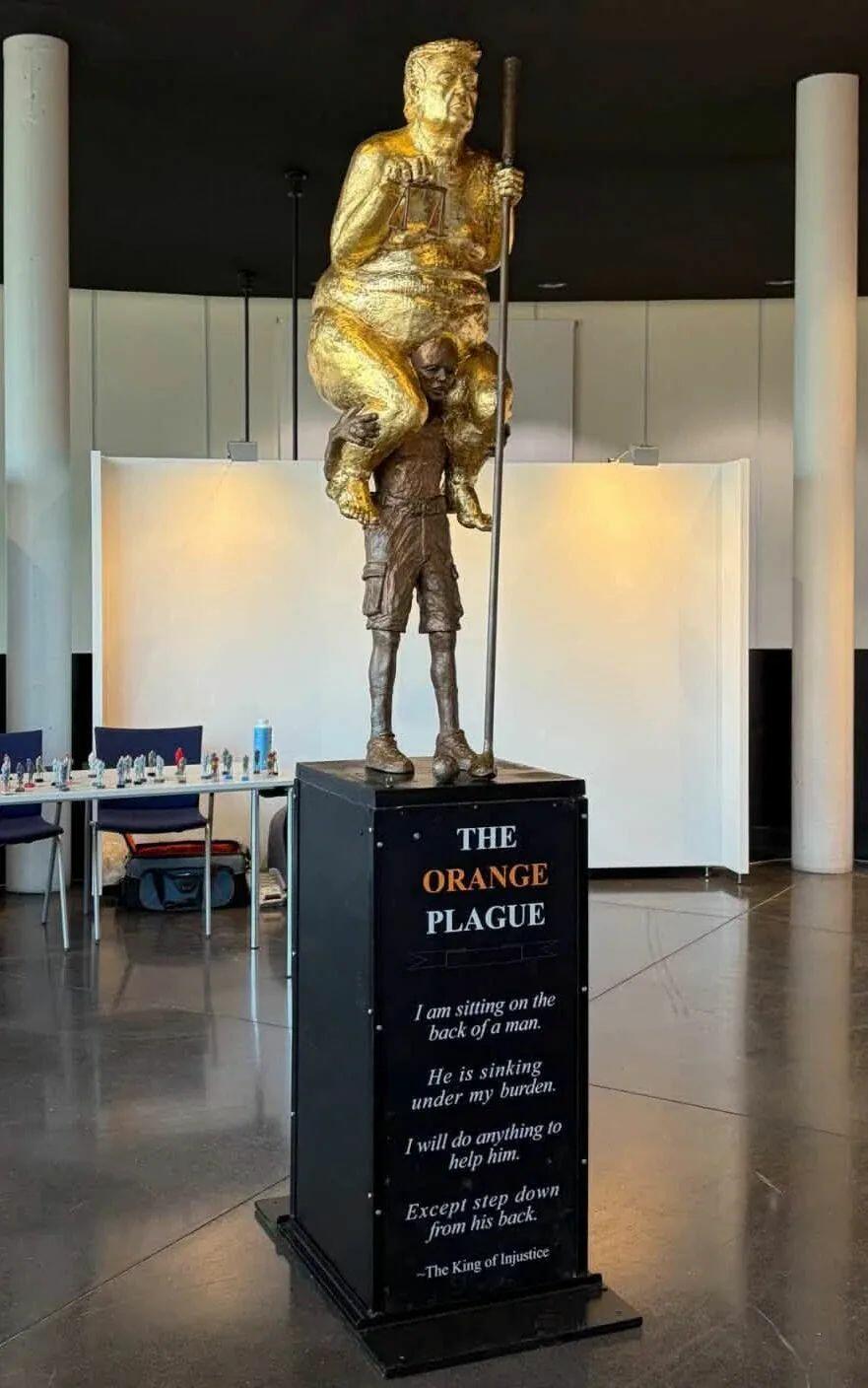
The Orange Plague, a gold-covered sculpture depicting US President Donald Trump, displayed at the European Parliament in Strasbourg. Image: ZeroHedge.
Created by Danish artist Jens Galschiøt, the sculpture is titled The Orange Plague and is also known as King of Injustice.
The artwork depicts Trump holding the scales of justice and an oversized golf club, accompanied by a globe-shaped golf ball.
Beneath him, a smaller man struggles to support his weight.
An inscription on the sculpture's plinth presents the figure as a powerful individual who acknowledges the burden he places on another person but refuses to relinquish his position.
The symbolism is deliberate. The artist portrays Trump as an embodiment of what he considers excessive political power, injustice and disregard for international cooperation.
The sculpture was displayed in a prominent passageway connecting European Parliament facilities, ensuring considerable exposure among parliamentarians, staff and visitors.
Its placement was not accidental.
Who Authorised the Exhibition?
The sculpture was brought into the European Parliament at the invitation of Per Clausen, a Danish member of the European Parliament associated with The Left political group.
Clausen publicly defended the exhibition as a legitimate expression of political criticism.
The important distinction is that the exhibition was initiated by an individual parliamentarian, rather than adopted as an official political statement by the European Parliament.
Reporting indicates that the exhibition was authorised within Parliament facilities, but that the institution did not endorse its political message.
This distinction matters.
The European Parliament contains representatives from competing political movements and viewpoints. Individual members routinely organise exhibitions, discussions and events reflecting their political interests.
Permission to use parliamentary facilities does not necessarily imply institutional agreement with the message being presented.
Nevertheless, allowing an exhibition within a prominent parliamentary space inevitably creates questions about how institutional neutrality is maintained, particularly when the subject is the serving president of a major international partner.
The Artist's Political Message
Galschiøt has explained that his sculpture draws inspiration from Hans Christian Andersen's The Emperor's New Clothes.
In Andersen's story, an emperor is persuaded that he is wearing magnificent garments when he is actually naked. His subjects refuse to acknowledge the obvious until a child publicly challenges the illusion.
Galschiøt uses that allegory to criticise Trump's political leadership.
The artist argues that Trump's policies threaten international cooperation, democratic institutions and efforts to address climate change.
These are the artist's political assessments, rather than findings established by the sculpture itself.
The gold covering is intended to symbolise wealth, privilege and the concentration of political power.
The smaller figure represents those whom the artist believes bear the consequences of decisions made by powerful leaders.
The sculpture is therefore not simply a caricature of Trump's appearance. It is an explicitly political statement about his presidency and the international order.
Political Satire or Institutional Responsibility?
Political satire has a long history in democratic societies.
Political leaders have been mocked through cartoons, theatre, sculpture and public demonstrations for centuries.
Such expression can serve a legitimate democratic purpose by challenging authority and questioning powerful institutions.
The central issue in Strasbourg is therefore not whether an artist should be permitted to criticise Donald Trump.
It is whether the prominent exhibition of an explicitly hostile political caricature inside an international parliamentary institution raises different considerations from displaying the same work in a private gallery or public protest.
Supporters of the exhibition argue that political art belongs within democratic spaces and that public officials should tolerate criticism, including ridicule.
Critics argue that parliamentary institutions should exercise greater restraint when providing prominent facilities for personal attacks on elected foreign leaders.
Both positions raise legitimate questions about the relationship between freedom of expression and institutional responsibility.
The relevant distinction is between permitting political expression and appearing to endorse it.
A Travelling Political Campaign
The Strasbourg exhibition was not the sculpture's first public appearance.
The artwork had previously been displayed in connection with the COP30 United Nations climate conference in Brazil in November 2025.
It also appeared at demonstrations concerning Greenland in Copenhagen during 2026.
The sculpture has therefore become part of a wider international campaign expressing opposition to Trump's policies.
Its appearance inside the European Parliament provided another prominent venue for that campaign.
Reports indicate that miniature reproductions of the sculpture were distributed during the exhibition, extending its message beyond the original installation.
This reinforces the conclusion that the exhibition was intended not merely as an artistic display but as an organised act of political communication.
What Does This Say About European Political Culture?
The controversy illustrates a broader tension within democratic institutions.
European political representatives frequently defend freedom of expression as a fundamental democratic principle.
That principle necessarily protects expression that others consider offensive, insulting or politically objectionable.
However, democratic institutions must also consider how their facilities, authority and public standing are used by individual representatives.
A parliamentary building is not simply another exhibition venue.
It is a place where legislation is debated, political differences are negotiated and international relationships are scrutinised.
When an individual parliamentarian invites an exhibition directly attacking a foreign head of state, questions arise about the distinction between the rights of elected representatives and the responsibilities of the institution hosting them.
The available reporting establishes that the exhibition was permitted.
It does not establish that the European Parliament collectively approved its message.
Nor does it establish that the display has caused measurable diplomatic damage.
Those distinctions are essential to assessing the incident fairly.
Does This Affect New Zealand?
For New Zealand, the immediate consequences are limited.
The exhibition does not alter New Zealand's trade agreements, diplomatic obligations or formal relationships with either the European Union or the United States.
Nevertheless, the controversy highlights an issue relevant to smaller countries whose economic and security interests depend on maintaining constructive relationships with larger international partners.
New Zealand maintains important relationships with both Washington and Brussels.
Disagreements over trade, security, climate policy and international institutions are inevitable.
The manner in which those disagreements are expressed can influence diplomatic relationships, although there is no evidence that this particular exhibition has affected New Zealand's interests.
For New Zealand policymakers, the broader lesson concerns the distinction between political criticism and institutional representation.
Individual politicians are entitled to express strong opinions about foreign leaders.
Public institutions, however, must consider whether the use of their facilities creates an impression of official endorsement.
That distinction is particularly important for smaller countries seeking to preserve independent foreign-policy relationships across competing international interests.
The Question That Remains
The Strasbourg exhibition demonstrates how political art can move beyond galleries and protests into the physical spaces of democratic government.
Its defenders regard the sculpture as legitimate satire directed at a powerful political leader.
Its critics question the judgement involved in displaying such a provocative caricature inside the European Parliament.
The established facts support a narrower conclusion than either political interpretation alone.
An individual European parliamentarian invited the exhibition. Parliamentary authorities permitted it. The artist used the opportunity to communicate an explicitly critical political message about Donald Trump.
Whether that represents an appropriate use of parliamentary facilities remains a matter of legitimate public debate.
The wider principle is straightforward: democratic institutions must accommodate political disagreement while maintaining clarity about whose views they are representing.
Sources
Independent reporting. Original context. Credited sources.