Newly released USAID documents reportedly reveal how the US government agency sought to harness Facebook and WhatsApp to increase Covid-19 vaccine uptake across developing nations. Internal correspondence from 2021 details proposed targeted advertising, behavioural research, automated messaging and partnerships involving technology companies, pharmaceutical interests and international organisations. The documents raise questions about transparency, public consent and the influence of digital platforms on individual decision-making.
INR Report: Based on reporting by RT International. Read the original report HERE.
Inside the USAID Files
More than one gigabyte of internal United States Agency for International Development (USAID) records has reportedly been released by the Trump administration, providing insight into the agency's activities during the Covid-19 pandemic.
Among the documents is a three-page concept note prepared in 2021 by USAID's Center for Innovation and Impact, outlining how Facebook's advertising infrastructure, behavioural data and WhatsApp messaging services could be used to increase demand for Covid-19 vaccines across low- and middle-income countries.
The proposal was developed during the global vaccine rollout, when many developing nations faced supply shortages alongside varying levels of public confidence in vaccination programmes.
The documents provide an opportunity to examine how government agencies and private technology companies sought to influence public health decisions through digital communications.
The Four-Stage Strategy
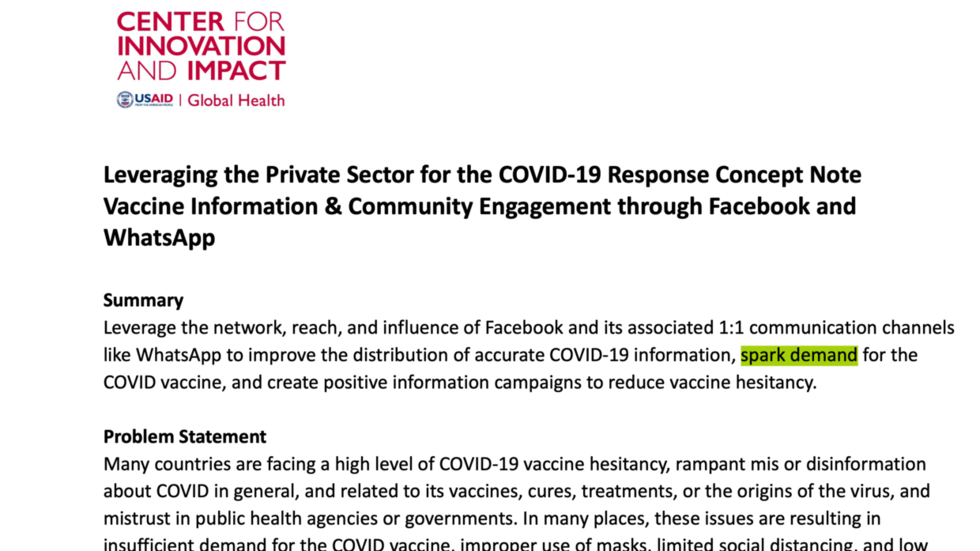
Screenshot of a 2021 concept note prepared by USAID's Center for Innovation and Impact. Source: USAID.gov.
The concept note outlined a four-stage approach to national vaccination campaigns:
- Building public confidence in vaccination.
- Targeting population groups considered at higher risk.
- Encouraging vaccination registrations and appointments.
- Reinforcing behaviour through subsequent messaging.
The proposal drew comparisons with techniques Facebook had previously employed to encourage voter participation during elections.
By combining targeted advertising, behavioural research and follow-up communications, USAID sought to understand how digital platforms could translate public health messaging into measurable changes in behaviour.
The original USAID concept note is available HERE.
Facebook's Direct Involvement
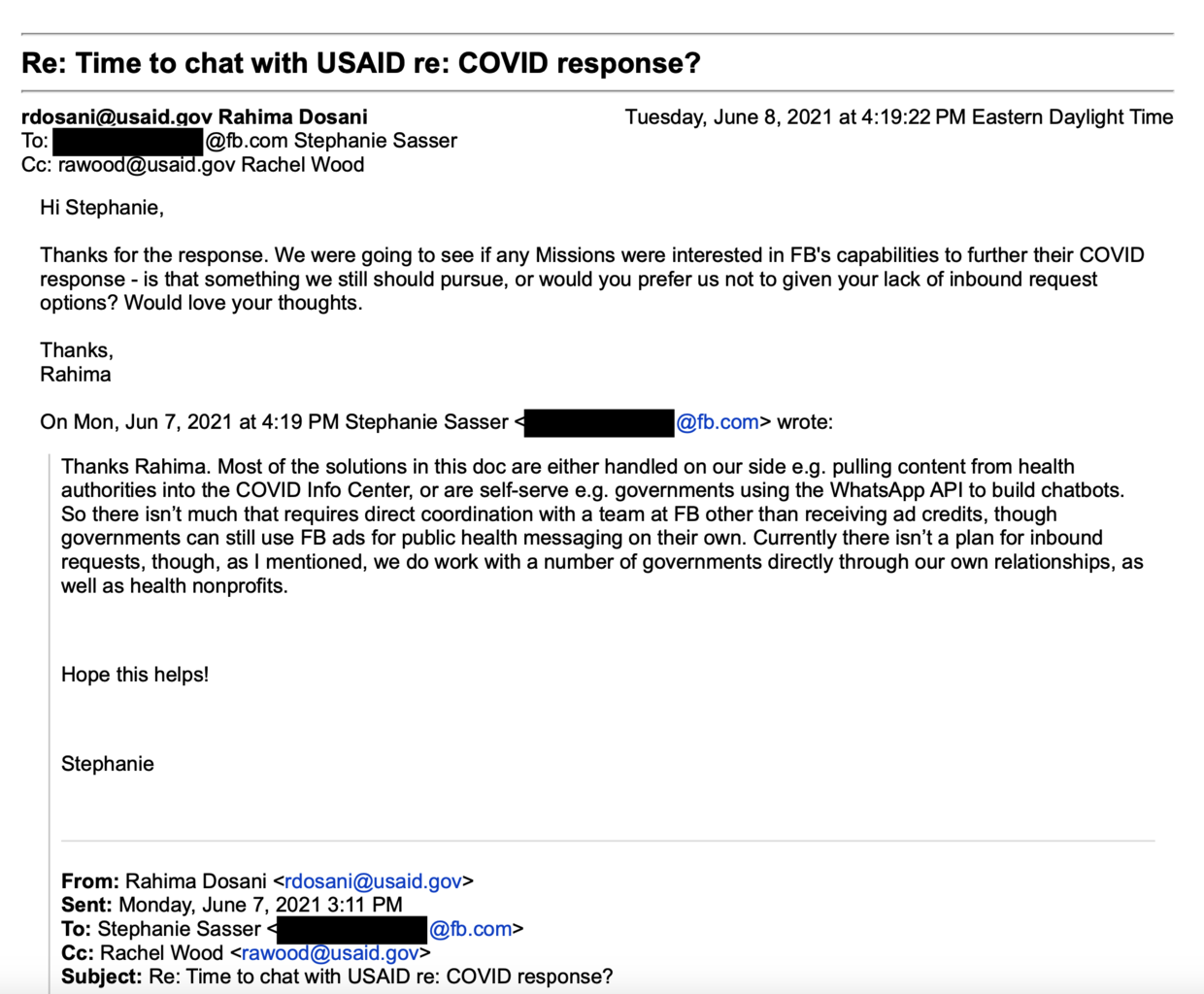
Correspondence between USAID senior market access adviser Rahima Dosani and Facebook representative Stephanie Sasser, 7–8 June 2021. Source: USAID.gov.
Correspondence dated 6 May 2021 shows USAID senior market access adviser Rahima Dosani identifying vaccine hesitancy and demand generation as potential areas of cooperation with technology companies.
Following discussions between USAID and Facebook, representative Stephanie Sasser submitted comments and amendments that were incorporated into the concept note before its proposed distribution to USAID missions overseas.
Subsequent correspondence raised the possibility of Facebook providing matching financial support to governments undertaking vaccination campaigns.
According to the proposal, Facebook had already provided more than US$30 million in advertising credits to governments, non-governmental organisations and other institutions for pandemic-related communications, generating an estimated 10 billion advertising impressions worldwide.
Behavioural Data and Digital Influence
USAID also examined Facebook's Data for Good programme, which conducted surveys across more than 200 countries to investigate factors influencing public attitudes towards vaccination and other health-related behaviours.
Such research could help campaign organisers identify barriers to vaccine uptake, refine their communications and assess the effectiveness of different advertising strategies.
The ability to measure responses to targeted messaging offered governments and organisations a means of evaluating whether communications resulted in changes in public behaviour.
While these techniques have applications in public health, their use also raises questions about transparency, data privacy and the boundaries between public information and behavioural persuasion.
WhatsApp and Government Partnerships
WhatsApp represented another significant component of the proposed collaboration.
According to the USAID documents, the messaging platform had worked with more than 150 governments at various levels, alongside international organisations, to establish Covid-19 information services.
These services had reportedly processed more than three billion messages during the preceding year.
Indonesia, South Africa, Argentina, Brazil and India were identified as examples of countries using messaging services to distribute vaccination information or facilitate registrations.
In Indonesia, approximately 500,000 healthcare workers reportedly registered for vaccination appointments through WhatsApp within five days of the service becoming available.
Facebook, Merck, WHO and the World Bank
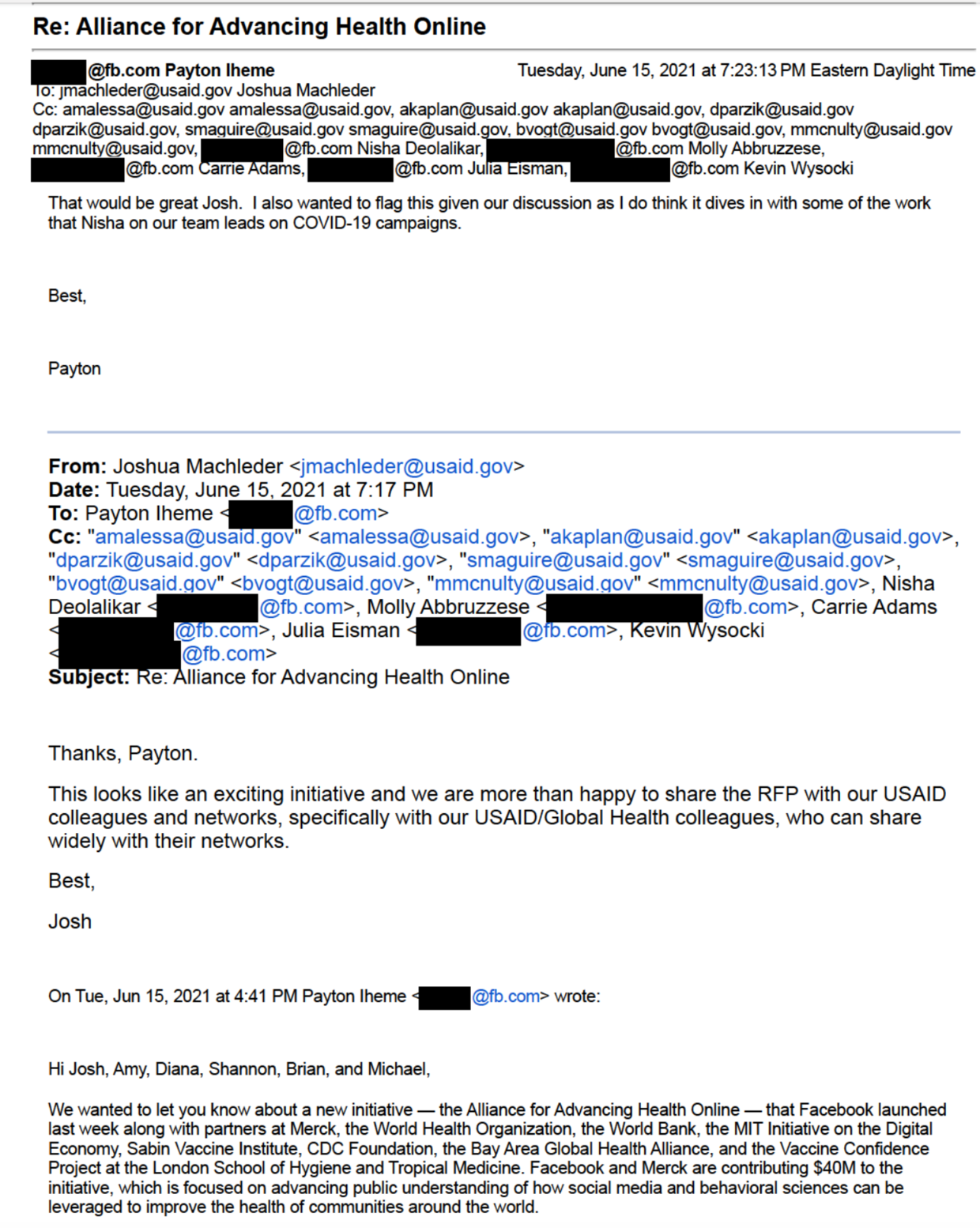
Correspondence between Facebook representative Payton Iheme and USAID senior media and internet freedom adviser Joshua Machleder, 15 June 2021. Source: USAID.gov.
Separate correspondence dated 15 June 2021 reveals discussions surrounding a US$40 million initiative jointly funded by Facebook and pharmaceutical company Merck.
Known as the Alliance for Advancing Health Online, the initiative included partnerships with organisations such as the World Health Organization and the World Bank.
Its stated purpose was to investigate how social media and behavioural science could improve health outcomes internationally.
One of its initial projects offered research grants to examine how digital platforms could strengthen vaccine confidence and increase vaccination uptake.
USAID senior adviser Joshua Machleder agreed to distribute information about the funding opportunity through the agency's international health networks.
The Gates Foundation and Nigeria
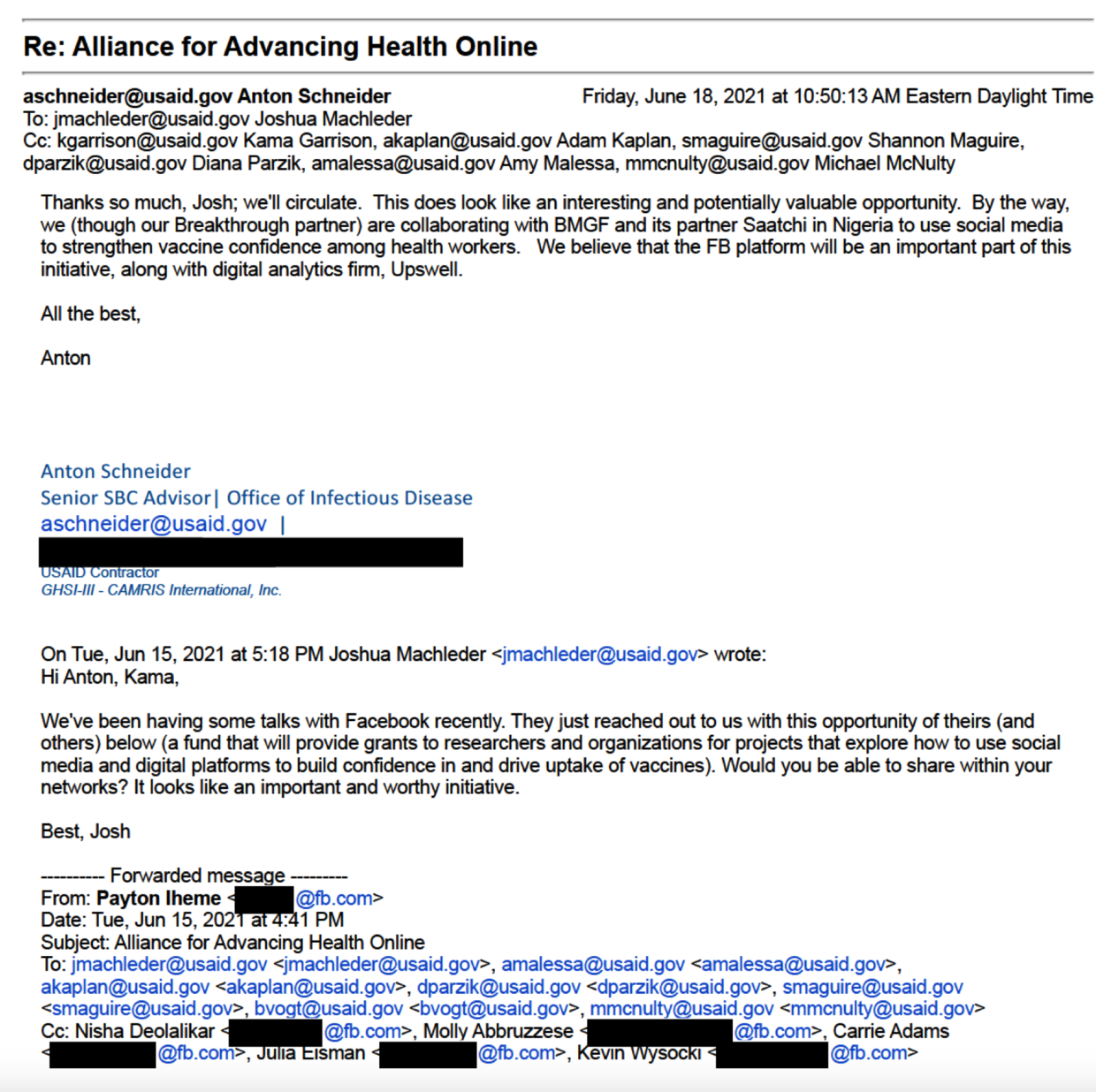
Internal USAID correspondence between advisers Anton Schneider and Joshua Machleder, June 2021. Source: USAID.gov.
The documents also indicate that USAID was already working on a social media campaign in Nigeria in collaboration with the Bill & Melinda Gates Foundation and its partner Saatchi.
In correspondence dated 18 June 2021, USAID behavioural change adviser Anton Schneider explained that the initiative was intended to strengthen vaccine confidence among healthcare workers.
Facebook was expected to play an important role alongside digital analytics company Upswell.
Further correspondence reportedly shows USAID's mission in India exploring similar partnerships involving Facebook, local organisations and UNICEF.
The Scale of the Campaigns
According to a 2023 US Government Accountability Office report cited by RT, USAID-supported Covid-19 vaccination campaigns had reached nearly 178 million people through traditional and social media by November 2021.
The figures cited in the newly released documents illustrate the scale of the wider digital communications infrastructure available during the pandemic.
| Programme or activity |
Reported scale |
| Facebook pandemic advertising credits |
US$30 million-plus |
| Global advertising impressions |
10 billion |
| Facebook and Merck health initiative |
US$40 million |
| Countries covered by behavioural surveys |
More than 200 |
| Governments working with WhatsApp |
More than 150 |
| WhatsApp Covid-19 messages |
More than 3 billion |
| People reached by USAID-backed vaccination campaigns |
Nearly 178 million |
These figures relate to different programmes and reporting periods. Advertising impressions and message volumes do not represent unique individuals or establish how many people were persuaded to receive a vaccination.
Beyond Public Health Messaging
The wider release of USAID records reportedly provides further insight into the agency's relationships with technology companies, including Meta and YouTube, concerning content moderation and efforts to address information classified as disinformation.
According to RT, correspondence from July 2022 indicates that USAID explored cooperation with the Global Disinformation Index (GDI), a British organisation partly funded by George Soros' Open Society Foundations.
The organisation subsequently proposed measures affecting the advertising revenue and online visibility of certain media outlets in Moldova, Armenia and Zambia.
These activities are distinct from the 2021 vaccination campaign proposals but raise related questions about the influence government agencies and private organisations can exercise over digital information environments.
Public Health, Persuasion and Informed Consent
Governments have long used advertising and public information campaigns to encourage behaviours intended to improve public health.
What distinguishes modern digital campaigns is the ability to identify specific audiences, tailor communications, measure responses and refine messaging using behavioural research.
The involvement of government agencies, pharmaceutical companies, technology platforms and philanthropic organisations raises legitimate questions about accountability, transparency and potential conflicts of interest.
Public health objectives do not remove the importance of informed consent, open scientific discussion or the public's ability to scrutinise government policy.
Equally, the existence of a coordinated communications strategy does not, by itself, establish that medical information was false, that vaccines were unsafe or that individuals were unlawfully coerced.
Does This Affect New Zealand?
New Zealand also employed extensive public health advertising and digital communications during the Covid-19 pandemic.
The release of these American documents raises questions relevant to New Zealand's own pandemic response and the relationships between government agencies, advertising companies, social media platforms and behavioural science specialists.
Questions worthy of examination include:
- What behavioural science techniques were employed in New Zealand's Covid-19 communications?
- How much public money was allocated to targeted digital advertising?
- What arrangements existed between government agencies and social media companies?
- What data was collected or used to assess public attitudes and behaviour?
- Were the nature and objectives of these campaigns adequately disclosed to New Zealanders?
- What safeguards protected informed consent, privacy and legitimate public debate?
The supplied USAID documents do not establish that New Zealand participated in the specific programmes described in this report.
However, they provide a basis for examining how similar digital communication techniques may have been employed domestically.
The broader issue extends beyond Covid-19. As governments increasingly utilise digital platforms and behavioural research to communicate with citizens, transparency regarding the methods, funding, objectives and institutional relationships behind those campaigns becomes increasingly important.
Sources