Alex Krainer
Following on from yesterday’s report about the strange relationship between Jeffrey Epstein
and his activities with some of the highest-level political operatives
in Great Britain. A different, but similarly sordid affair has been
brought into the limelight in UK proper, the rape gang affair, which
some have called “the greatest peacetime crime and coverup in British
history.”
As a reminder, starting apparently in the
1970s, gangs of men of Pakistani and Bangladeshi descent systematically
groomed, drugged, serially raped and sold girls from disadvantaged
backgrounds in English towns across the country. The abuse was reported
in 50 towns and cities across the UK. Hundreds of thousands of English
girls were targeted, but this crime was being systematically covered up
and in many cases enabled at every level of the British system,
including social workers, police, media, and public officials including
at least two of Britains prime ministers: Gordon Brown and Sir Keir Starmer.
People wonder: is government organized crime?
The coverup was almost successful, but is now again center stage partly thanks to Elon Musk and partly to independent MP Rupert Lowe
and his independent investigation, much of which was broadcast publicly
on social media. Before the investigation closed, Lowe gave an
interview for the Peter McComrack Show in which he made a number of
statements which, not so long ago, would have seemed off the charts
insane. Today unfortunately, they do not.
For example, Lowe
stated that the “British state has become the enemy of the electorate,”
that fraud, waste and corruption are everywhere, that MPs no longer
represent the people and wondered if the government was organized crime.
In light of the evidence presented, that question is not an
exaggeration - it is entirely appropriate to ask. Lowe further said that
British people are wondering the same, that they “now realized they’d
been hoodwinked into thinking they had a choice,” that they could vote
in change, and that the mood in society is “febrile.”
Loss of legitimacy could lead to civil war
What Lowe discussed seems to dovetail what professor David Betz has been warning about:
namely, that British society is now “explosively configured” to descend
into a civil war which could erupt within the next five years. The
polarization that’s escalating social tensions is driven by the system’s
“destruction of legitimacy.”
Betz explained that the
government itself was doing this through its dual standard justice
system, open borders policy and their inability to protect children from
grooming gangs. Today we know that it wasn’t “inability,” but
unwillingness, which is why the people’s mood is “febrile.”
The chaos will engulf the markets
In
his interview, Rupert Lowe shared some of the same concerns we wrote
about in this report since 2021 and reached conclusions which are almost
identical to ours. All the chaos he sees in the UK will inevitably take
a heavy economic toll on the nation. In fact, Lowe said that Britain
basically doesn’t even have an economy and that it was only a matter of
time before the British pound collapses.
For whatever reason,
capital markets are slow to discount all these developments, but that
doesn’t mean that a crisis isn’t brewing and that at some point we won’t
get an “unexpected” avalanche that will be obvious to all. In their
“collective wisdom,” markets might already be sensing risk and reacting
accordingly, as the chart below reveals:
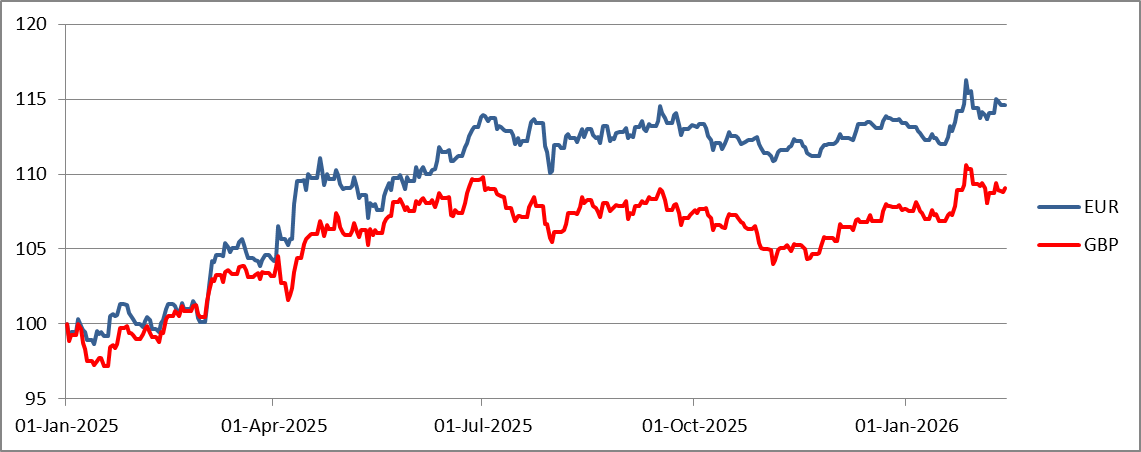
Basically
from the day of President Trump’s inauguration, the US dollar peaked
(the price of euro and pound hit a trough) and since then it has
depreciated by around 15% against the euro, but only about 8% against
the British pound.
Of course, there could be many explanation for
the pound’s underperformance, but here the comparison looks at two
flawed currencies with deteriorating economic fundamentals. The fact
that the pound advanced only a bit more than half the euro’s advance
against the dollar may reflect the markets’ view that the pound and the
British economy are the weakest link among Western economies. This is
exactly what we’ve been predicting since 2021, and five years on, the
markets appear to be converging on our views.