Since
the French Revolution, most violent regime changes have resulted in
terrible, unforeseen consequences, including years of war and civil war
that achieve nothing.
John Leake
The four most expensive words in the English language are “this time it’s different.”
―Sir John Templeton
In her 1983 novel, Sudden Death,
Rita Mae Brown—reflecting on the nature of addiction— wrote that
“Insanity is doing the same thing over and over again, but expecting
different results.” The quotation is frequently misattributed to Albert
Einstein.
In 1790, Edmund Burke, a Member of Parliament, published his pamphlet Reflections on the Revolution in France,
in which he set forth his reasons for believing that the violent
overthrow of the Bourbon King Louis XVI would be a disaster for France
and all of Europe. His primary intention was to persuade his Whig Party,
especially his close friend and former ally, Charles James Fox, to drop
their support for the revolutionaries.
Burke—who had vociferously argued that King George III should recognized the perfectly legitimate
grievances of the British colonists in North America—regarded the
French revolutionaries as dangerous radicals who would unleash chaos,
war, and bestial lawlessness.
With amazing prescience, he
predicted the Reign of Terror. He also had the following to say about
who would ultimately bring an end to the chaos in France.
In
the weakness of one kind of authority, and in the fluctuation of all,
the officers of an army will remain for some time mutinous and full of
faction until some popular general, who understands the art of
conciliating the soldiery, and who possesses the true spirit of command,
shall draw the eyes of all men upon himself. Armies will obey him on
his personal account. There is no other way of securing military
obedience in this state of things. But the moment in which that event
shall happen, the person who really commands the army is your master—the master (that is little) of your king, the master of your Assembly, the master of your whole republic.
At
the time Burke penned this, he knew nothing about the young Corsican
artillery officer, Napoleon Bonaparte, who graduated from the École
Militaire in Paris in 1785. What Burke did understand—far better than
most so-called educated people—is human nature and the complex system of
a large society.
Not only did Napoleon become France’s master,
he also became the master of much of Europe from 1803 - 1815, thrusting
the Continent into constant warfare, killing millions of young soldiers
and civilians.
Burke’s thesis is that it is impossible to
overthrow a long established order without producing a host of
unintended, terrible consequences. The schemers who do this will, based
on crude
speculations of a contingent
improvement … tear asunder the bands of their subordinate community and
to dissolve it into an unsocial, uncivil, unconnected chaos of
elementary principles … [resulting in an] antagonist world of madness, discord, vice, confusion, and unavailing sorrow.
I
cannot think of a better description of what happened to Iraq, Libya,
Syria, and Afghanistan after the U.S. government overthrew the long
established regimes of those countries.
This morning I did a
quick assessment of the following violent regime changes since Louis XVI
was executed in 1793, after which Napoleon Bonaparte came to power and
thrust Europe into years of terrible warfare.
- 1914: Austria tries to overthrow King of Serbia, which leads to World War I and millions dead. Epic Fail.
- 1917:
Idiot schemers in German government give Vladimir Lenin safe passage
from his Swiss exile back to Russia to overthrow the Russian Provisional
Government and take Russia out of the war. Lenin succeeds, but then
unleashes the worst regime in history on Russia—a regime that
subsequently threatened all of Europe. Epic Fail.
- 1919-1920:
Following World War I, punitive treaties formally dissolve Habsburg,
Hohenzollern, and Ottoman regimes. Europe and the entire Middle East are
further destabilized, leading directly to World War II. Epic Fail.
- 1953: The CIA and British intelligence orchestrated Operation Ajax,
a covert coup to overthrow Iran's democratically elected Prime
Minister, Mohammad Mossadegh, replacing him with a dictatorship under
Shah Mohammad Reza Pahlavi. Epic Fail
- 1963: CIA
backs military coup to overthrow South Vietnamese President Ngo Dinh
Diem, thereby deepening U.S. involvement in Vietnam. Epic Fail.
- 2001-2021:
U.S. occupation of Afghanistan, resulting in tens of thousands dead,
tens of thousands of traumatic brain injuries, and trillions spent,
achieves nothing, leaves Taliban in power. Epic Fail.
- 2003: Overthrow of Saddam Hussein unleashes years of violence, chaos, and ISIS on Iraq and strengthens Iran. Epic Fail.
- 2011:
U.S. leads military action to overthrow Libyan dictator Muammar
Gaddafi, unleashing a civil war and humanitarian crisis that persists to
this day. Epic Fail.
- 2011-2026: U.S. support of Islamic
terrorists to overthrow Bashar al-Assad of Syria thrusts country into
years of civil war and unleashes a massive refugee crisis with
catastrophic consequences for Europe. Epic Fail.
- 2014:
U.S. National Endowment for Democracy (NED)—long suspected of being a
CIA front organization—provides key support for Euromaidan protests that
oust Ukrainian President Victor Yanukovich, who sought better relations
with Russia to prevent Ukraine from being made into a NATO proxy. Epic
Fail.
Reviewing this dreary history, it occurs to
me that the one time that vigorously supporting the violent overthrow
of an existing regime would have made perfect
sense was the July 1944 German military officers plot to overthrow
Hitler. Claus von Stauffenberg and his fellow plotters were reasonable
and decent men.
However, British and U.S.
intelligence offered zero encouragement to these men and their liaison
Otto John—a lawyer for Deutsche Lufthansa's legal department in
Madrid—who sought to form an alliance with British intelligence.
Moreover, in 1943, Roosevelt and Churchill announced their idiotic
proclamation of “Unconditional Surrender” to appease Stalin, thereby handing the Nazi regime its best propaganda material of the entire war.
This
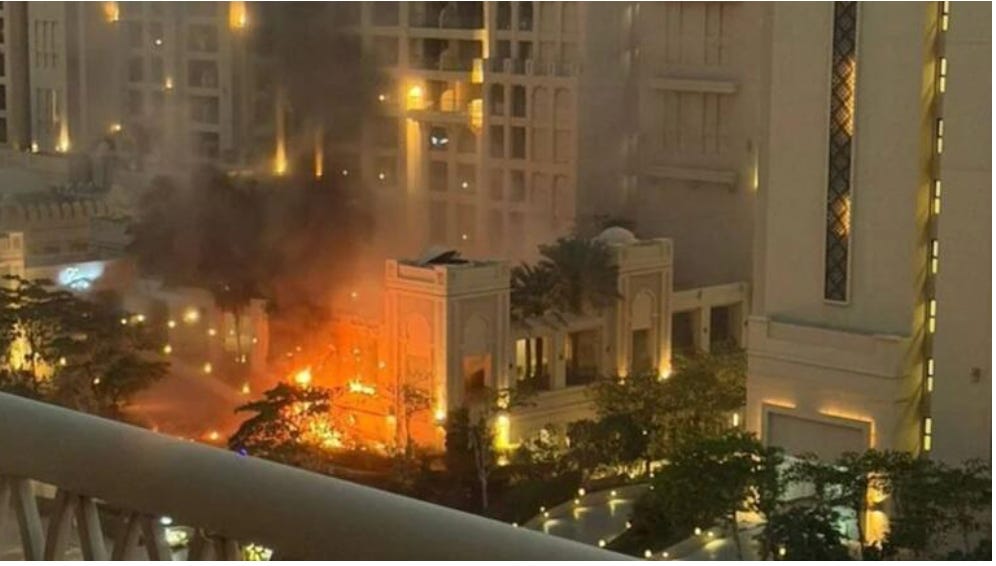
morning I woke up to the news of “Operation Epic Fury”—the latest
regime change war in Iran. Especially distressing is the news of how
quickly the destruction has spread to other countries in the region,
including the UAE city of Dubai.
We
are assured that “this time it will be different”—that all will go
smoothly and that a new era of freedom and prosperity shall now dawn in
Iran and the broader Middle East.
I sure hope so, but I doubt it.