Alex Krainer
Following on from yesterday’s discussion, Mario Nawfal pointed out during our interview on Wednesday
that crude oil prices were actually falling, suggesting the Middle East
situation was under control and that commercial shipping would soon
normalize. The markets were seemingly converging on that view. Namely,
on Monday, 9 March, the Brent crude oil price spiked, reaching almost
$120/bbl during the morning hours - more than $26/bbl above Friday’s
$93/bbl close.
But from there it corrected sharply, falling
below $83/bbl on Tuesday, which was more than $10 below Friday’s close.
Of course, such volatile gyrations generate a lot of commentary and
premature jumping to conclusions. What I tried to convey to Mario Nawfal
and his audience was that we shouldn’t read too much into such
short-term developments.
We’re in for unexpected surprises
As
readers of this newsletter know, large-scale price events (LSPEs)
almost invariably unfold over intervals that can span months or even
years. That’s the way this Iran episode will likely play out. In
yesterday’s article I discussed the reasons why I believe that the
current war might not conclude on the Trump administration’s desired
schedule but on the basis of Iran’s strategic objectives, which could
take months or years to accomplish.
This is why the Hormuz
disruption could be long-lasting, and the markets will have plenty of
time to digest it and react accordingly. Unfortunately for the rest of
us, markets often overreact, implying that we could be in for unexpected
surprises to the up-side. As the process unfolds, narratives will catch
up to explain the price action and predict what happens next.
In markets, prices lead and narratives follow
It
has long been my contention that in securities markets, prices lead and
narratives follow, as I summed up in this 2016 article: “Market facts vs. market narratives.”
Once we are aware of this, we can see it happen again and again. In
addition to the examples I discussed in the linked article, I
highlighted another case in point with crude oil in 2023: as the price
of a barrel rallied from the low $70s in June to the mid-$90s in
September, analysts accompanied the move with a slew of reports and
commentary explaining why this was happening.
On 23 September 2023, a ZeroHedge headline read, “US Shale Giant Agrees With JPMorgan: Oil Headed For $150“.
The article laid out the market fundamentals that would propel the oil
price toward JPMorgan’s target, but—surprise, surprise—that never
happened. On the other hand, had the oil prices crashed, all the reports
would be explaining the reasons why it crashed. The whole point of all
that intellectual busywork is to forecast future price events, which is a
total waste of time and effort.
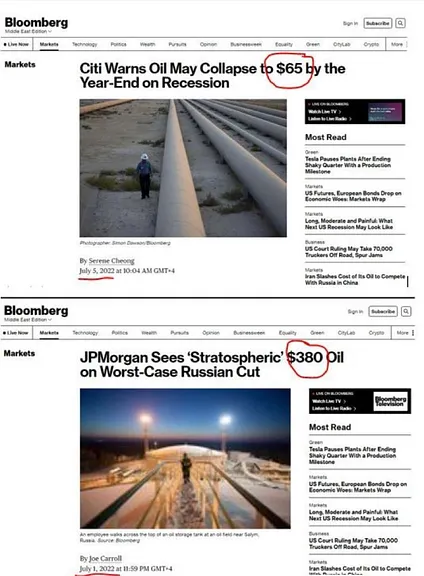
Consider two articles that
were published by Bloomberg, four days apart, in the summer 2022.
Citi’s and JPMorgan’s learned analysts looked at the same market, did
their homework and reached radically different conclusions:
Secular nonsense
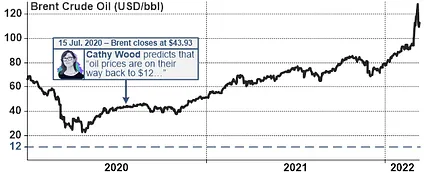
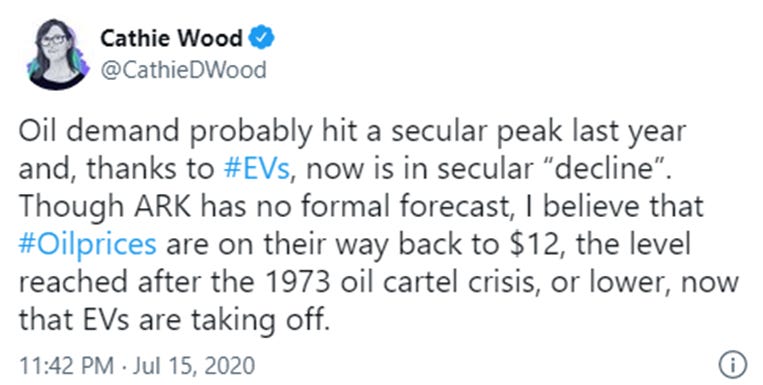
Not to be forgotten, in 2020, the former next Warren Buffett, Cathie Wood made her own genius forecast that oil would go down to $12/bbl. That never happened either:
All
these brainy narratives and predictions are duly reasoned by
authoritative market analysts, who are armed with all the market
intelligence that money can buy and always sound like they’re much
smarter than you are.
It’s
not disappointing that Ms. Wood got that secular forecast wrong. What’s
disappointing is that she made the forecast in the first place. In the
end however, some analyst will prove right in their forecasts and then
they’ll probably be paraded in the financial press as “the analyst who
predicted XYZ.. now they are saying that such and such will happen...” This
kind of thing has been going on forever, but from an investor’s point
of view, it’s all worth less than zero. It’s literally better to practice calligraphy than to listen to all the nonsense.
LSPEs unfold as trends
The
indisputable fact about markets is that large-scale price events unfold
as trends over months and years. Earlier this month we discussed how
the price of gold languished for nearly three years in a horizontal
range between $1,800 and $2,000 per troy ounce. Today it is trading
above $5,000/tr.oz. That LSPE didn’t happen overnight; it spanned two
years and it unfolded as a trend. We should expect the same process to
unfold in energy markets. The long-term chart of oil prices is why I
suspect that we ain’t seen nothing yet:
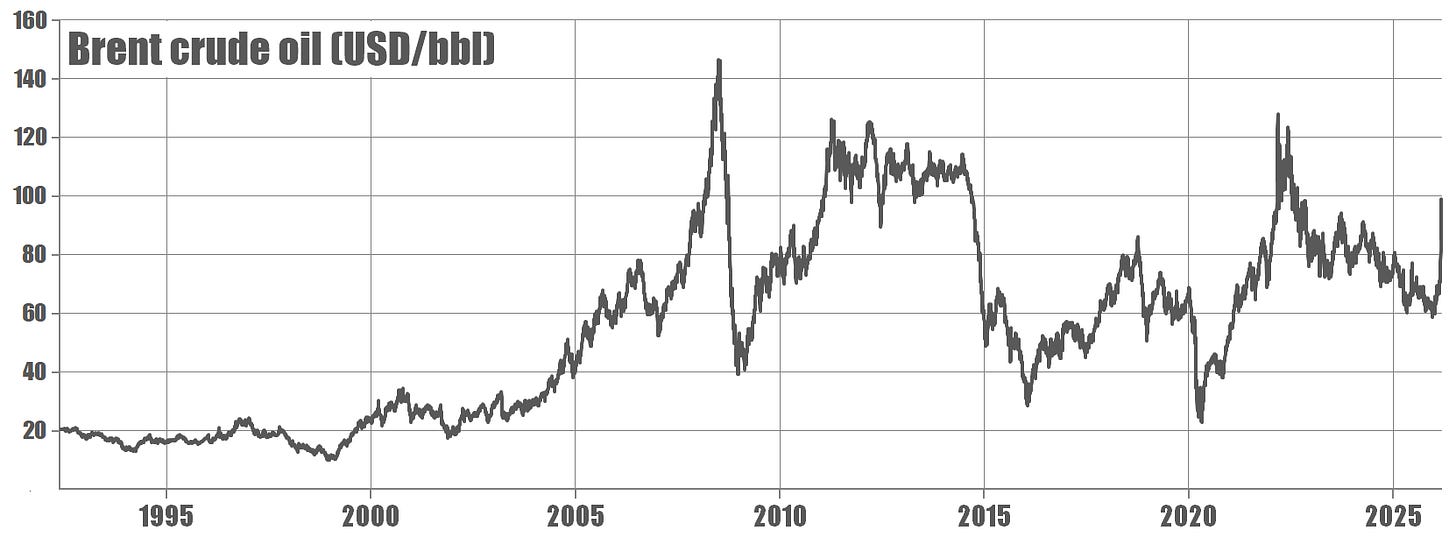
Today,
a barrel of Brent crude trades at around $100 which, in view of the
last 15 years of price action isn’t especially high, despite the fact
that those 15 years never saw anything remotely similar to the Hormuz
disruption that suddenly took about 20% of the world’s oil supply off
the market and which might not normalize in the short term.
That
suggests that the markets haven’t properly digested what just happened.
They are like that Tomas and his family enjoying their lunch as an
avalanche is barreling at them. The Hormuz disruption will almost
inevitably drive the next LSPE to levels we have not seen before. Nobody
could predict whether this might be $150, $380, or $500 per barrel,
but we shouldn’t be surprised if the trend triggered by the war in the
Middle East runs for many months. Unexpected surprises could be up
ahead.