The Islamic Republic will likely become much stronger, but also more moderate, free, and open.
John Leake
It
seems to me that the history of Iran between 1941 and 1979 was
dominated by the drama of the British, Americans, and Russians coveting
the nation’s vast and strategically located oil reserves. As I mentioned
in an earlier column, I was surprised to learn that Iranian Light is
almost as valuable as West Texas Intermediate.
Iran's main oil
fields are concentrated in the southwestern province of Khuzestan and
the Persian Gulf, with key onshore fields like Ahvaz, Gachsaran, and
Marun dominating production. Roughly 90% of Iran's crude exports pass
through Kharg Island, the primary export terminal located in the
northern Persian Gulf.
It’s hard to quantify the sheer vastness
of this prize. IF the Iranians had been allowed to sell this oil on the
open market, without the crippling sanctions imposed by the US, Britain,
and the EU, it would have become an extremely wealthy country.
The
oil fields were why Great Britain and the Soviet Union invaded Iran in
1941 with the handy excuse that they needed the oil to fuel the Red
Army’s fight against Germany.
After the war, the oil fields were
the prize that the Anglo-Persian oil company wished to keep for itself.
The following history of company is very interesting.
Naturally
the West was badly butt-hurt when Ruhollah Khomeini led a popular
revolution to throw out the Shah, who had served as a British-US puppet
since the British invaded in 1941.
The Iranian oil fields were
also the prize that Iraqi dictator Saddam Hussein sought when he invaded
Iran in 1980 with billions of US aid, dual-use technology, and
intelligence to Iraq to ensure it could maintain military capacity. I
suspect the US plan was to use Saddam as the attack dog and then strike a
deal with him to share the loot if he won the war against Iran.
After
Saddam withdrew his forces in 1988, in effect losing the war, he
complained to George H.W. Bush that Iraq was financially ruined by the
war, and he blamed neighboring oil producers—especially Kuwait—for
worsening the situation by horizontal drilling into Iraq’s reserves.
Saddam’s complaint was the basis for his 1990 invasion of Kuwait. At
that point, he outlived his usefulness to the US, and so instead of
supporting him, the US reversed its policy and made him the bogeyman.
When
evaluating the Iranian regime, it is important to understand that its
militarism and repressive policies are actually fostered by the exertion
of outside pressure on the country. Sanctions and attacks on the
Iranian currency by the US Treasury Department cause economic hardship
for moderate people who yearn for a more open society.
My mother’s
early American ancestors were members of the Puritan congregation of
Plymouth and Massachusetts Bay. With increasing prosperity and trade in
the 18th century, they ditched their austere Calvinism and became far
more secular and worldly. The same process was evident in Amsterdam and
the Hanseatic cities of Germany. Trade and interaction with the rest of
the world foster openness and liberality.
The US and Israeli
strategy of sanctions, threats, and attacks has apparently only
strengthened the position of militant hardliners in Iran while making
the middle class anemic.
Currently, it appears that China is
making moves to bring Iran out of a state of siege and into the world of
trade, unencumbered by sanctions. President Trump has acknowledged that
China was instrumental in getting Iran to agree to the cease fire and
to meet Kushner, Witkoff, and Vance in Islamabad.
Given that the
US and Israel attacked Iran while its Foreign Minister was in Europe to
meet with Kushner and Witkoff, one can imagine that the Iranians have
zero trust in these guys.
The most pressing question at the
moment is whether Iran will agree to drop its demand that Israel stop
attacking Lebanon. JD Vance made a fool of himself by claiming that the
Iranians had simply misunderstood that Israeli operations in Lebanon
weren’t part of the ceasefire. It remains to be seen whether the
Iranians will play along with this charade.
It appears that China
may be pressuring Iran to drop support of its Hezbollah proxy in
Lebanon and to make other concessions to the US in return for the
economic sanctions being lifted.
Another obvious sticking point
is the 440 kilograms of 60% enriched uranium that Iran still has in its
possession. It appears that F-15 shot down on April 3 may have been part
of a high-risk special forces operation to seize Iran’s enriched
uranium stockpile that went awry.
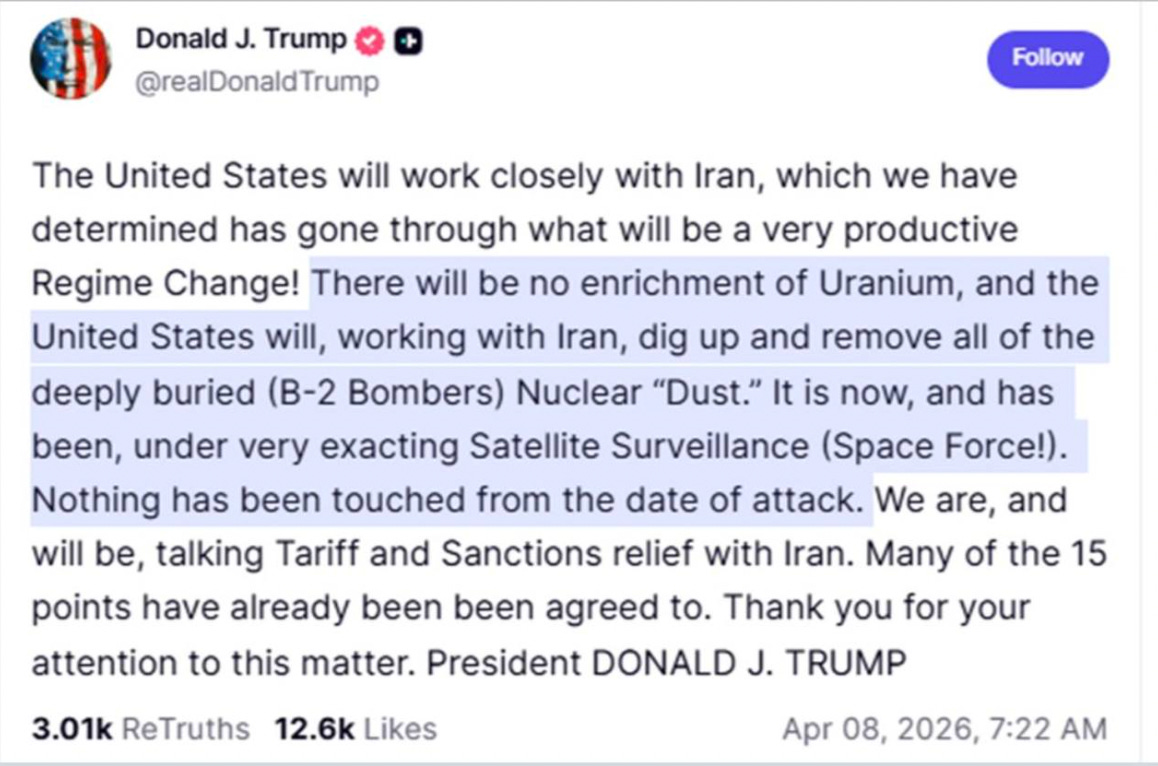
For his part, Trump
recently claimed in Truth Social post that Iran’s uranium remains
pulverized and lying under the rubble of last summer’s Operation
Midnight Hammer. If this assertion is true, it’s further proof that the
threat of “imminent” nuclear attack as the casus belli in February was a lie.
Now
that Iran has been attacked simultaneously by two nuclear-armed powers,
with President Trump issuing a threat to end Iranian civilization
forever, it seems very unlikely that Iran will give up its uranium. On
the contrary, it will likely conclude that nuclear weapons are essential
for deterring further aggression from the US, just as North Korea long
ago concluded.
Since North Korea obtained and successfully tested
a nuclear weapon in 2006, its dynastic dictator, Kim Jong Un—widely
regarded as aggressive and unpredictable—has repeatedly threatened
“shocking and unimaginable disaster,” and “total destruction” of the
United States if it takes military action against North Korea. Despite
his threats, most military analysts believe he is a rational actor who
understands the doctrine of Mutually Assured Destruction (MAD) and
therefore maintains nuclear weapons as a means of deterrence rather than
suicidal aggression.
The proposition that Iran wishes to acquire
nuclear weapons in order to use them in offensive attacks against
Israel and the United States has never seemed plausible to me. An
offensive attack would result in Iran’s prompt and utter destruction by a
US counterstrike and Israeli counterstrike launched from its Dolphin
class submarines armed with nuclear missiles.
The assertion that
the Iranians are irrational actors who do not recognize and respect the
MAD doctrine strikes me as no more credible than George W. Bush’s 2002
proclamation that leaving Saddam Hussein in power would soon result in
“a mushroom cloud over Manhattan.”
The Chinese—who strike me as
far more calculating and coolheaded than the foul-mouthed clowns in
Washington— have made huge investments in Iran, and they appear
confident that Iran has no desire or intention to destroy itself by
launching nuclear attacks against Israel and the US.
Increasingly,
it seems to me that the war against Iran is a classic example of the
so-called Thucydides Trap — that is, a war that occurs when a rising
power threatens to displace an established ruling power. Derived from
ancient Greek historian’s analysis of the Peloponnesian War in which
Sparta became increasingly alarmed at the rise of Athens, and ultimately
declared war against the city-state.