Source:
Author: John Leake
The unique and virulent epidemic that erupted in Brooklyn in May–June 1916 has long been a fascinating mystery. A 2011 paper presents a plausible solution.
Last year, while researching polio for Vaccines: Mythology, Ideology, and Reality, attention was drawn to the unusual characteristics of the 1916 epidemic of paralytic polio in New York City.
The outbreak began in a poor Brooklyn neighbourhood, largely inhabited by recently arrived Italian immigrants. Conditions were overcrowded and unsanitary, with the nearby Gowanus Canal heavily contaminated by raw sewage.
Despite these environmental factors, the outbreak exhibited a highly unusual pattern.
It spread from a distinct epicentre outward — similar to earlier outbreaks such as the 1854 London cholera epidemic documented by Dr. John Snow.
Epicentre of the Outbreak
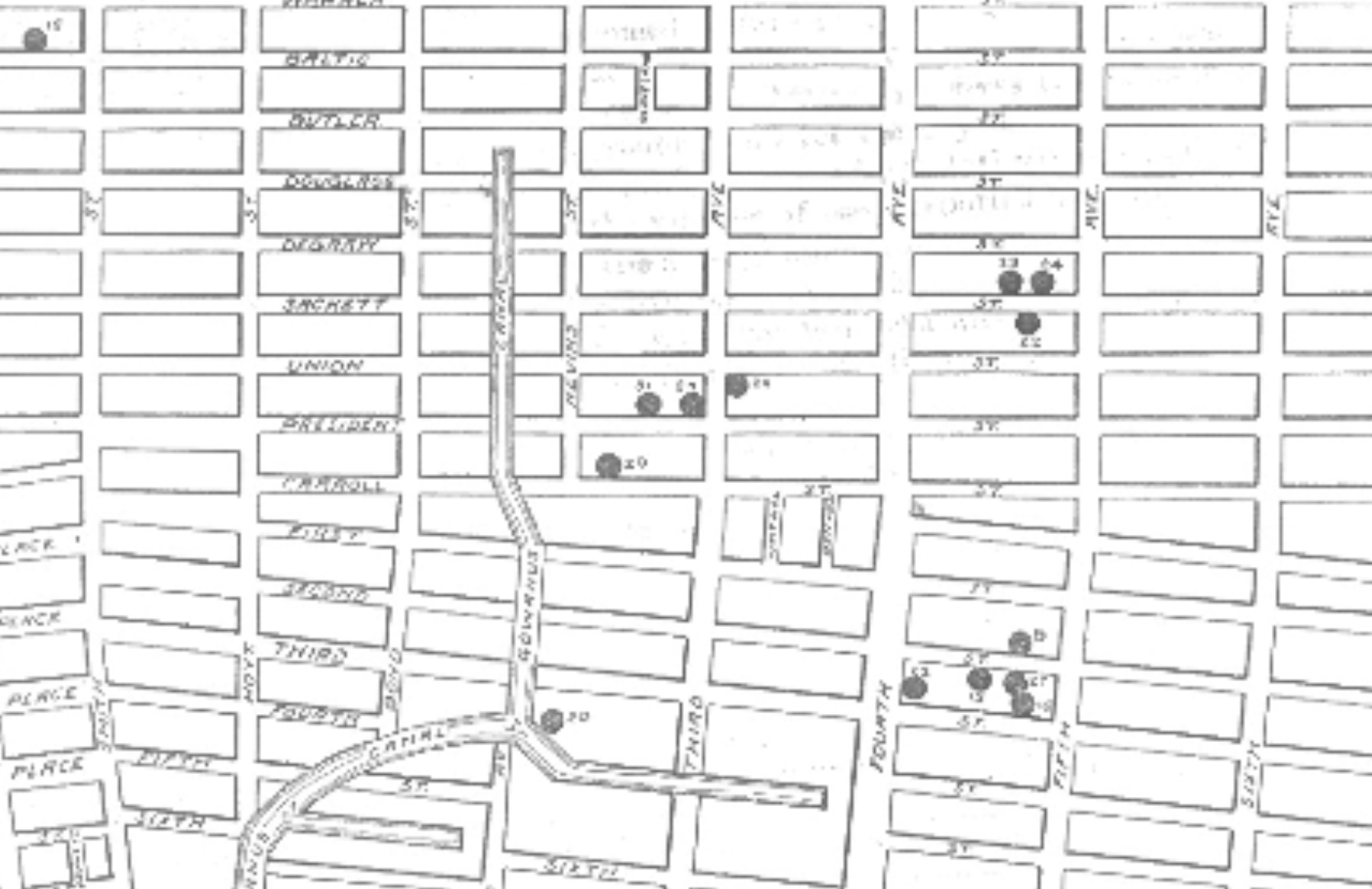
First documented cases of the 1916 Brooklyn outbreak
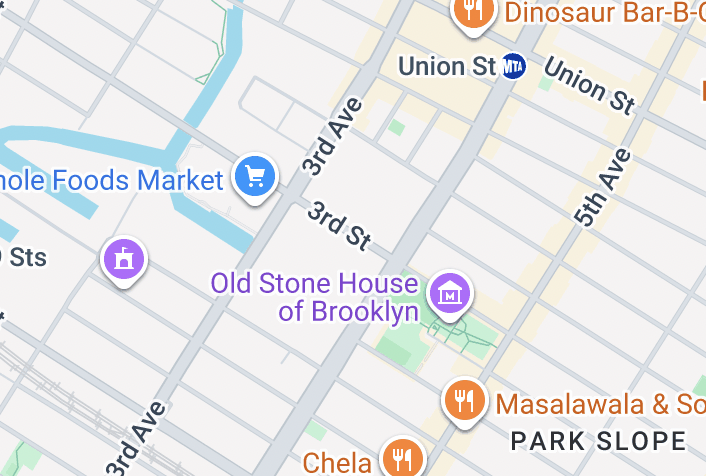
Google map of the neighborhood today
The spread pattern strongly suggests a central origin point rather than random environmental exposure.
Understanding the Nature of Polio
Polio is a complex disease:
- Around 75% of infections show no symptoms
- Around 25% show mild flu-like symptoms
- Only a small fraction (1 in 200 to 1 in 2000) develop paralysis
This makes epidemic behaviour difficult to interpret.
Historically, polio was widespread but mild in early childhood, with severe outbreaks becoming more common only in the late 19th and early 20th centuries.
This shift has been linked to improved sanitation reducing early exposure and natural immunity.
Why the 1916 Outbreak Is Different
The 1916 outbreak stands out because:
- It occurred in a population likely already exposed to polio
- It spread rapidly across boroughs
- It followed a distinct radial pattern from a central point
- It caused unusually high levels of severe disease
These factors suggest the possibility of a novel and highly virulent strain.
Alternative explanations such as environmental toxins or misdiagnosed illnesses do not fully explain the observed pattern.
The Rockefeller Institute Hypothesis
A 2011 paper by Harold V. Wyatt introduces a controversial but intriguing possibility.
At the time of the outbreak:
- Researchers at the Rockefeller Institute were actively experimenting with poliovirus
- The virus was being passaged through monkey spinal tissue
- Mutations may have occurred during these experiments
Wyatt proposes that:
“An animal-house worker might have been infected during a post-mortem examination… with accidental carriage into a household in Brooklyn and further dissemination in the community.”
This suggests a potential early example of a laboratory-associated outbreak.
Supporting Context
The Rockefeller Institute was located just three miles from the outbreak epicentre.
Transport links connected Manhattan directly to Brooklyn, providing a plausible pathway for transmission.
The hypothesis suggests that:
- A mutated strain escaped laboratory conditions
- It entered a susceptible population
- It spread rapidly before adapting and losing its unique characteristics
Full Paper Reference
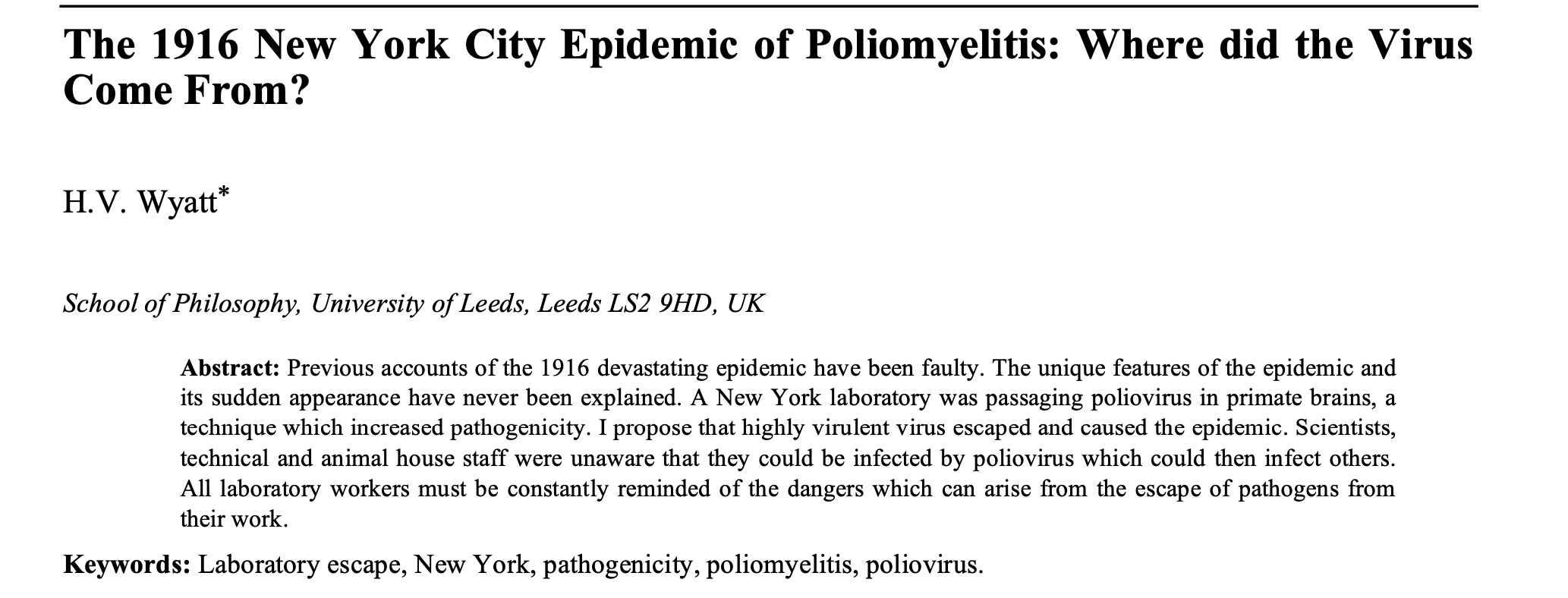
Click image to view the full paper
Read the full paper here:
https://benthamopenarchives.com/contents/pdf/TOVACJ/TOVACJ-4-13.pdf
Key Takeaway
The 1916 polio epidemic remains one of the most unusual outbreaks in modern medical history.
While definitive proof remains elusive, the evidence suggests:
- A distinct origin point
- A highly virulent strain
- A spread pattern inconsistent with normal environmental transmission
The possibility of a laboratory-associated origin cannot be dismissed.
References
[i] https://www.cdc.gov/polio/about/index.html
[ii] https://babel.hathitrust.org/cgi/pt?id=uc1.b3208372&view=1up&seq=389&skin=2021
[iii] https://web.archive.org/web/20110524151308/http://whqlibdoc.who.int/hq/1993/WHO_EPI_GEN_93.16_mod6.pdf
[iv] https://pubmed.ncbi.nlm.nih.gov/26508622/
Disclaimer
This article is based on historical analysis and published research. The hypotheses discussed are part of ongoing academic debate and should be interpreted within that context. This content is provided for informational purposes only and does not constitute medical or scientific advice.