Author: RT Newsroom
RT presents the Social Well-Being Index, a new way to measure whether societies can sustain themselves, protect life, and remain cohesive
What makes a prosperous nation?
The West has one answer: money.
For decades, Western institutions have measured things like GDP, sustainability and ‘human development’ to show which countries are doing well in the world.
But do these things indicate what is truly important for humans as a species and a society? Heavily skewed towards individual consumerism, they downplay tradition and paint the growth of human population as a problem – to the point where family is seen as an atavism and ‘child-free’ appears to be the lifestyle of the progressive future.
Such views are very clearly filtered through the prism of the modern liberal West – so much so that they serve as soft-power tool for promoting Western ‘values’. If your country scores high on a Western index of well-being or development, it doesn’t really mean it’s ‘doing well’ by itself – it simply means it is aligned with a certain world-view.
The emerging new multipolar world order needs new benchmarks, which is why RT is introducing the Social Well-Being Index – a new and unique way to measure the status of nations, which takes into account the most fundamental and objective criteria of societal health to create a deeper understanding of global development trends.
Why we need the Social Well-Being Index
In recent years, the topic of the sustainability of nations has emerged from the oblivion into which it had sunk decades earlier, during the era of the confrontation between capitalist and socialist world systems. While Marxism-Leninism didn’t view nations as actors in historical processes, the main alternative to the communist ideology of the USSR and China was Western liberal universalism that emerged in the latter half of the 20th century.
Western capitalist elites won the ideological battle by presenting mass consumption as the solution to social well-being. Emerging victorious, the West dictated the terms of globalization. However, it soon became clear that globalized capitalism, like the global communist movement before it, did not ensure national sovereignty or the sustainability of nations, since this limited the power and profits of the globalist elite.
The influence of this elite is maintained not only through the dollar and NATO’s military strength but also through intellectual dominance—i.e., the promotion of “correct” concepts when it comes to the challenges and goals of human development. This led to the establishment of a binary development paradigm (“Sustainable Development” + “Human Development”), which imposed a universal “environmental” and “humanitarian” agenda on all countries while largely ignoring the sustainability of nations.
The Sustainable Development Goals adopted by the UN shortly after the collapse of the USSR and the Soviet bloc stemmed from the Limits to Growth report published by the Club of Rome. Along with ecological and social responsibility, it promoted the need to reduce the human footprint, presenting population growth in the Global South as a catastrophic “demographic explosion” and recommending population control as a prerequisite for sustainable development. Simultaneously, “green investing” mechanisms were employed to restrain developing nations and reinforce the dominance of the post-industrial West.
In turn, the Oxford concept interpreted human development as individual well-being and freedom of self-expression. Grounded in this concept, the UN’s Human Development Index (HDI) which measures income, life expectancy, and education levels, highlights the inverse correlation between these “human development” indicators and birth rates in different countries. This reinforced the perception that large populations are underdeveloped and hinder both the sustainable progress of humanity and the “human development” of individuals in each country. There was only one notable exception, which we will discuss later.
At first glance, it looks like the HDI evaluates countries, but in fact it evaluates and compares average individuals rather than nations, ethnic groups, or communities within which the Homo sapiens has always existed. This approach implies that human society is merely a collection of rational individuals, and that individuals are primary and society is secondary. By turning individualism into a methodological principle, the HDI not only showcases the West’s economic leadership but also emphasizes its “humanitarian” superiority, thus becoming another tool of global Westernization.
The Western idea of globalization has gained considerable traction beyond the “golden billion” partly because it claimed to promote the spread of Western models of prosperity and individual self-expression. The proliferation and maximization of what has come to be regarded as human well-being and development have led to the following results.
In the West and among those nations that embraced Western individualistic values and consumerist ideals, rising living standards and education levels resulted in a dramatic decline in birth rates, leading to the shrinking and aging of the population. These trends have become so pronounced that they now appear irreversible.
Against the overall demographic decline of the modern world, the country that particularly stands out is the US. It is now the third largest world country in terms of population which keeps growing because of immigration. Apparently, the US isn’t eager to get a taste of its own medicine and implement population control.
However, America’s once-mighty “melting pot” is struggling to cope with the influx of immigrants, and the mass migration of poor, diverse peoples poses a major challenge for the country. In Western Europe, the situation is even more critical – immigrants from different cultures, who were supposed to fill gaps in the labor market left by the declining native population, have only exacerbated the systemic crisis.
This modern “migration period” is intensifying the internal crisis of the Western civilization, which, without any wars or disasters, has encountered unprecedented desocialization. We are witnessing the dismantling of nearly all established social structures, including the family unit, which has long served as the foundation of human society.
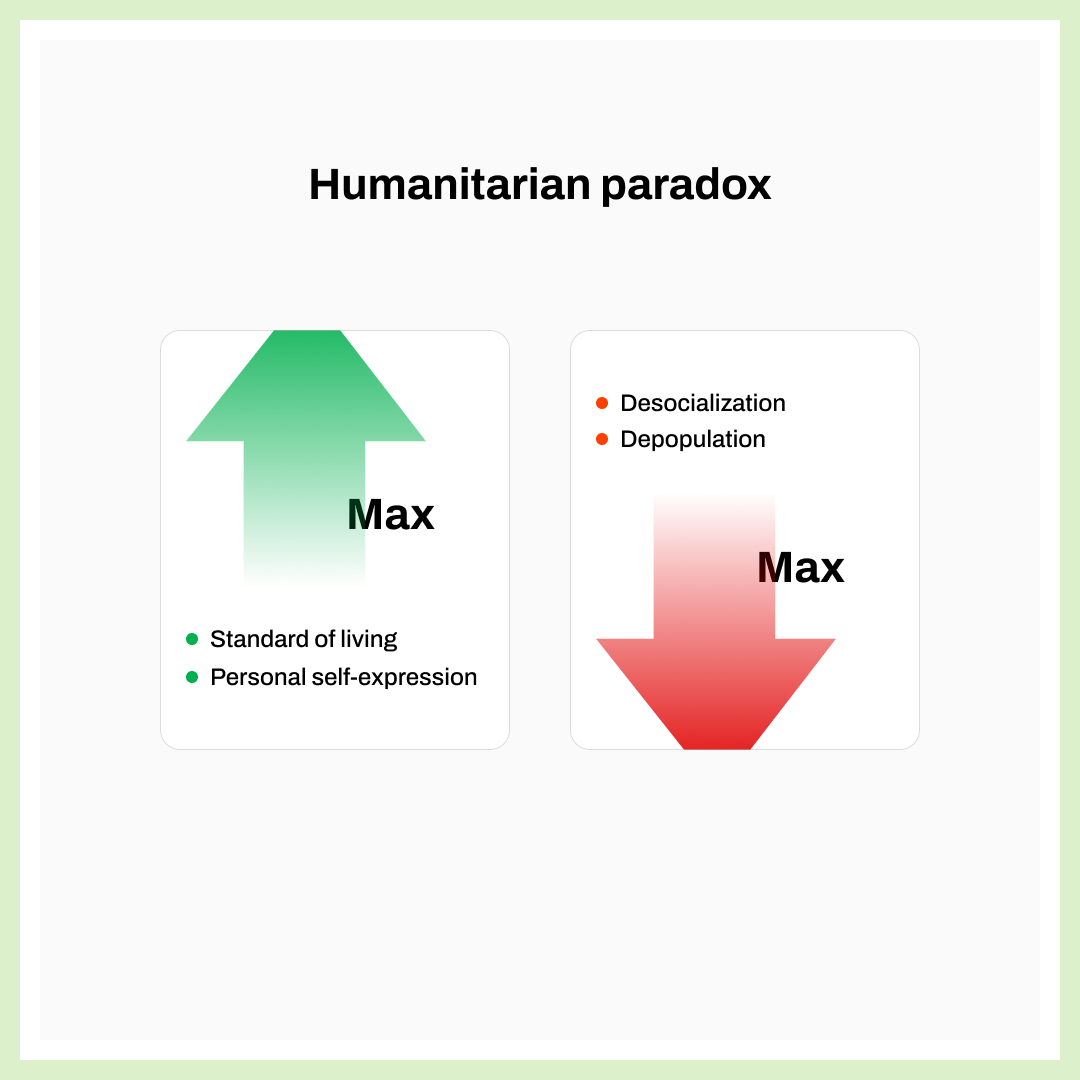
Meanwhile, the commonly accepted “human development” and “quality of life” indexes, utilized by international organizations and national governments, fail to recognize these alarming trends and either consciously or unconsciously overlook the fundamental paradox of modern human development: that the cult of maximizing individual well-being and self-expression is undermining human society.
© RT
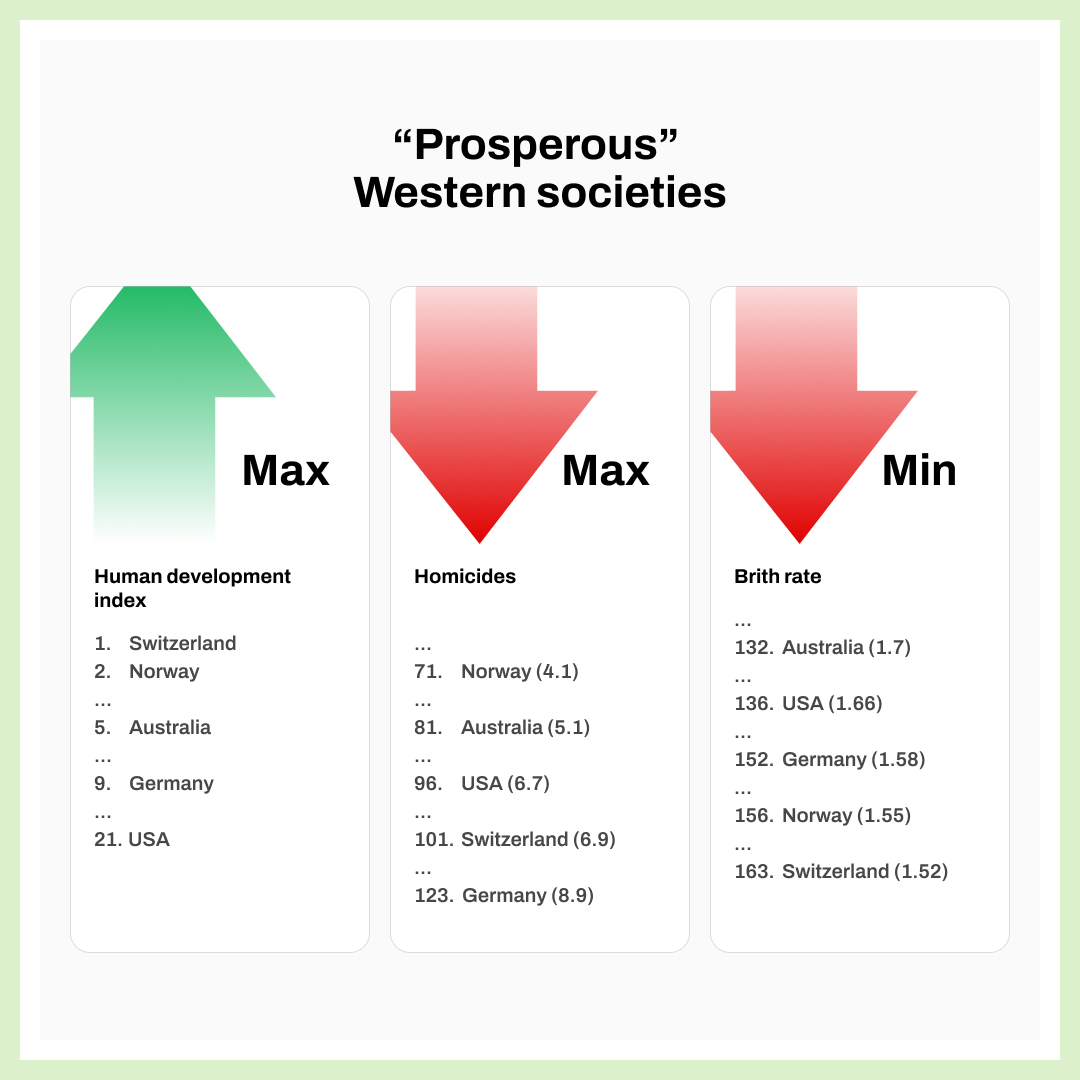
The humanitarian paradox seen above appears to be universal, affecting nearly all countries in today’s globalized world, and particularly the most “advanced” nations, which form the “core” of the modern world system. To illustrate this point, let’s consider some of the wealthiest and most developed Western countries – specifically the United States, Germany, Switzerland, Norway, and Australia – which top the UN Human Development Index. Now, let’s take a closer look at the statistics on murder rates (number of homicides per 100,000 people) and birth rates (total fertility rate) in these supposedly prosperous societies.
© RT
The commonly held belief that highly developed Western countries represent a model of social well-being does not reflect reality. The “golden billion” is grappling with deep issues that can no longer be masked by high living standards; in fact, these problems often emerge as the darker side of consumerism. This shows the heavy price paid for prioritizing individual comfort and hedonism as the ultimate goals of human existence. Meanwhile, desocialization trends which are emerging in the West, such as the dissolution of the family and the shift towards child-free lifestyles, are presented as the pinnacle of progress. These ideas are spread through globalization and can be even more destructive in nations undergoing “modernization” than in the West.
In this context, countries that strive to build a new world order urgently need an effective strategic framework to assess the genuine well-being of nations for the purpose of planning and evaluating sustainable development.
What the Social Well-Being Index measures
The Social Well-Being Index is a tool for measuring and comparing the well-being of historically established human communities: localities, peoples, and nations. In defining human well-being and measuring it, we imply the following fundamental principles.
The highest good for any person is life itself. This fact is universally acknowledged by all religions, civilizations, and cultures. Thus, human well-being as such first of all supposes procreation, or the production of new life. Consequently, any indicators of human development that fail to consider this aspect cannot accurately assess human well-being.
While the production of offspring is an essential part of human well-being, it is not sufficient in itself. Human existence from birth until death inevitably involves suffering. If life itself is the supreme good, then other things that ensure well-being are essentially means of alleviating suffering. Therefore, human well-being implies not only producing new life, but also organizing life in such a way as to help alleviate suffering.
What the Social Well-Being Index shows
At first glance, the ranking of countries based on the Social Well-Being Index might come as a surprise. It significantly differs from GDP per capita rankings and from the Human Development Index (HDI).
To take a more detailed look at RT's Social Well-Being Index, complete with all the statistics, analytical articles, and real-time monitoring of relevant trends from around the world, check out the dedicated website and the Russian version.