Some observers will inevitably ask whether New Zealand could be experiencing similar trends beneath the surface. While no direct comparison has been established, the question is likely to gain traction given New Zealand followed a broadly similar vaccination timeline and public health approach. If comparable data patterns were emerging locally, it would raise serious questions about monitoring, transparency, and whether long-term outcomes are being fully examined. At minimum, it underscores the need for clear, up-to-date reporting and open analysis of New Zealand’s own infant health and birth statistics.
by Nicolas Hulscher, MPH
A major new peer-reviewed study we just published in Medical Research Archives has uncovered a shocking reversal: after two decades of steady progress, infant mortality surged 37% since 2020, congenital abnormality deaths jumped 46%, and registered live births collapsed by 24% — all coinciding with expanded vaccination campaigns in the Philippines.
The study is titled Global Implications of Vaccination and Rising Infant Mortality in the Philippines, authored by Sally A. Clark, Claire Rogers, Mila Radetich, Nicolas Hulscher (myself), Kirstin Cosgrove, Breanne Craven, M. Nathaniel Mead, and James A. Thorp.

Using official Philippine Statistics Authority data on 41.7 million births and over 546,000 infant deaths from 2000–2024, plus Department of Health vaccination records, we documented a sharp turnaround after two decades of steady progress.
Infant mortality rate fell to a historic low of 11.05 deaths per 1,000 live births in 2020. Then it rose 37% to 15.11 by 2024 — a statistically significant jump (p < 0.0001) that erased more than 20 years of gains in just five years.

At the same time, registered live births dropped 24% from their 2012 peak (p < 0.0001), with an accelerating decline after 2019.

We found clear temporal links between rising infant deaths and key elements of the national vaccination program.
Pneumococcal Conjugate Vaccine (PCV) coverage surged from 24% in 2015 to 76% in 2023. The correlation with infant mortality was extremely strong: r = 0.93 (p = 0.00074) from 2015–2023 and r = 0.77 (p = 0.016) when including 2024 data.
Mortality peaks across the first year of life aligned precisely with the National Immunization Program schedule:
- Birth doses of Hepatitis B and BCG coincided with early neonatal spikes.
- 6-, 10-, and 14-week doses of PCV, pentavalent, and polio vaccines matched major post-neonatal peaks (especially months 2–4 and month 7).
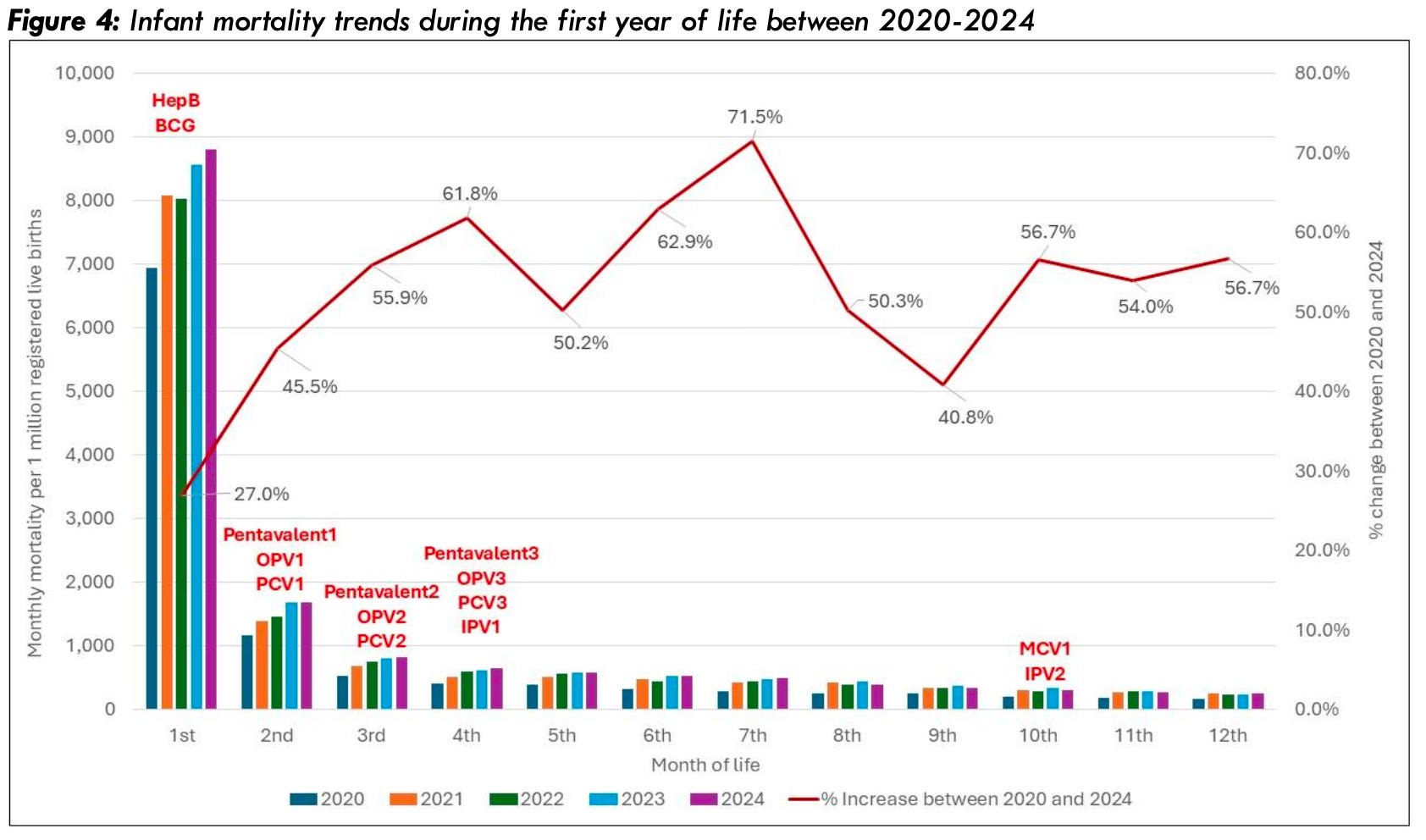
National “catch-up” vaccination campaigns in April–June 2022 and 2023 were followed by clear monthly spikes in infant deaths. In 2024, with no nationwide campaign, those peaks were noticeably lower.

The sharp reversal also coincides precisely with the national COVID-19 vaccination rollout. The program launched in March 2021, with professional societies actively recommending the shots for pregnant women. By early 2023, 70.3% of the eligible population — and a striking 88.8% of adults aged 18-59 (the prime reproductive-age group) — were fully vaccinated.

As a result, the first birth cohorts gestated after widespread maternal COVID-19 vaccination (starting in 2021) experienced the dramatic infant mortality rise, along with a 46% increase in congenital abnormality deaths and major spikes in respiratory diseases (+124%), infectious/parasitic diseases (+125%), and unexplained sudden deaths (+106%, including SIDS).