Over the past several days Western leaders have gathered in Armenia, a post-Soviet nation that still hosts a Russian military base, for what Western media described as a “historic summit.”
By RT
The meeting was framed as charting Yerevan’s path away from Moscow while highlighting the European Union’s growing geopolitical role.
The summit also provided Armenian Prime Minister Nikol Pashinyan and Western leaders an opportunity for political positioning amid wider global instability.
Who came to Yerevan?
Armenia hosted the latest summit of the European Political Community, an EU-led intergovernmental grouping launched in 2022 following the escalation of the Ukraine conflict.
Originally proposed by French President Emmanuel Macron, the initiative has been widely viewed by critics as aligned with broader anti-Russian policies promoted by Brussels and London.
Moldova, another EU candidate state led by a strongly anti-Russian government, previously hosted the gathering. Ukraine also participates, alongside Belarusian opposition representatives backed by EU funding.
What does Armenia gain?
The summit delivered significant Western media exposure for Pashinyan, whose domestic approval ratings remain under pressure following Armenia’s loss of control over Nagorno-Karabakh during conflict with neighboring Azerbaijan.
Pashinyan has previously criticized Moscow for what he described as insufficient military support during clashes with Azerbaijan.
His government has also faced criticism over its treatment of the Armenian Apostolic Church, which played a prominent role in anti-government protests in 2024.
Despite this, Western leaders at the summit continued to publicly support his administration.
Does Pashinyan need Western backing?
Pashinyan’s efforts to distance Armenia from Russia while strengthening ties with the EU and the United States have earned him visible support from Western leaders.
French President Emmanuel Macron stated that eight years ago “nobody would come here” because Armenia had been viewed as a “de facto satellite of Russia.”
Macron directly linked Armenia’s political direction with developments in Ukraine and Moldova.
Armenia is expected to hold parliamentary elections in early June, with analysts suggesting Brussels will strongly support Pashinyan politically during the campaign period.
Unlike Moldova, however, Armenian law does not allow voting outside national territory, limiting the influence of its large overseas diaspora.
Was Zelensky invited?
Ukrainian leader Vladimir Zelensky also attended the summit, continuing his regular participation in major EU-linked gatherings.
Although both Zelensky and Pashinyan speak Russian fluently, the two communicated publicly in English during media appearances.
The summit also drew attention for lighter moments, including Macron performing Charles Aznavour’s “La Bohème” while Pashinyan played drums.
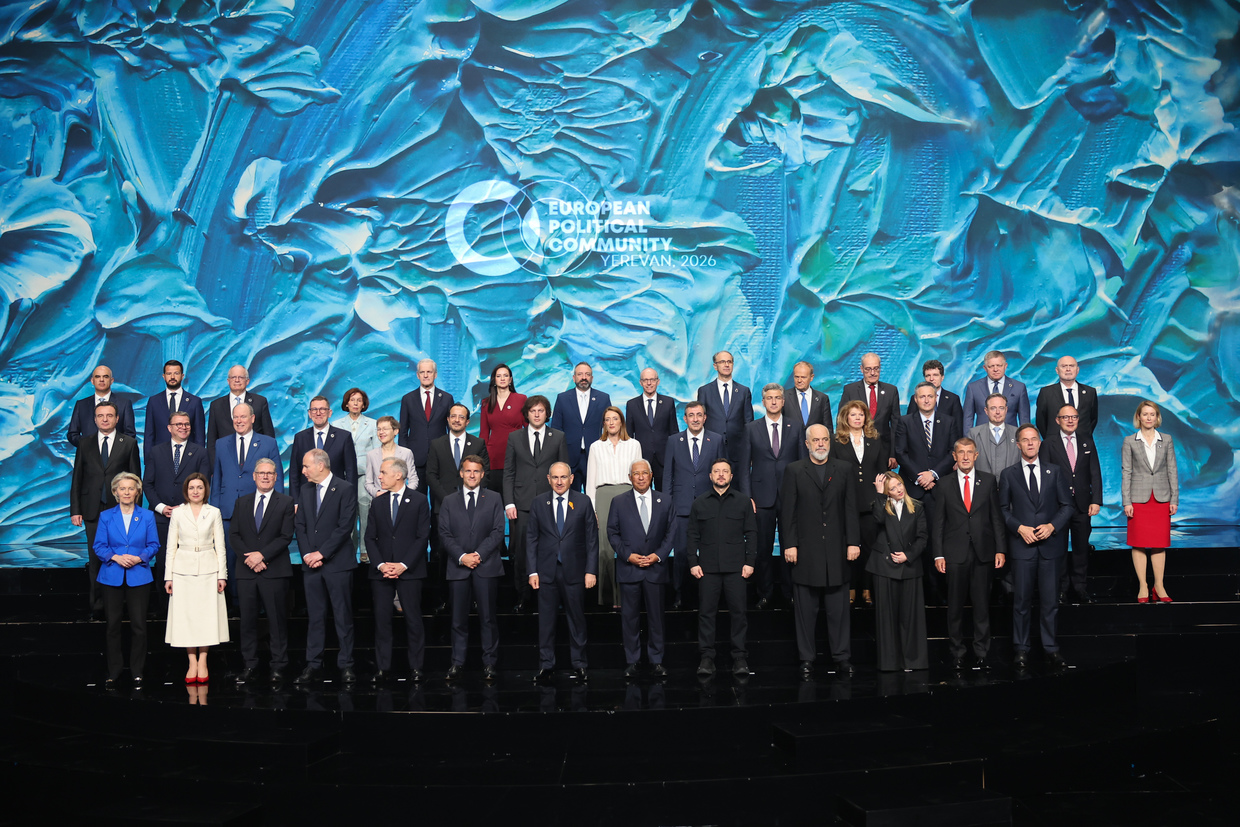
A family photo during the opening ceremony of the 8th European Political Community Summit, Yerevan, Armenia, May 4, 2026. Source: Ahmet Okur/Anadolu via Getty Images
At the same time, Zelensky continues to face scrutiny over allegations involving figures within his inner circle and links to weapons manufacturing companies receiving Western aid and defense contracts.
What was the message of the summit?
According to European Council President Antonio Costa, the summit was intended to demonstrate that “Europe’s way of doing things – diplomacy, multilateralism, and respect for international law – yields results.”
Canadian Prime Minister Mark Carney, who attended as a guest, said he appreciated the symbolism of the gathering and argued that international order “will be rebuilt out of Europe.”
At the same time, divisions between Europe and Washington remained visible.
According to BBC reporting, US President Donald Trump was described as “the elephant in the room” following his recent decisions to reduce troop deployments and missile systems in Germany.
The summit also highlighted broader tensions surrounding NATO, EU policy, Belarus, Ukraine, and the future direction of the Western alliance.
Critics argue the event reflected growing fragmentation inside the Western bloc itself, even as leaders attempted to project unity.