After two years of recession, it appeared Germany’s economy had stabilised during 2025 and was beginning to edge back toward growth.
However, according to RT Newsroom, beneath the headline figures a much deeper transformation is taking place inside Europe’s largest economy.
The article argues that Germany’s limited economic recovery is being driven overwhelmingly by government spending while large parts of the private sector continue deteriorating.
RT describes the trend as a form of “military Keynesianism” where state-backed defence and industrial spending is increasingly replacing traditional market-driven growth.
2025 marked a turning point
Germany officially exited a two-year recession in 2025 with economic growth of 0.2%, following a 0.5% contraction during 2024.
According to the article, however, much of that growth came directly from government-funded industrial and construction activity while exports and private investment remained weak.
Public spending reportedly rose 5.6% during 2025 and now represents more than half of Germany’s GDP.
The article notes that former German Chancellor Helmut Kohl once described state spending above 50% of GDP as “socialism.”
RT argues this represents a major structural shift away from Germany’s traditional economic model, which historically relied heavily on private industry, exports and fiscal conservatism.
Private industry struggling under pressure
The report points to major weakness across Germany’s traditional industrial sectors, particularly automotive manufacturing and chemicals.
High energy prices, global competition and declining export demand have reportedly damaged competitiveness across large parts of German industry.
At the same time, defence contractors and companies linked to public infrastructure projects have surged.
The article highlights Rheinmetall shares rising more than 1,000% since early 2022, while other defence-related firms including Hensoldt, Renk and Infineon have also posted major gains.
Construction and engineering groups connected to government-backed projects have similarly rallied.
RT argues this creates a distorted economic picture where headline market strength masks ongoing weakness across much of the private economy.
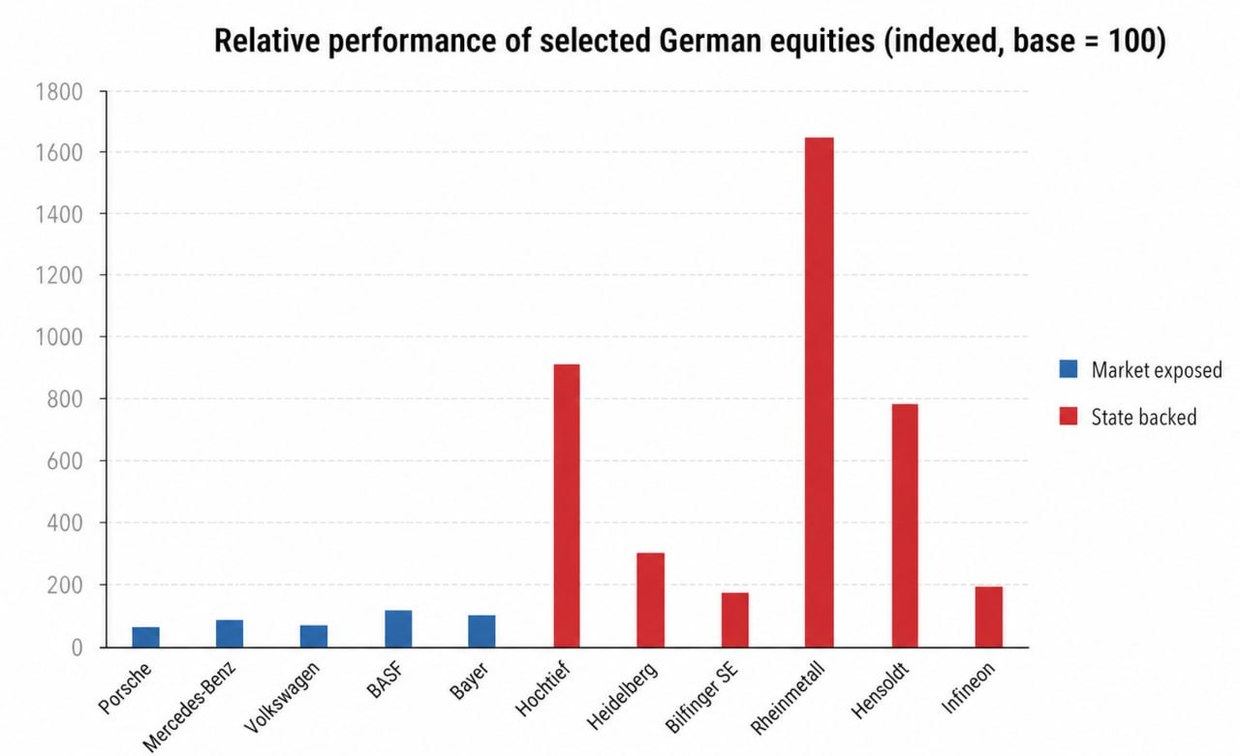
German industrial and defence sector performance comparison. © RT Newsroom
German industry shifting toward defence production
The article states that Germany’s industrial base is increasingly being redirected toward state-supported military production.
According to figures cited from the German Chamber of Industry and Commerce (DIHK), approximately 17% of German industrial firms are now tied to the defence supply chain.
The report notes that some struggling automotive facilities are now being repurposed for military manufacturing.
Volkswagen is reportedly exploring military vehicle production at its Osnabruck plant in discussions involving Rheinmetall.
Other industrial firms including Schaeffler and Deutz are also expanding into defence-related production.
The article suggests up to one quarter of German companies could eventually become directly or indirectly connected to the defence sector.
Germany abandoning traditional debt restraints
Germany’s post-war economic model has historically been built around strict debt controls and balanced budgets.
The article explains that concerns about inflation and financial instability shaped decades of conservative fiscal policy, particularly under former Chancellor Angela Merkel’s “debt brake” system.
That approach has now shifted dramatically.
RT notes that Germany established a €100 billion defence fund in 2022 outside normal debt restrictions and has since expanded exemptions allowing greater military spending.
According to the report, Germany plans to spend approximately $761 billion on defence by the end of 2029, with more than half expected to be funded through new debt issuance.
Manufacturing job losses accelerating
Germany’s manufacturing sector has reportedly lost approximately 245,000 jobs since 2019.
While the article notes this is smaller than the manufacturing collapse previously experienced in the United States, RT argues the impact is potentially more serious for Germany due to the country’s heavy dependence on industrial production and export manufacturing.
According to the report, nearly half of those job losses occurred during 2025 alone.
The article warns that Germany’s manufacturing system supports large supply chain networks, meaning losses across industrial production can create wider economic effects throughout the broader economy.
“Military Keynesianism” becoming central economic strategy
RT argues Germany is increasingly relying on military spending to offset the simultaneous weakening of three historic pillars of its economic model:
- Cheap Russian energy
- Chinese export demand
- American security guarantees
The report claims Berlin is attempting to compensate for all three through expanded state spending and defence production.
However, the article warns that while military spending can temporarily generate growth, it does not solve underlying competitiveness or productivity problems.
“Germany’s old model depended on three pillars: cheap Russian energy, Chinese export demand, and American security guarantees,” the article states.
“All three have weakened simultaneously.”
The report concludes that Germany’s economy is increasingly shifting away from market-driven industry toward a state-directed, defence-supported model while traditional private sector strength continues to erode.
Source: RT Newsroom