A newly published scientific study has revealed that an active faultline running through South Auckland could potentially generate an earthquake measuring up to magnitude 6.8, raising fresh questions around Auckland’s long-term seismic risk and urban expansion planning.
Mangatangi Fault near the Hunua Ranges in South Auckland. Photo: Supplied
By elocal source RNZ
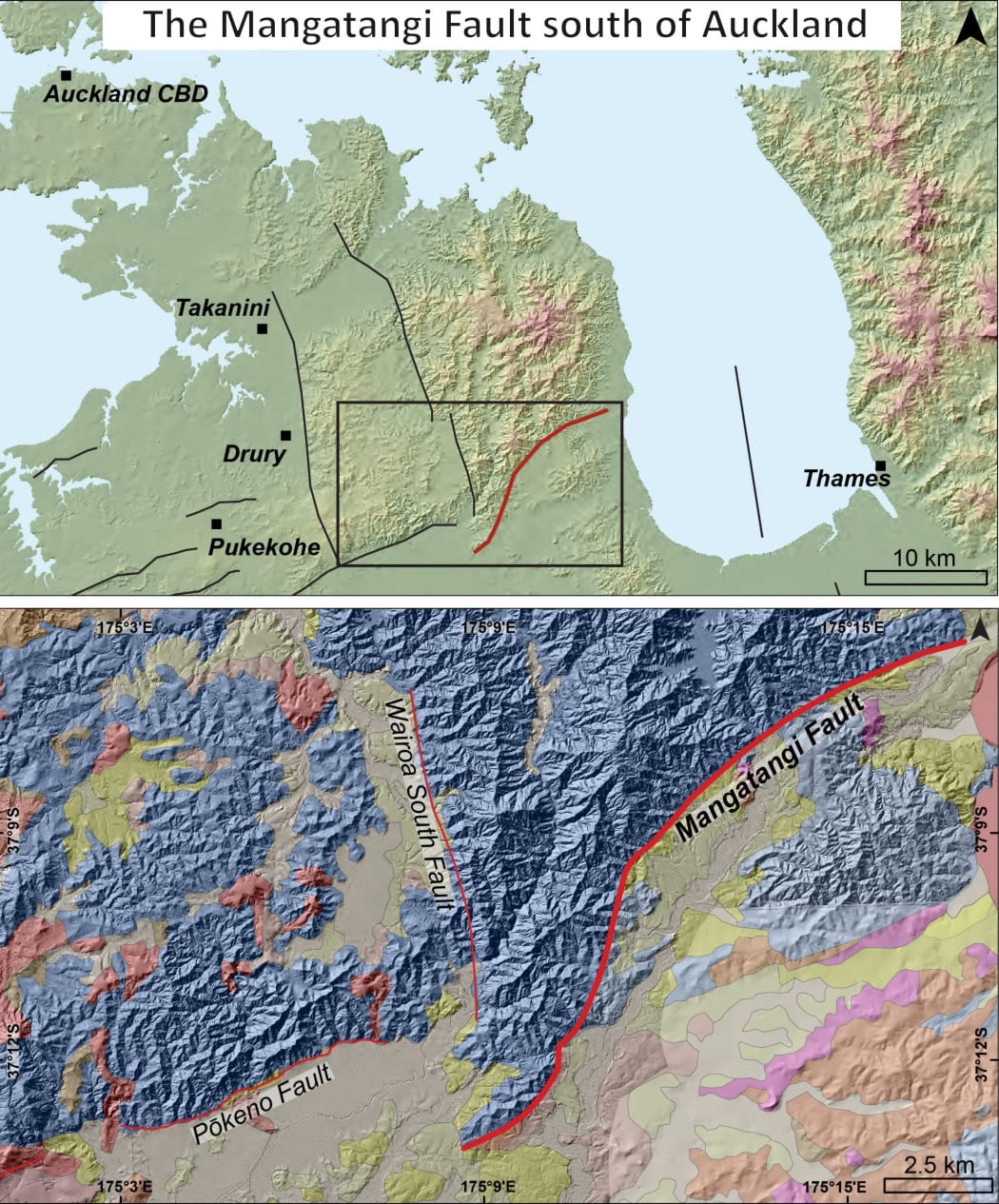
The study, published in the New Zealand Journal of Geology and Geophysics, focuses on the Mangatangi Fault which runs alongside the Hunua Ranges in South Auckland.
Researchers from the University of Auckland say a rupture along the faultline could have serious consequences for parts of South Auckland and potentially central Auckland as well.
Auckland’s Earthquake Risk May Be Underestimated
While Auckland is not generally viewed as a major earthquake zone compared with Wellington or parts of the South Island, researchers involved in the study say the public may underestimate the region’s seismic potential.
According to co-author Dr James Muirhead, the findings highlight how little is still known about Auckland’s earthquake history.

Co-author of the study Dr James Muirhead. Photo: Supplied
“Auckland's level of hazard is obviously nothing like Wellington's or much of the South Island, but it may be significantly higher than the public and policymakers believe - we need more factual information to know,” Dr Muirhead said.
The Mangatangi Fault is now classified as active because geological evidence suggests it has ruptured within the past 10,000 years. Under scientific classification standards, any fault movement within the last 125,000 years qualifies as active.
Rapid Southern Expansion Raises Infrastructure Questions
Researchers say Auckland’s continued southern growth may be increasing exposure to seismic risk as more homes, infrastructure and transport systems expand closer to the faultline corridor.
Lead author Hannah Martin said that while the fault may not rupture for many thousands of years, the possibility cannot be ignored.

Lead author Hannah Martin. Photo: Supplied
“It remains an active fault with the potential to generate a large earthquake in a region that doesn't expect one,” Martin said.
The findings may reignite wider discussions around long-term infrastructure resilience, building standards and emergency preparedness in New Zealand’s largest city.
Earthquakes Already Occur Beneath Auckland
Although most Aucklanders rarely feel seismic activity, researchers say earthquakes already occur beneath the region every year.
Scientists involved in the study are continuing to investigate Auckland’s wider fault systems using advanced geological mapping, trenching work and ground-penetrating radar technologies.
Researcher Dr Jennifer Eccles said better scientific evidence allows for more realistic long-term planning.
“It's always better to plan based on evidence rather than on our best hopes or worst fears,” Eccles said.
The Bigger Picture
The study serves as a reminder that New Zealand’s geological risks extend beyond the country’s better-known earthquake zones.
While the probability of a major Auckland earthquake remains low in the short term, the research highlights how rapidly expanding urban regions can unknowingly build around long-dormant geological hazards.
For now, researchers stress the goal is not to create fear, but to improve understanding of Auckland’s underlying seismic landscape before future growth places even more people and infrastructure at risk.