History's Largest Human Trafficking Ring
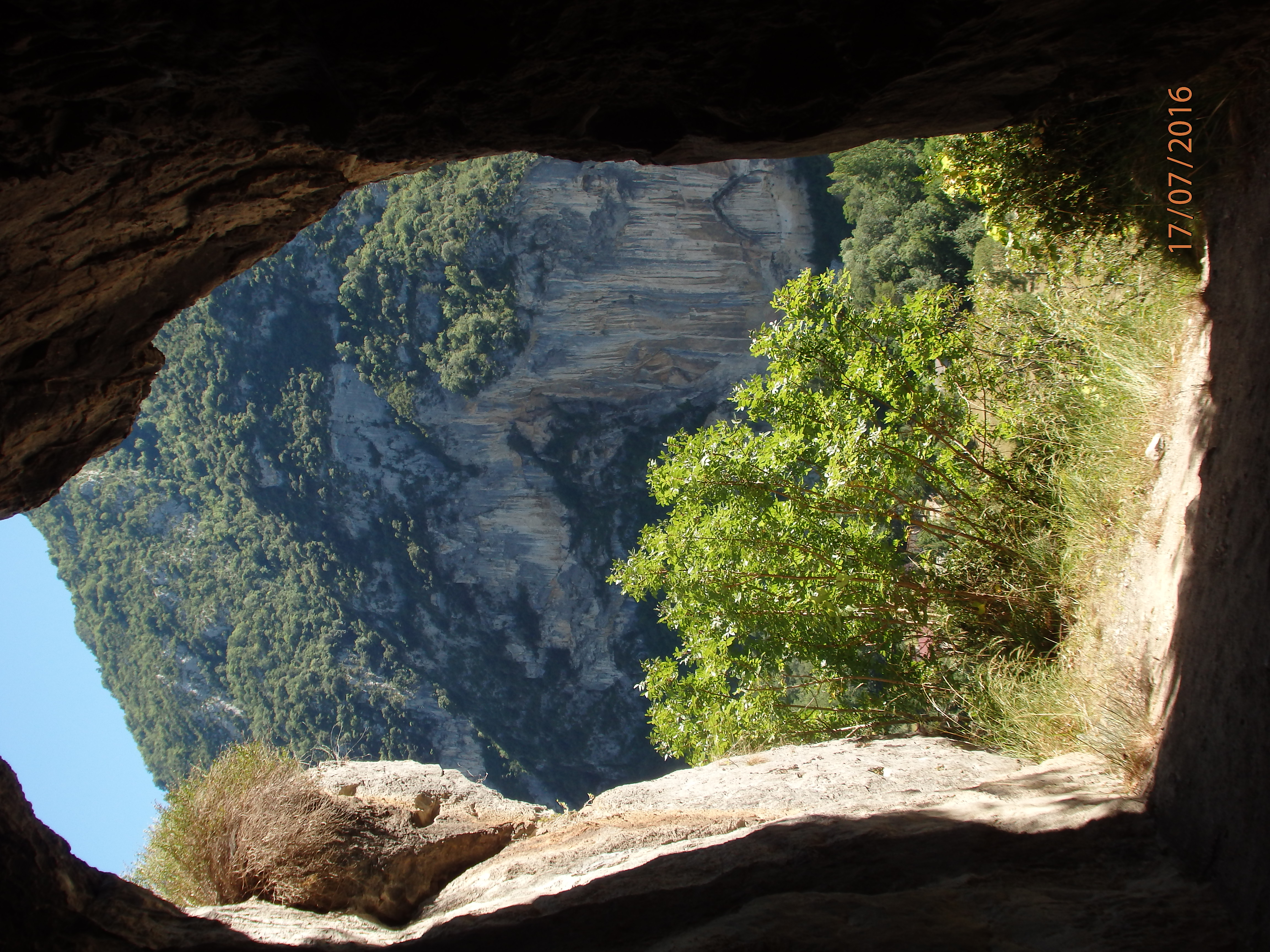
A secret cave, hidden from modern times, filled with old ritual memories
Fall of the Cabal Official
Published 9 June 2026
History is an organic concept. When you analyze the word, you already see it’s true meaning: His Story.
The history of wars has always been written by the conquerors.
The history of culture and major events have always been written or altered by the ones in power, whether that was the church or the cabal.
To find true history, one has to either physically go to a certain area to talk to the people or find (forgotten) witness accounts, buried by the official narratives.
I experienced this myself, when I discovered the ancient land of the Kathars in the south of France. While wandering through the ancient mountains, discovering long forgotten and overgrown ruins, I encountered local people who were willing to share their stories with me.
They told me about their ancestors, their pure faith, the prosecutions throughout the centuries (especially the 13th), their suppressed hatred against the official church. They still guard the sacred sites, do its upkeep and fight the government that wants people to forget.
There is such a difference between the official narratives, its tourist sites and the hidden truth. Still these stories sing around, are shared within families and among friends. But they are nowhere to be found in any history books. This entire area remembers the past, while what really happened remains hidden from those outside the region.
This is the same everywhere in the world. Even if you live in an ultra modern area, it wasn’t always like this. Civilizations have literally been build on top of each other. You have to dig to find the past.
Everything in life is connected. Life itself evolves in spirals.
This means that time and again, we stumble upon the same obstacles, the same challenges. Nothing is new or unique in its kind.
So when we talk about the Epstein files, revealing ‘The Worlds Largest Human Trafficking Ring’, I tend to start looking in the past. What was there before and how did we handle it back then?
We don’t have to go far back in time. Let’s have a look at central Europe, exactly one hundred years ago.
Meet Zwi Migdal
Meet Zwi Migdal, a criminal organization founded by Ashkenazi Jews in Poland in the 19th century, based mainly in Argentina.
Why do I immediately start with calling the founders Ashkenazi’s? As they are the group of people, previously knows as Khazars, and currently as the Cabal. Please watch our very important part 1 of the Sequel to the Fall of the Cabal to learn more about this.
This distinction between Jews and Ashkenazi’s is the reason why I needed such a long introduction to this article. History truly is His Story, a narrative made to fulfill the purpose of the conquerors. To understand something about life, we need to find real truth and see the hidden masks of the perpetrators.
Zwi Migdal’s main operation was the trafficking of young women from Central Europe (mainly from Warsaw) into sexual slavery and forced prostitution. The organization functioned from its foundation in the 1860s until 1939 (Hitlers invasion in Poland).
By 1929, the Zwi Migdal was believed to be constituted by around 500 pimps, it controlled 2,000 brothels and employed 30,000 women, according to the late writer Ernesto Goldar.
The organization’s annual turnover was $50 million at the turn of the 20th century (approx. $2 billion today). Annually… on human trafficking and sexual exploitation… After the First World War, it had 400 members in Argentina, Buenos Aires being its main center of operations. It had branch offices in Brazil (Rio de Janeiro, São Paulo and Santos), the United States, Poland, South Africa, India and China.
Zwi Migdal, named after its founding member, Luis Zvi Migdala, ran its criminal activities under the facade of a mutual aid organization. Its members deceived young and impoverished Jewish women in Eastern Europe and, under the false pretense of a marriage, would whisk them away to South America, where they would be exploited as sex workers.
Doesn’t this all sound very familiar?
As we told you in the Sequel, the Cabal uses the same tricks over and over again. When you seen them once, you will recognize them everywhere…
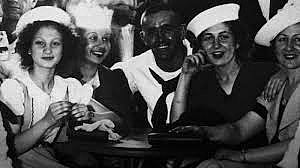
The ZWI MIGDAL, the early 1900s trafficking ring
At that time, where prostitution was not a crime in Argentina and many of the immigrants were men with no family in the country, the business of brothels was indeed a thriving one.
Canadian journalist Isabel Vincent described the Zwi Migdal as “an octopus, achieving an almost unassailable position.”
How The Network Operated
The trafficking operations of the Zwi Migdal would begin in Europe. A well-mannered and elegant-looking man would appear in poor Jewish villages in Poland or Russia. He would advertise his search for young women to work in the homes of wealthy Jews in Argentina by posting an advertisement in the local synagogue. Fearful of pogroms and often in desperate economic circumstances, parents would send their daughters away with the man, hoping that this might offer them a fresh start.
Another popular ruse was to find pretty girls and marry them, usually in a quick wedding ceremony known in Yiddish as a “shtille chupah”. The girls bade their families farewell and boarded ships to Argentina, believing that they were on their way toward a better future. The rape of the girls and abuse as sex slaves often started on the ship. Some of them were married off to local men so that they could obtain entry visas.
Prostitutes who failed to satisfy their clients were beaten, fined, or sent to work in rural houses. Every business transaction was logged. The ruffians held a "meat market" where newly arrived girls were paraded naked in front of traders in places such as Hotel Palestina and Cafe Parisienne. These activities went on undisrupted because government officials, judges, and journalists frequented the brothels.
City officials, politicians, and police officers were bribed. The pimps had powerful connections everywhere. The largest brothels in Buenos Aires housed as many as 60 to 80 sex slaves.
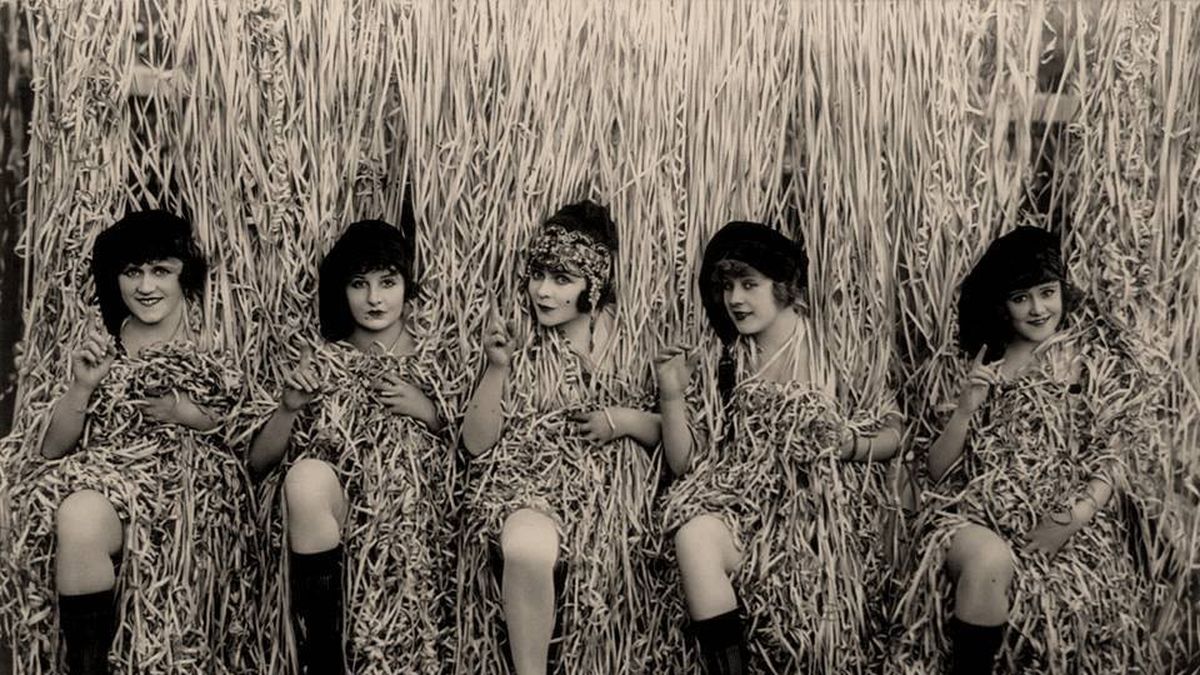
Zwi Migdal, una historia de trata de personas aún por contar
Division Within The Jewish Community
Then something very interesting happened. The normally cohesive Jewish community seemed to break up, showing us the division between the Ashkenazi’s and the ‘real Jews’.
A significant number of Jews who had come to Brazil did so as families and viewed prostitution as immoral and “impure” influences. Their resistance grew against the Zwi Migdal, establishing a distance between local Jewish associations and the ‘impure’ pimps, practicing a trade which threatened the Jewish moral system.
Amongst them, were the Soprimitis and the Ezrat Nashim. The former provided help to Jewish immigrants in Argentina on how to fight the impure, while the latter operated in the port of Buenos Aires and tipped off young women traveling alone on the risks of getting involved with pimps.
These struggles forced the Zwi Migdal to relocate to Rio, which caused an increased battle against the group among Brazilian Jews. They became isolated within the Jewish Community, being negatively viewed as the Eastern European Jews (meaning Ashkenazi’s).
The Zwi Migdal was forced to split and a splinter group led by Simon Rubinstein established its own society named Ashkenazum. How obvious do you need it?
The Zwi Migdal had turned Argentina into a nightmare of prostitution and exploitation. It had constructed an empire build on bribery and corruption, involving many officials and lawmakers. It seemed like they were indestructible, being the Deep State of the 19th and 20th century.
But it turned out that only one courageous young woman was needed to give the death blow to the organization.
Meet Raquel Liberman.

Raquel Liberman nel 1919, quando ancora viveva in Polonia. Credit: Nora Glickman, The Jewish White Slave Trade and the Unknown Story of Raquel Liberman
Liberman was only 22 years old, when she arrived at the port of Buenos Aires in 1922, according to her biography in the Jewish Women’s Archive. Liberman had come from Poland with her two very young sons to join her husband Yaacov Ferber, who had traveled to South America a year before. Only a couple of months later, Liberman found herself a widow, as Ferber had died from tuberculosis.
She ended up being a prostitute, being exploited by her new husband/pimp Josè Salomon Korn.
Liberman reached out for help to Simon Brutkievich, not knowing Brutkievich was actually Zwi Migdal’s president. In her desperation Liberman felt she had no choice but to go to the authorities.
Slipping into his office on New Year’s Eve of 1929 she came before Julio Algasaray, deputy commissioner of the police of Buenos Aires, to tell her story and become an informant. Algasaray was one of the few officials who would not accept bribes from Zwi Migdal and he had been waiting for someone to come forward for years, while gathering information and evidence on the criminal organization. The moment for a trial had finally come.
434 members of the Zwi Migdal were called before justice. The case was handled by an investigative judge, Rodriguez Ocampo, who also refused to be bribed. The lengthy trial ended in September 1930, with 108 criminal convictions.
“The very existence of the Zwi Migdal Organization directly threatens our society,” wrote Ocampo in his verdict, handing down long prison sentences.
The pimps appealed their sentences from prison in January 1931, and senior Justice Ministry officials released all but three of them. After this was reported in the media, public outrage convinced the authorities to rescind the releases. Later, hundreds of pimps were deported to Uruguay, but slowly returned over the years.
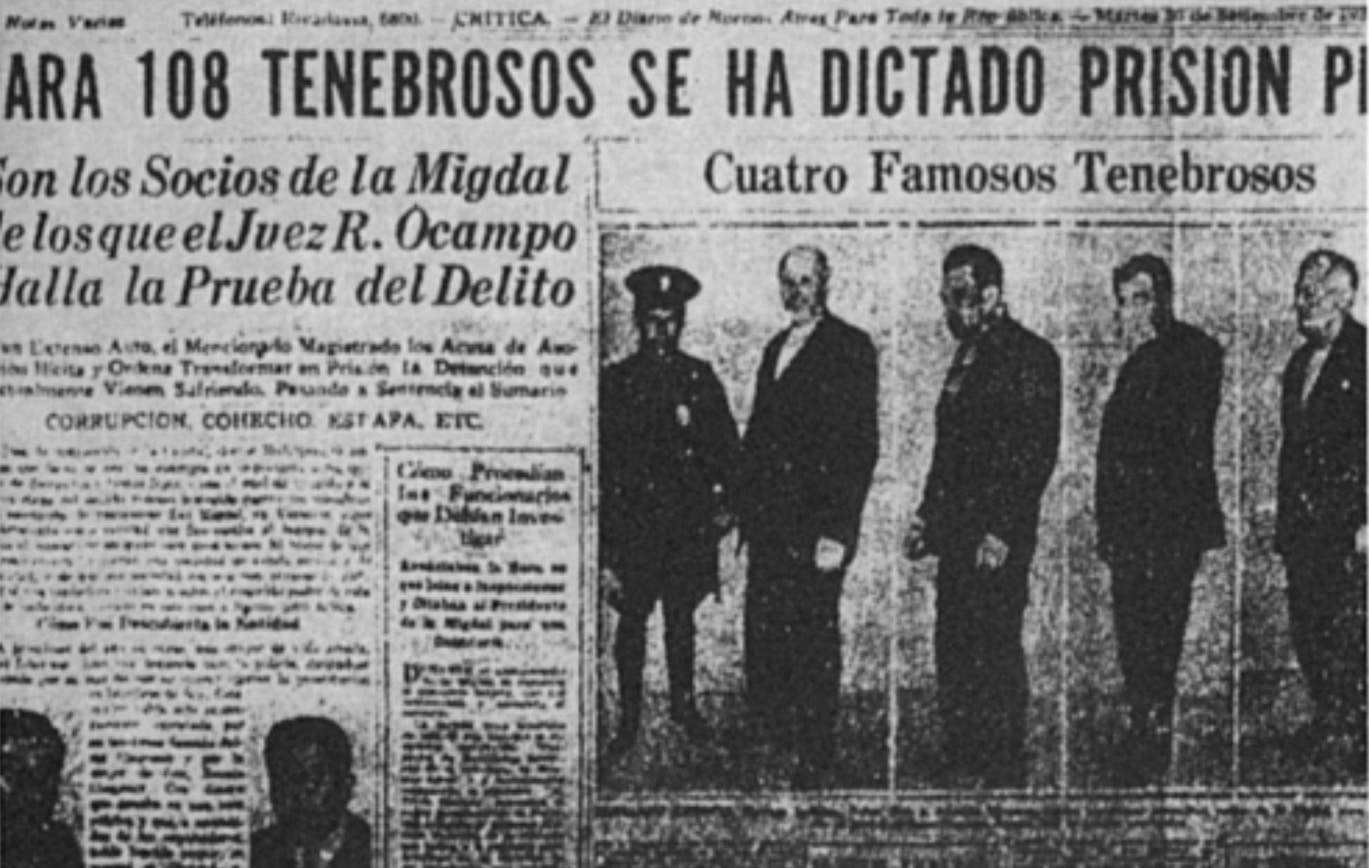
Page of a Buenos Aires daily, Diario Critica, after the verdict against the Zwi Migdal, 1930
Conclusion
The legal battle against the Zwi Migdal, which had corrupted many officials in the Argentinian capital, felt to Algasaray as a face-off between “a Lilliputian against Hercules,” as he said in one exposè written later.
But they did it. Justice was served and the Ashkenazi mafia went underground, licking its wounds. It was more than a century later that another huge human trafficking ring of the same massive scale was discovered.
True, while the genius behind the human trafficking ring laid itself to rest, the human trafficking and forced prostitution never stopped. It had becomes splintered in many local groups, still dominating South America with bribes and corruption. But the world wide organization behind it, was stopped. Forced underground by a few brave people. Ordinary people, like you and me.
Right now, the fight against human trafficking and forced prostitution has become a priority for the US Administration. Under the Monroe Doctrine, it invited all countries in the America’s to join in this fight.
Lately Guatemala and Ecuador accepted this invitation and “agreed to carry out joint strikes with the United States military inside its territory to target drug and human trafficking groups”.
The world is being cleared from the cruel practice of human trafficking and sexual exploitation. Yes, we don’t see much action based on the Epstein files. Yet. I can’t see what is happening behind the scenes. We don’t know what is being prepared and what games are being played to remove the current biggest human trafficking ring from existence.
When you take into account that all visitors of Epstein Island are probably perpetrators, this will be the biggest criminal investigation ever, having to be conducted in every country of the world.
As always, time will tell.
Our job is to inform people. Show them the history of the world. As truly understood history can teach us so much about the present. About how to deal with the repeating evil in our world.
One day, I hope, ‘his story’ will become ‘Our Story’. The stories told by local people, narrated from generation to generation. The stories from those who had to endure ‘history’. That would be the greatest treasure and gift to our future generations.
Source
Source: Fall of the Cabal Official, History's Largest Human Trafficking Ring, published 9 June 2026. Original article republished in Format B.