Christopher Luxon remains Prime Minister and leader of the National Party after surviving another confidence vote. But with little more than 12 weeks until the election, surviving his own caucus may prove considerably easier than convincing New Zealand voters that the Government deserves another term
eLocal Report: Based on analysis by RNZ political reporter Russell Palmer.
Prime Minister Christopher Luxon has survived another challenge to his leadership, but the circumstances surrounding the vote suggest the political problem facing National has not disappeared.
This is now the third credible public challenge to Luxon’s leadership since November and the second confidence vote he has publicly faced. With the general election little more than 12 weeks away, repeated questions from within National’s own ranks risk becoming part of the election campaign itself.
RNZ political reporter Russell Palmer describes the latest result as a “hollow victory”. Luxon remains undefeated in the formal sense, but every leadership challenge inevitably raises the question of why another confidence vote was necessary in the first place.
For voters, however, there is a bigger issue than National Party caucus politics.
New Zealanders will soon decide whether the Coalition Government has delivered what it promised in 2023 — particularly on the economy, the cost of living and competent economic management.
Another Confidence Vote
Luxon faced the media after Wednesday’s vote but gave little away.
Unlike the confidence vote in April, when he revealed he had called the vote himself and criticised media reporting about discontent inside National, his latest appearance was shorter and considerably more guarded.
He answered no questions and concentrated on the approaching election.
The repeated challenges are significant because political parties generally want leadership questions settled well before an election campaign begins. Leadership speculation consumes political oxygen that would otherwise be spent selling policy and defending the Government’s record.
It also provides ammunition to opponents who can argue that if National MPs themselves are questioning the leadership, voters have reason to do the same.
A Difficult Fortnight
The latest challenge follows several difficult weeks for Luxon.
One controversy arose after he announced during a live radio interview that National would campaign on holding a referendum on the MMP electoral system — apparently without first consulting his MPs or party.
National subsequently backed the proposal, but the manner in which it was announced raised questions about political management.
There was also an awkward contradiction with National’s attempts to focus its election message on household finances. A referendum would carry a substantial public cost at a time when the Government continues to emphasise fiscal restraint.
Luxon then found himself discussing possible new taxes, including changes involving fuel excise and an accommodation levy, shortly after National had announced budget responsibility rules.
Another controversy followed comments to the Rotorua Business Chamber suggesting some small businesses had developed a “parent-child” mentality towards government. Luxon later apologised.
Individually, political mistakes of this kind are survivable.
Collectively, however, they contribute to a perception problem — particularly when they occur alongside worsening polling and challenges to the leader’s authority.
The Economic Question May Matter More
For eLocal, this is where the election discussion becomes considerably more important.
Leadership personality and political communication matter, but households and businesses ultimately experience government through economic conditions.
National came into office promising stronger economic management, lower inflationary pressure, greater discipline in government spending and improved conditions for businesses and households.
The Government can legitimately argue that it inherited a difficult economy.
New Zealand emerged from the Covid period carrying substantially higher government debt, enormous monetary stimulus from the Reserve Bank’s Large Scale Asset Purchase programme, severe inflationary pressures, sharply higher interest rates and an economy struggling to regain momentum.
But by Election 2026, voters are no longer judging the previous Government.
They are judging this one.
That distinction becomes increasingly important as National attempts to campaign on economic competence.
Recent indicators present a mixed picture. Some parts of the productive economy are showing encouraging signs — particularly agriculture and export-related sectors — while many households and businesses continue to struggle with the cumulative effects of inflation, high borrowing costs, weak domestic demand and the economic downturn.
For National, the political question is becoming straightforward:
Do New Zealanders feel better off than they did three years ago?
The Businessman Prime Minister
Luxon entered politics with an unusual advantage.
His previous career as chief executive of Air New Zealand allowed National to present him as a professional manager capable of bringing business discipline to government.
That positioning was important during the 2023 campaign.
National had won just 25.6 percent of the party vote in 2020. Under Luxon, it recovered to 38 percent three years later and returned to government.
That is a significant political achievement.
His management skills have also helped maintain a three-party coalition involving National, ACT and New Zealand First — an arrangement many initially expected would prove difficult to manage.
But the businessman image creates its own political test.
If voters are asked to accept managerial competence as one of a Prime Minister’s strongest qualifications, they are also entitled to judge the Government by measurable outcomes.
Growth.
Productivity.
Real household incomes.
Business formation and failure.
Government debt.
Taxation.
Employment.
Investment.
And ultimately whether New Zealanders believe the country is becoming economically stronger.
Coalition Management Has Been Both Strength and Weakness
Luxon has generally succeeded in keeping the Coalition Government intact.
That should not be dismissed.
ACT leader David Seymour and New Zealand First leader Winston Peters represent distinctly different political constituencies and frequently take positions that create difficulties for National.
Yet coalition stability can also make the Prime Minister appear constrained.
Peters in particular has repeatedly demonstrated an ability to dominate political news cycles and publicly challenge positions associated with National.
The result is an unusual political dynamic.
Luxon is unquestionably Prime Minister, but the political authority of the office can sometimes appear less dominant than would normally be expected of the leader of the largest governing party.
Repeated challenges from within National only magnify that perception.
The India Free Trade Agreement
RNZ points to the India Free Trade Agreement as one of the Government’s important achievements and argues it should significantly increase some New Zealand exports while diversifying trading opportunities.
The agreement is unquestionably one of Luxon and Trade Minister Todd McClay’s major foreign-policy and trade initiatives.
However, eLocal has previously argued that the agreement deserves considerably more scrutiny than simply measuring increased exports.
The appropriate test is the National Interest Test.
Does the agreement improve New Zealand productivity?
Does it increase household prosperity?
Does it strengthen national resilience?
Does it protect New Zealand sovereignty?
And are the long-term economic benefits greater than the wider costs and commitments accepted by New Zealand?
Those questions will ultimately be answered by outcomes rather than political announcements.
From Labour’s Covid Government to National’s Record
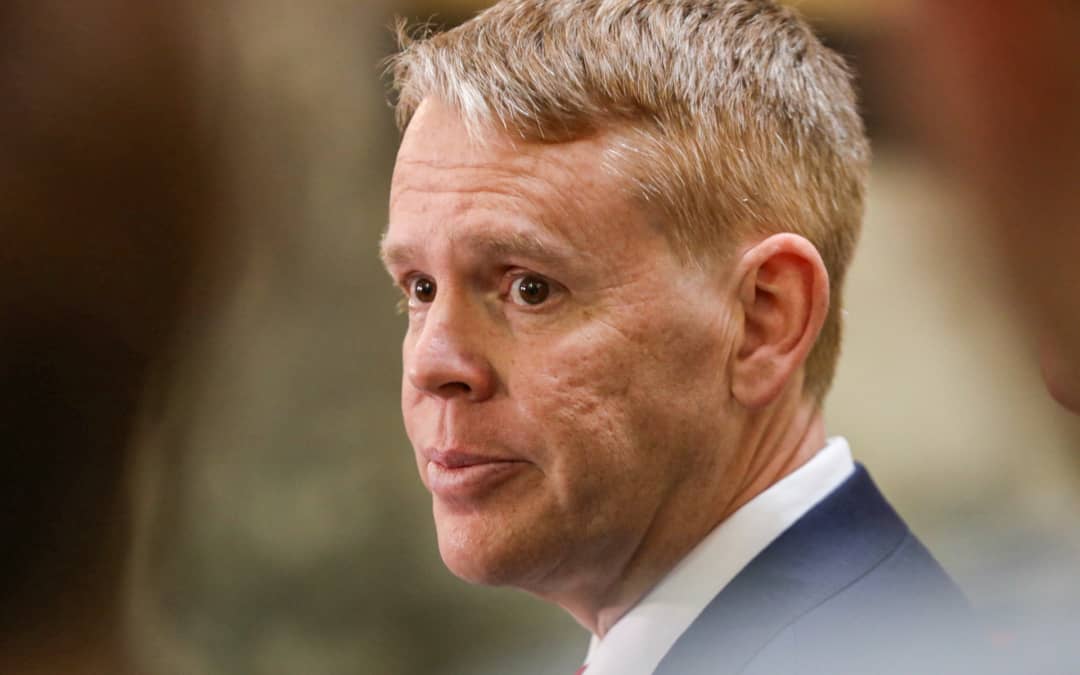
Opposition MPs have criticised National for political infighting. Photo: Zach Cornelisen / RNZ.
National’s 2023 victory cannot be separated from public dissatisfaction with Labour’s Covid-era governing and economic approach.
Lockdowns, government spending, Reserve Bank monetary stimulus, inflation, mandates and the subsequent cost-of-living crisis fundamentally changed the political environment.
Luxon successfully positioned National as the alternative.
But three years later, the comparison with Labour becomes less politically useful.
Governments eventually inherit ownership of the conditions over which they preside.
National therefore faces the same test Labour faced in 2023.
Not what did the previous Government do?
But:
What have you done?
Election 2026 Changes the Calculation
This leadership challenge therefore matters for reasons beyond Christopher Luxon’s personal political future.
New Zealand is approaching an election in which voters will be asked to assess three years of Coalition Government.
National will argue it inherited serious economic problems, restored discipline to government, strengthened international trade relationships and began the difficult work required to rebuild the economy.
Its opponents will point to unemployment, business failures, household pressure, government cuts, taxation and weak economic growth.
Both arguments deserve examination against measurable evidence.
That is where the coming election should be fought.
Not merely around personalities.
Not around political slogans.
And certainly not around which party can generate the most favourable headlines.
The Question National Must Answer
Luxon has survived another confidence vote.
Politically, that gives him another victory.
But leadership votes inside Parliament are decided by MPs.
The next confidence vote will be conducted by several million New Zealanders.
And unlike a caucus meeting, that vote cannot be managed behind closed doors.
With Election 2026 approaching, National now has a relatively short period in which to make its case.
The question confronting Christopher Luxon is therefore no longer simply whether his caucus has confidence in him.
It is whether New Zealand does.
Source
Russell Palmer, Political Reporter, RNZ — “Confidence only gets you so far: Undefeated, PM Christopher Luxon is still on the ropes.” Source material supplied for this eLocal Report.
Independent reporting. Original context. Credited sources.