New Zealand’s membership of the Paris climate agreement is emerging as a significant dividing line between the parties that currently make up the government. Christopher Luxon says remaining in Paris is an economic necessity; Winston Peters argues New Zealand must confront whether the agreement can realistically deliver what was promised.
eLocal Report: Based on reporting by Lillian Hanly, Political Reporter for RNZ — read the original report here.
New Zealand’s future participation in the Paris climate agreement has become an increasingly visible point of disagreement between Prime Minister Christopher Luxon and Foreign Minister Winston Peters, with the two leaders presenting markedly different arguments about the value of remaining within the international framework.
Luxon has made National’s position unusually clear ahead of potential post-election coalition negotiations. Asked by RNZ whether remaining in the Paris Agreement would be non-negotiable in talks with prospective coalition partners, Luxon confirmed that it would.
His argument is primarily economic rather than ideological. Luxon said leaving Paris would make New Zealand poorer and potentially expose exporters to consequences in international markets.
“We need to stay in the Paris Agreement because it only makes New Zealand poorer if we come out of it,” Luxon told RNZ.
That position puts National directly at odds with New Zealand First, which is campaigning on withdrawing from the agreement, while ACT has also indicated it does not support the existing commitment.
Peters Questions the Coalition Politics
Peters, speaking while attending the Pacific Islands Forum meeting in Palau, responded to Luxon’s declaration by questioning the Prime Minister’s political experience.
Asked whether Luxon was wise to establish Paris membership as a bottom line before coalition negotiations, Peters said the situation demonstrated that “experience does matter in politics”.
The NZ First leader said he was “quite astonished” by political leaders setting out bottom lines ahead of negotiations and argued that such an approach showed insufficient appreciation of the realities of MMP government.
It follows another recent disagreement between the coalition partners after National announced proposed legislation banning social media access for children under 16 without first securing support from its coalition partners.
Peters subsequently described that episode as showing “a lack of understanding of how the system works”.
Read RNZ’s report on that earlier coalition disagreement.
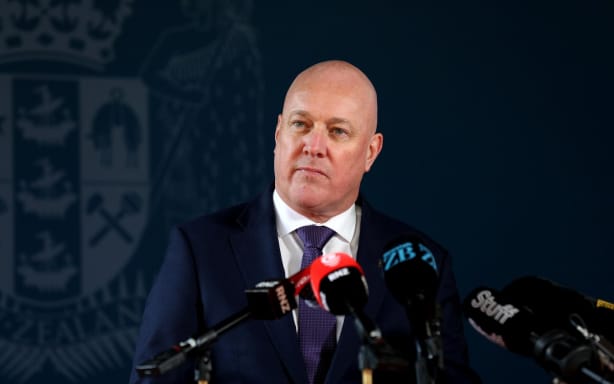
National leader Christopher Luxon. Photo: RNZ / Nick Monro
Peters Questions Whether Paris Can Deliver
Behind the political exchange is a more substantive disagreement about the effectiveness of the Paris framework itself.
Pacific nations are discussing their commitment to the agreement and its objective of holding the increase in global average temperatures to well below 2°C above pre-industrial levels, while pursuing efforts to restrict warming to 1.5°C.
RNZ has reported on the Pacific nations’ discussions here.
Peters questioned whether those ambitions could meaningfully be achieved while some of the world’s largest economies remained responsible for a substantial share of global emissions. He specifically named China, Russia, the United States and India.
“This is our problem we've got here. Can we possibly actually honour the Paris Accord in any meaningful way, while that is going on?” Peters said.
He acknowledged that raising the argument while attending the Pacific Islands Forum was politically difficult because it “doesn't suit the conversation”.
Peters also pointed to New Zealand’s original position around agricultural food production, saying the country’s participation had been secured in the context that food supply would be exempt.
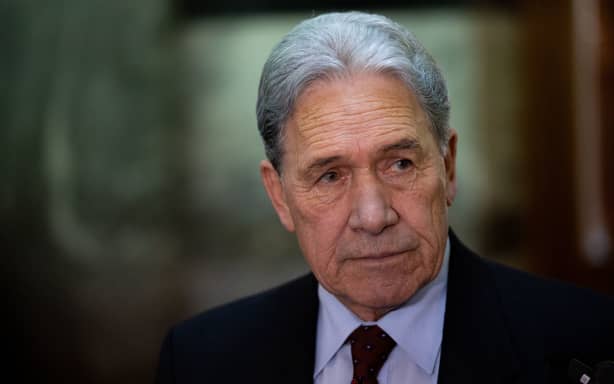
New Zealand First leader Winston Peters. Photo: RNZ / Baz Macdonald
Luxon Says It Comes Down to Trade
Luxon declined to engage directly with Peters’ criticism of his political experience. Instead, he returned to what he described as the economic case for remaining within Paris.
“There’s no doubt about it,” Luxon said.
He argued that competitor nations and multinational companies purchasing New Zealand products could remove those products from shelves if New Zealand withdrew from the international climate framework.
“That’s just going to hurt every single farmer, every single New Zealander if we did that,” he said.
For Luxon, therefore, Paris membership is not simply about New Zealand’s contribution to reducing global emissions. It is also about protecting the country’s position as an export economy selling agricultural and other products into markets where environmental commitments increasingly form part of commercial and regulatory expectations.
Luxon also defended Peters’ record in the Pacific, pointing to investments supporting climate resilience across the region as evidence that the Foreign Minister understood the threat climate change posed to Pacific nations.
New Zealand Is Already Off Track
There is another complication in the debate: New Zealand is currently not on track to meet the targets associated with its Paris commitments.
Luxon acknowledged the difficulty, saying the government would “do the best we can” while seeking to avoid sending billions of dollars offshore.
That creates an important distinction in the political argument.
The question is no longer simply whether New Zealand should belong to the Paris Agreement. It is also what remaining a member ultimately requires New Zealand to do — domestically or internationally — if its emissions targets cannot be achieved within the country.
For voters, exporters and taxpayers, that may prove to be the more consequential question.
Pacific Nations Want the Commitment Maintained
International relations expert Professor Alexander Gillespie told RNZ that Palau was seeking a climate declaration involving continued Pacific commitment to the Paris Agreement and its 1.5°C objective.
“That is a commendable goal,” Gillespie said.
“You want the Pacific countries to be leading this challenge, because in terms of risk, they are at the forefront of the risk.”

Professor Alexander Gillespie. Photo: Wayne Mead
Gillespie nevertheless pointed to the international difficulty confronting Pacific governments. Some countries have withdrawn from or weakened their climate commitments while vulnerable Pacific nations continue to face substantial adaptation costs.
He estimated the Pacific requires around $3 billion annually for climate adaptation, while currently receiving perhaps $1 billion or slightly less.
Does This Affect New Zealand?
Very directly.
The disagreement exposes three separate questions that are likely to matter beyond the election campaign.
The first is trade. Luxon argues Paris membership helps preserve New Zealand’s access to overseas customers and multinational buyers. If that is the basis for remaining, the economic consequences of either staying or leaving should be capable of being quantified rather than treated simply as political assertions.
The second is cost. New Zealand is not presently on track to achieve its Paris targets. If future compliance requires purchasing offshore carbon credits or making other international payments, voters have a legitimate interest in knowing the likely cost, who ultimately pays it, and what measurable global environmental benefit New Zealand receives in return.
The third is effectiveness. Peters’ argument raises the question of what New Zealand’s commitments can realistically achieve when major emitting economies follow different trajectories. Conversely, New Zealand’s relatively small share of global emissions does not by itself answer Luxon’s argument that participation may carry economic value through trade relationships and market access.
Those are different propositions and should be assessed separately.
As coalition negotiations increasingly determine which election policies actually become government policy under MMP, the dispute also illustrates a broader political reality: campaign positions and coalition outcomes are not necessarily the same thing.
Whether Paris ultimately becomes a genuine coalition bottom line may therefore tell voters almost as much about the operation of New Zealand’s MMP system as it does about climate policy.
Source
Lillian Hanly, Political Reporter, RNZ: “Winston Peters takes crack at Christopher Luxon over Paris climate agreement stance”
Additional RNZ links retained from the original report:
New Zealand's four Realm leaders and the Pacific climate discussion
Luxon says remaining in Paris is non-negotiable
Pacific leaders gather in Palau ahead of PIF meeting
Coalition name-calling as Labour backs social media ban
Independent reporting. Original context. Credited sources.