New Zealand’s two largest political parties have both fallen below 30 percent in the latest Taxpayers’ Union-Curia poll, while support has shifted sharply towards the Greens and ACT. Despite National’s decline, the current National-ACT-NZ First coalition would still retain a parliamentary majority on the poll’s projected seats.
eLocal Report: Based on reporting by RNZ Digital reporters for RNZ.
New Zealand’s political landscape is showing signs of fragmentation as both National and Labour lose support in the latest Taxpayers’ Union-Curia poll, leaving neither of the traditional major parties able to command even 30 percent of the party vote.
Labour recorded the larger historical setback, falling 1.9 percentage points to 25.9 percent. RNZ reports this is Labour’s lowest result in this particular poll since July 2024 and is below the 26.9 percent it received at the 2023 general election.
National also declined, dropping two percentage points to 29 percent. That puts the governing party substantially below the 38 percent party vote it secured at the 2023 election.
The result does not, however, translate into a change of government. On the poll’s seat calculations, National, ACT and New Zealand First would together hold 64 seats, compared with 56 seats for Labour, the Greens and Te Pāti Māori.
Greens and ACT Pick Up the Support
The most striking movement is occurring outside the two largest parties.
The Greens climbed 3.8 percentage points to 13.9 percent, while ACT increased 3.2 points to 10.5 percent. Together, those results suggest voters dissatisfied with the major parties are not necessarily moving across the traditional left-right divide. Instead, support appears to be shifting towards smaller parties on both sides.
New Zealand First declined 0.7 points to 8.4 percent, keeping it comfortably above the five-percent threshold.
Te Pāti Māori increased half a percentage point to 2 percent. Its parliamentary prospects remain closely connected to electorate results, with the party seeking to win Māori electorates rather than relying primarily upon reaching the five-percent party-vote threshold.
The smaller-party results reported by RNZ were NZ Loyal on 1.5 percent, Animal Justice on 1.2 percent, Women's Rights on 0.7 percent, Vision NZ on 0.5 percent and the New Conservatives on 0.5 percent.
Opportunity Falls Below the Threshold
The poll delivers a significant setback for Opportunity, led by Qiulae Wong.
After previously recording 6.1 percent in the same polling series, Opportunity has fallen to 4.5 percent. That leaves it below the five-percent threshold required to enter Parliament through the party vote without winning an electorate seat.
The distinction is potentially decisive. On the results reported by RNZ, Opportunity would receive no seats and therefore could not assume the kingmaker position suggested by some earlier polling.
That leaves the current governing bloc with a parliamentary majority despite National itself polling below 30 percent.
The result illustrates one of the defining characteristics of New Zealand’s MMP system: the fortunes of a government cannot be assessed simply by comparing National with Labour. Coalition arithmetic, electorate victories and whether smaller parties cross the five-percent threshold can determine the final balance of power.
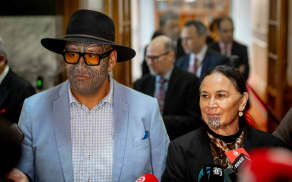
Te Pāti Māori are trying to win all seven Māori seats, rather than boost their party vote. Photo: RNZ / Mark Papalii
Luxon Remains Ahead of Hipkins
The weakening of the major parties is also reflected in the preferred prime minister numbers.
Christopher Luxon remains ahead of Chris Hipkins, but both leaders lost support. Luxon fell two percentage points to 21.2 percent, while Hipkins dropped 2.9 points to 16.9 percent.
That means the poll is not simply recording dissatisfaction with one government or one political leader. Both major parties and both men competing to lead the next government have lost ground simultaneously.
For Labour, the 25.9 percent result will be particularly uncomfortable because it places the party below its already poor 2023 election result. For National, falling below 30 percent raises a different issue: its ability to govern increasingly depends upon the combined strength of ACT and New Zealand First.
A More Fragmented Election Contest
Taken together, the numbers point towards an increasingly fragmented 2026 election contest.
National and Labour together account for just 54.9 percent of support in this poll. Meanwhile, the Greens, ACT and New Zealand First collectively account for 32.8 percent.
That does not by itself establish a permanent realignment. Individual opinion polls are snapshots rather than election results, and relatively small movements can substantially change MMP seat calculations — particularly when a party such as Opportunity is sitting close to the five-percent threshold.
But if the broader pattern persists, the election may increasingly be determined not by which major party dominates, but by how successfully each can assemble a governing bloc from a more dispersed electorate.
Does This Affect New Zealand?
Directly. The poll highlights how much New Zealand’s MMP system can amplify changes among smaller parties.
A party moving from 4.5 percent to just above five percent could potentially bring a new bloc of MPs into Parliament. Conversely, falling beneath the threshold can leave a substantial number of party votes without direct representation unless the party wins an electorate seat.
The more important signal may therefore be the combined weakening of National and Labour rather than which one happens to be ahead.
If both remain below 30 percent, ACT, the Greens, New Zealand First and potentially Opportunity could exercise considerably greater influence over coalition formation and the policies ultimately implemented after the election.
For voters, that makes the party vote — and the five-percent threshold — particularly consequential in 2026.
About the Poll
The poll was conducted by Curia Market Research for the New Zealand Taxpayers’ Union. It surveyed 1000 adult New Zealanders by telephone and online between 1 and 3 September 2026 and was weighted to the adult population.
The reported maximum margin of error is ±3.1 percentage points, and 4.1 percent of respondents were undecided on the party-vote question.
That margin is important when interpreting individual party movements. The poll provides evidence of current voter sentiment, but it should not be treated as a prediction of the final election result.
Source: RNZ Digital reporters, Labour and National polling collapsing - both under 30 percent, RNZ, September 2026. Read the original RNZ report
Independent reporting. Original context. Credited sources.