The predictions have become votes. Alternative für Deutschland has secured 43.8% in Saxony-Anhalt — its strongest result ever — leaving Germany's political establishment confronting a question that can no longer be contained by polling: will the largest party be able to govern?
INR Report: Based on reporting by ZeroHedge HERE
Germany's political earthquake did not end when the votes were counted.
It may only have begun.
Alternative für Deutschland secured 43.8% of the vote in Saxony-Anhalt's regional election, outperforming pre-election polling and delivering the party its strongest state-election result to date. Chancellor Friedrich Merz's Christian Democratic Union fell to 17.2%, while turnout reached a record 77.8%. The final result gave the AfD 39 of the state parliament's 83 seats — three short of the 42 required for an absolute majority. (OSW Ośrodek Studiów Wschodnich)
The voters turned out.
Now Germany has to decide what their votes mean.
AfD Wins — But Falls Three Seats Short
According to Deutsche Bank senior economist Marion Mühlberger, whose analysis is reproduced by ZeroHedge, the AfD's 39 seats produce an extraordinary parliamentary arithmetic.
The CDU, Social Democrats, Greens and Left also collectively hold 39 seats. The remaining five belong to the Bündnis Sahra Wagenknecht (BSW).
That makes a comparatively small political party potentially decisive in determining who governs Saxony-Anhalt.
X post retained from the original article:
View the embedded X post
The post was embedded by ZeroHedge immediately after its summary of the election result and parliamentary numbers.
BSW Becomes the Kingmaker
Mühlberger's analysis identifies two principal possibilities.
The first is an AfD minority government, potentially enabled by BSW without the parties entering a formal coalition.
The second is political deadlock followed eventually by another election.
BSW has called for political change in areas including energy policy, sanctions against Russia, education and public broadcasting. There is therefore some policy overlap between BSW and AfD, although BSW has rejected a formal coalition with the party. Reuters also reports that BSW representatives are prepared to talk with the AfD and that its five seats could make it the parliamentary kingmaker. (Reuters)
That does not necessarily prevent BSW from facilitating an AfD government.
One possibility would see BSW support or tolerate an AfD administration without formally joining it. Alternatively, its parliamentarians could abstain during a decisive vote, potentially allowing an AfD minority administration to emerge.
The distinction matters.
Germany's political firewall around the AfD could technically remain intact while the party nevertheless takes control of a state government.
Or Germany Could Vote Again
The second possibility is even more politically explosive.
AfD lead candidate Ulrich Siegmund has raised the prospect of another election rather than making far-reaching compromises simply to obtain coalition partners.
According to the Deutsche Bank analysis reproduced by ZeroHedge, there are several constitutional pathways through which an early election could eventually occur.
The newly elected parliament must convene by 6 October, but there is no fixed deadline for choosing the next state premier. The existing administration can therefore remain in a caretaker capacity while negotiations proceed.
If attempts to establish a government fail, parliament could ultimately dissolve itself under procedures set out in the regional constitution.
That would send voters back to the polls.
And that creates an enormous risk for parties attempting to exclude the AfD.
The Firewall Could Become an AfD Campaign Weapon
If another election occurs, the AfD would enter it with an extraordinarily simple political argument:
We won. You prevented us from governing. Give us the majority needed to govern alone.
Mühlberger specifically identifies the danger of such a narrative.
The argument that other parties are attempting to prevent the election winner from exercising power could strengthen the AfD's case for an outright majority. Smaller parties would simultaneously face the danger of falling below Germany's 5% electoral threshold, potentially changing the parliamentary arithmetic again.
There is no guarantee another election would produce an AfD majority. Opposition to the party could equally mobilise centrist and left-wing voters.
But forcing another election after an AfD vote of 43.8% would be an extraordinary political gamble.
The Economic Warning
Deutsche Bank's analysis is distinctly cautious about an AfD government.
Mühlberger argues that an AfD minority administration could damage Saxony-Anhalt's economic prospects through increased policy uncertainty, reduced direct investment and greater difficulty attracting skilled workers.
The analysis also identifies potential friction between an AfD administration and parts of the civil service.
However, Saxony-Anhalt represents less than 2% of German GDP. Mühlberger therefore considers it unlikely that economic difficulties within the state would materially affect Germany's overall economy.
Nor would an AfD state government control Germany's national fiscal or economic policy.
The greater significance of Saxony-Anhalt is political.
It could provide the AfD with something it has never previously possessed at this level: the experience and institutional legitimacy of governing.
Two More Elections Are Coming
Chancellor Merz has little time to absorb what happened.
Germany faces two more state elections on 20 September, in Berlin and Mecklenburg-Vorpommern.
The political environments are very different.
ZeroHedge cites the Polymarket market for Mecklenburg-Vorpommern, which at the time of its report placed the AfD's probability of winning at 82%.
Mecklenburg-Vorpommern Parliamentary Election Winner market
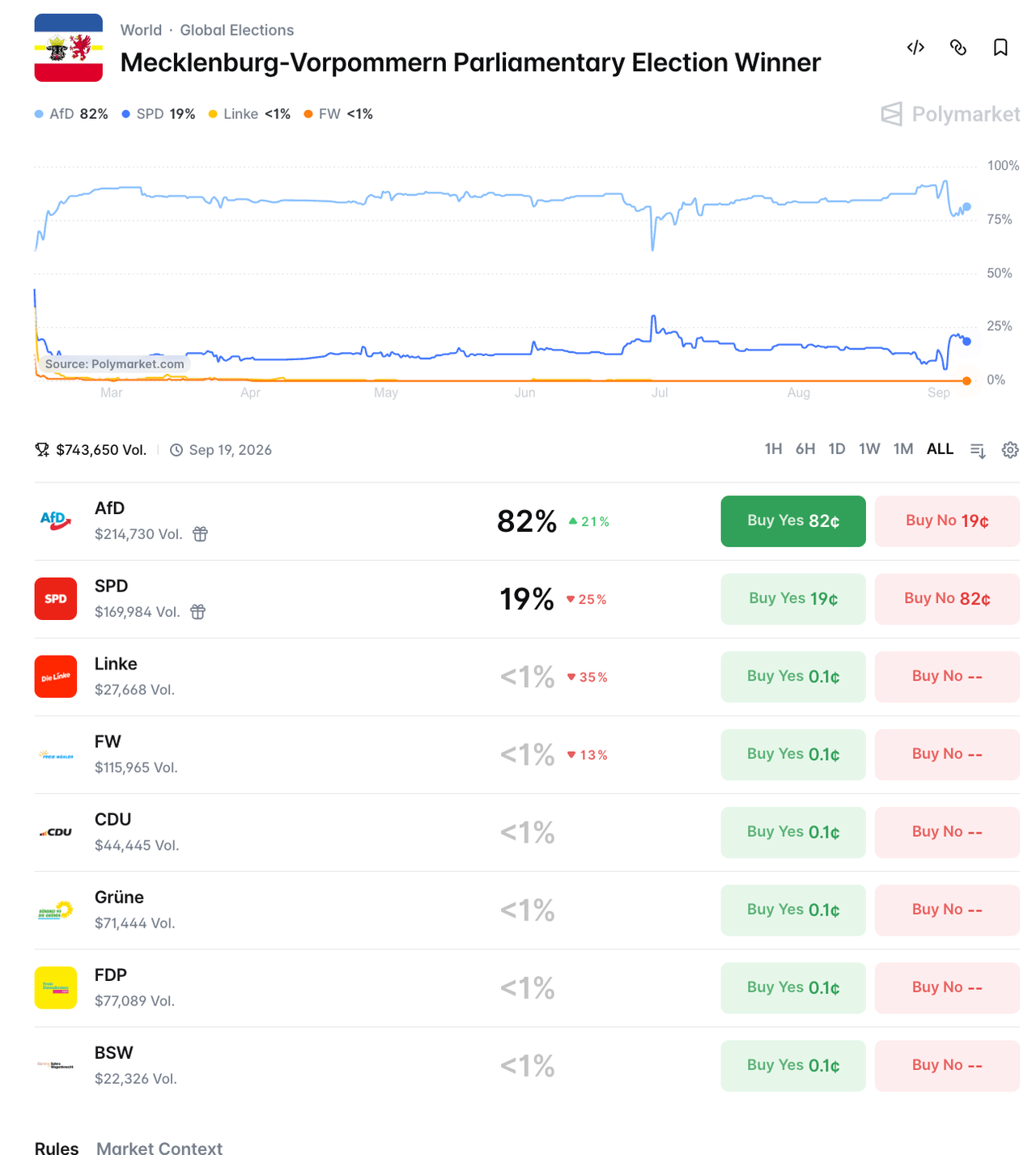
Prediction-market probabilities for Mecklenburg-Vorpommern. Image via ZeroHedge.
Berlin presents a considerably more difficult electoral landscape for the party.
ZeroHedge reported the corresponding Berlin prediction market at approximately 18% for an AfD victory.
Berlin State Election Winner market
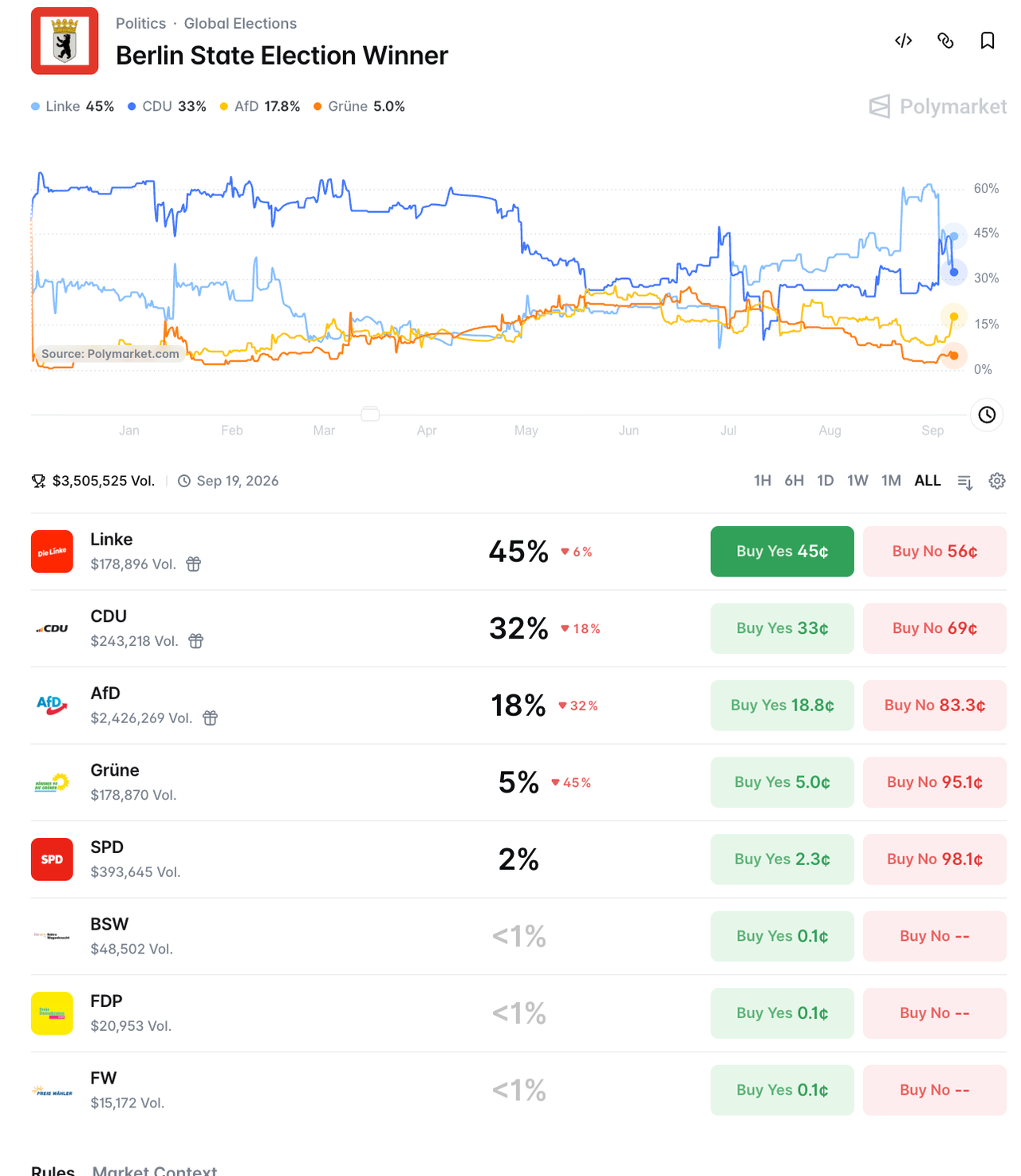
Prediction-market probabilities for the Berlin state election. Image via ZeroHedge.
For Merz, the immediate question is therefore whether Saxony-Anhalt represents the high-water mark of the AfD surge — or merely the first result in a sequence.
Markets Are Watching Something Different
There is another intriguing dimension to the political shift.
While Deutsche Bank's assessment warns of potential economic damage under an AfD administration, Nomura analyst Andrzej Szczepaniak has offered a different perspective on Europe's broader political movement.
ZeroHedge links to his analysis:
“Seeds Of Political Change”: Nomura Sees Europe Lurching Right, And Markets Are Fine With It
According to the ZeroHedge account, Szczepaniak argues that financial markets appear less concerned about right-wing populist parties than about populist parties of the left advocating substantially higher government spending.
That is significant.
For years, European political debate has frequently presented nationalist or populist electoral advances as inherently destabilising for markets.
Investors may be making a more pragmatic calculation, looking at taxation, expenditure, deficits, regulation and economic policy rather than political labels alone.
From Protest Party to Governing Party?
The greatest significance of Saxony-Anhalt may therefore have little to do with one state's economic output.
The AfD has spent much of its existence operating as an opposition movement.
Opposition allows political parties to attack the system without responsibility for administering it.
Government changes that.
Budgets must balance. Ministers must make decisions. Bureaucracies must be managed. Campaign promises collide with constitutional restrictions, federal responsibilities and economic realities.
An AfD government in Saxony-Anhalt would therefore become a political laboratory.
If it failed badly, Germany's mainstream parties could argue that the experiment demonstrated the risks they had warned about.
If it governed successfully, however, the consequences for Germany's political establishment could be profound.
The firewall surrounding the AfD depends partly upon the proposition that the party should not be normalised as a governing political force.
Once it governs somewhere, that argument becomes considerably harder to maintain.
The Numbers Have Changed the Argument
There is also an unavoidable democratic reality.
At 10% support, excluding a political party from governing coalitions is comparatively straightforward.
At 20%, it becomes harder.
At 43.8%, the argument changes fundamentally.
The AfD did not narrowly become the largest party in a fragmented field. It won more than twice the CDU's vote share and came within three parliamentary seats of governing alone. Independent reporting from Germany confirms the 43.8% result, 39 seats and record turnout. (OSW Ośrodek Studiów Wschodnich)
That does not require other political parties to abandon their principles or enter coalitions they oppose.
But it does mean that Germany's political establishment now faces a structural problem.
If the AfD continues increasing its vote, coalition arithmetic eventually ceases to provide an effective firewall.
Merz Faces the Political Consequences
The ZeroHedge report also retained a second X post addressing Chancellor Friedrich Merz and the political consequences of the result.
X post retained from the original article:
View the embedded X post
The political pressure on Merz is now extending beyond Saxony-Anhalt. Reuters reports that the AfD result has intensified strains within the federal governing coalition as Merz attempts to pursue economic and social reforms while confronting historically weak approval ratings. (Reuters)
Does This Affect New Zealand?
The German result offers a useful lesson for every representative democracy, including New Zealand.
Political systems can contain insurgent movements through coalition rules, institutional conventions and agreements among established parties.
What they cannot indefinitely contain is electoral mathematics.
When a sufficiently large share of the population concludes that established political parties no longer represent its interests, those voters do not necessarily return to the centre simply because their preferred party is excluded from power.
Exclusion can sometimes have the opposite effect.
It can reinforce the argument that the political establishment is protecting itself from voters rather than responding to them.
That does not mean Germany and New Zealand are politically equivalent. They clearly are not.
But the underlying democratic principle is universal.
Political legitimacy ultimately depends upon voters believing that elections can meaningfully affect who governs and the direction in which their country travels.
Saxony-Anhalt has now moved the European debate beyond polling, speculation and protest.
43.8% of voters have delivered a result.
The next question is whether that result produces a government.
And with Berlin and Mecklenburg-Vorpommern voting on 20 September, Europe may not have to wait long to discover whether Saxony-Anhalt was an exception — or the beginning of something much larger.
Source: ZeroHedge, 8 September 2026 — AfD's Historic Win Shocks German Political Establishment: Here's What Happens Next
Independent reporting. Original context. Credited sources.