Britain, France and Canada are moving to restrict imports from Israeli settlements in the occupied West Bank as international pressure over settlement expansion and violence intensifies. New Zealand has joined calls for Israel to change course but is stopping short of the trade measures being pursued by several of its traditional partners.
eLocal Report: Based on reporting by Lillian Hanly and Peter Hutchison for RNZ, with AFP reporting HERE
Britain, France and Canada have announced plans to ban imports from Israeli settlements in the occupied West Bank, marking a significant escalation in Western pressure on Israel over settlement expansion and violence involving Israeli settlers and Palestinians.
The measures were announced alongside broader international criticism of Israel's West Bank policy. British Foreign Secretary Ed Miliband told Parliament that the British government believed Palestinians were being subjected to what he described as “ethnic cleansing” in parts of the West Bank by violent settlers, while accusing the Israeli government of failing to adequately intervene. Israel strongly rejected those accusations.
London, Paris and Ottawa also joined nine European countries in a statement supporting restrictions on trade with Israeli settlements. Britain, France and Canada separately warned that continued settlement activity represented a direct threat to prospects for a two-state solution.
Britain Moves From Condemnation to Trade Restrictions
The importance of the announcement lies partly in the transition from diplomatic criticism and individual sanctions to restrictions affecting economic activity.
Britain's measures are expected to cover goods originating from Israeli settlements. According to RNZ and AFP, the settlements principally export agricultural products, wine, Dead Sea cosmetics and various industrial goods.
Trade between Britain and the occupied Palestinian territories was approximately £38 million in 2025, according to figures cited from the British government, suggesting the immediate economic effect may be relatively limited. Politically, however, the decision establishes a clearer distinction between trade with Israel itself and trade originating in settlements in occupied territory.
Ireland and Spain have already introduced measures affecting settlement trade, while France has been advocating similar action at European Union level. Denmark, Finland, Iceland, Ireland, Norway, Poland, Portugal, Spain and Sweden joined the latest foreign ministers' statement alongside Britain, France and Canada.
French Foreign Minister Jean-Noël Barrot also said on X that France “will end trade” with settlements in the occupied West Bank.
The United States is taking a different position. US Secretary of State Marco Rubio said Washington would not join the measures, with RNZ reporting that the United States does not want to destabilise the occupied territory.
Israel Responds Against Britain
Israel reacted quickly to Britain's announcement.
The Israeli government ordered the closure of Britain's consulate in Jerusalem and banned 12 British citizens from entering the country, including politicians from Britain's governing Labour Party.
Israel also announced that British diplomats would be removed from a centre involved in monitoring the US-brokered Gaza ceasefire arrangements and that British involvement in training Palestinian Authority forces would be prohibited.
Israeli Foreign Minister Gideon Saar described Miliband's accusations in Parliament as “outrageous lies”.
The confrontation therefore extends beyond the comparatively modest value of the affected trade. It represents a significant deterioration in diplomatic relations between Britain and Israel.

British Foreign Secretary Ed Miliband addresses the House of Commons on the proposed import ban covering goods from settlements in occupied Palestinian territories. AFP PHOTO / PRU. Editorial use restrictions apply.
Settlement Expansion Drives International Pressure
The underlying dispute concerns Israel's continued expansion of settlements in the occupied West Bank.
Israeli Prime Minister Benjamin Netanyahu has vowed to continue establishing settlements. The settlements are regarded as illegal under international law by the United Nations and most of the international community, a position Israel has disputed in various legal and political contexts.
Particular concern surrounds the E1 development plan, approved by Israel last year after having been frozen for decades. RNZ reports that the plan would involve approximately 1,200 housing units and would further separate Israeli-annexed East Jerusalem from other parts of the West Bank.
The issue has become increasingly intertwined with reports of settler violence against Palestinians.
According to an AFP tally based on Palestinian health ministry figures cited by RNZ, Israeli forces or settlers have killed at least 1,105 Palestinians in the West Bank since the beginning of the Gaza war following Hamas's 7 October 2023 attack on Israel.
Britain is also expanding sanctions beyond trade. Companies and individuals providing construction, financing or real-estate services supporting settlements could face British sanctions, while advertising or promoting property within Israeli settlements will be prohibited in Britain.
Five additional individuals accused of involvement in violent attacks against Palestinians have also been sanctioned. London says it has now imposed sanctions on 38 people in connection with settler activity.
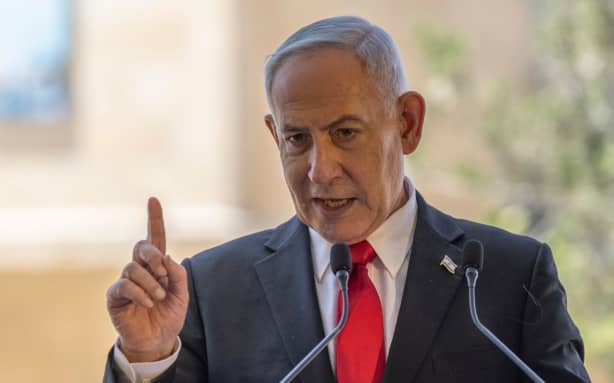
Israeli Prime Minister Benjamin Netanyahu has vowed to continue establishing settlements. AFP / Ilia Yefimovich
New Zealand Condemns Settlements — But Draws a Line at Trade
New Zealand's position is notable because Wellington agrees with much of the criticism being directed at Israeli settlement policy while declining to adopt the trade response announced by Britain, France and Canada.
Foreign Minister Winston Peters said New Zealand was “deeply concerned by the deteriorating situation in the West Bank”, warning that there had been a marked escalation in Israeli actions that threatened the prospects for a durable peace.
Peters reaffirmed New Zealand's position that Israeli settlements in the occupied Palestinian territories violate international law and that further expansion undermines the prospects for a two-state solution.
New Zealand also strongly condemned violence by Israeli settlers against Palestinian civilians and called for accountability.
Peters joined international partners in calling on Israel to end settlement expansion, prevent and address settler violence and avoid actions that further undermine prospects for peace.
He additionally said New Zealand strongly opposed measures advancing annexation or threatening the forcible displacement of Palestinians.
But Wellington stopped there.
Why New Zealand Will Not Join the Import Ban
A spokesperson for Peters drew an important distinction between sanctions and restrictions on international trade.
New Zealand, the spokesperson said, has not traditionally used trade measures to address foreign-policy issues.
Introducing such restrictions would require a substantially broader policy process and would be complex. The government is not prepared to undertake that process ahead of New Zealand's election.
That does not mean New Zealand has taken no punitive action.
The government says it has imposed travel bans on 38 Israeli settlers and two Israeli ministers, with the most recent measures announced in June. According to Peters' spokesperson, those restrictions represent a clear signal that settler violence is considered unacceptable.
New Zealand's approach therefore remains one of diplomatic condemnation and targeted restrictions rather than using access to the New Zealand market as an instrument of foreign policy.
A Growing Division Among Western Governments
The announcements expose an increasingly complicated Western approach towards Israel.
Britain, France and Canada are moving towards direct economic measures against settlement activity. A wider group of European governments supports restrictions, while Ireland and Spain have already acted.
New Zealand agrees with much of their criticism but has declined to follow them into trade restrictions.
The United States has rejected joining the new measures altogether.
Israel, meanwhile, argues that some of the accusations being levelled against it are false and has demonstrated that governments taking action may face diplomatic retaliation.
This means what began principally as international criticism of settlement construction is developing into a broader argument about trade, sanctions, diplomatic relations and the willingness of Israel's traditional Western partners to impose material consequences.
Does This Affect New Zealand?
Directly.
The issue now presents New Zealand with a foreign-policy choice that goes beyond issuing statements about the Middle East.
Wellington's position is that the settlements violate international law, settlement expansion undermines a two-state solution, settler violence must be addressed and actions threatening forced displacement are unacceptable. Yet the government has also decided that trade restrictions are not presently the appropriate mechanism for responding.
That distinction is important because Britain, France and Canada are moving in the opposite direction.
For New Zealand exporters and policymakers, there is also a broader precedent to consider. Using import restrictions as an instrument of foreign policy moves trade policy into territory traditionally occupied by diplomatic sanctions. New Zealand's reluctance suggests the government remains wary of blurring those boundaries without a full domestic policy process.
The immediate question is therefore not whether New Zealand agrees with its partners about settlement expansion. On much of that issue, it clearly does.
The question is how far New Zealand is prepared to go to enforce that position economically.
For now, Winston Peters has drawn the line before a trade ban.
Source: Lillian Hanly, RNZ Political Reporter, and Peter Hutchison with Delphine Touitou in Paris, AFP/RNZ, 9 September 2026 — UK, France, Canada to ban imports from Israeli settlements - NZ critical but stops short of joining
Independent reporting. Original context. Credited sources.