German Chancellor Friedrich Merz has cancelled a planned appearance at the United Nations General Assembly in New York as political pressure intensifies at home. The decision follows a severe CDU defeat in Saxony-Anhalt, deteriorating public confidence in Merz and further state elections that could reshape Germany's political landscape.
Merz Cancels UN Trip as Political Pressure Builds in Germany
Chancellor stays in Berlin after major CDU electoral setback
German Chancellor Friedrich Merz has cancelled a planned appearance at the United Nations General Assembly in New York as political pressure intensifies at home. The decision follows a severe CDU defeat in Saxony-Anhalt, deteriorating public confidence in Merz and further state elections that could reshape Germany's political landscape.
INR Report: Based on reporting by Reuters and RT, independently checked against German and international reporting. Read the original RT report HERE:
https://www.rt.com/news/645858-germany-merz-cancels-un/
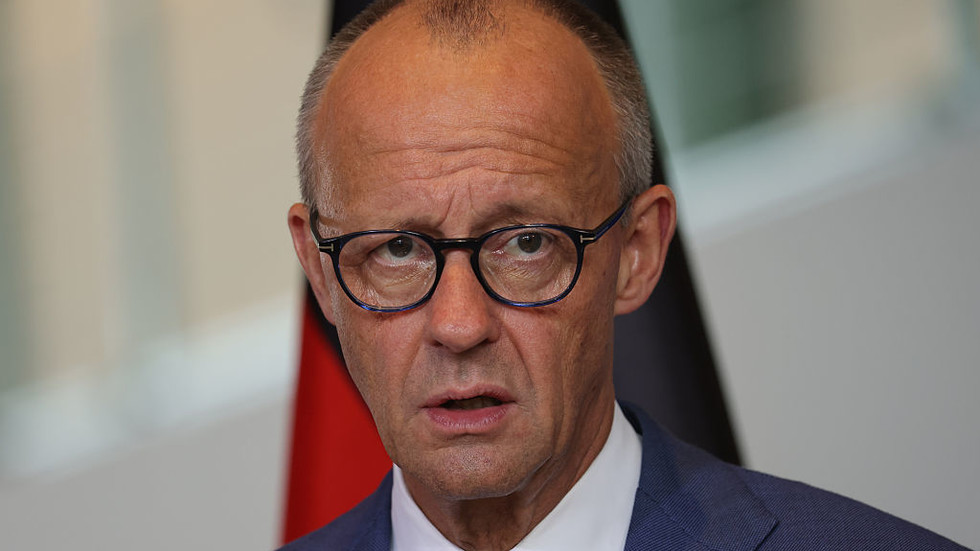
German Chancellor Friedrich Merz speaks at a press conference in Berlin, Germany, 15 September 2026. Credit: Getty Images / Michele Tantussi
Berlin Takes Priority Over New York
German Chancellor Friedrich Merz will no longer travel to New York for the United Nations General Assembly as originally planned.
A German government source told Reuters that Merz's "presence is required in Berlin." The cancellation comes as his Christian Democratic Union confronts one of the most difficult periods of his chancellorship, with further regional elections approaching and questions emerging within Germany about his political leadership.
Reuters reports that the CDU has called a special meeting as the party attempts to respond to recent electoral setbacks. Eight CDU state premiers subsequently issued a joint statement supporting Merz and arguing that political stability should take precedence over internal leadership disputes. Bavaria's CSU leader Markus Söder has also publicly backed him.
That support is significant because speculation about Merz's future has intensified, but there is an important distinction between political pressure and an imminent resignation. Merz has publicly indicated that he intends to remain chancellor and complete his term.
AfD Reshapes the Political Landscape
The immediate political shock came from Saxony-Anhalt, where the Alternative for Germany made major gains at the expense of the established parties.
Reuters reports that the result has intensified pressure on Merz ahead of further state elections. National polling cited by Reuters places the AfD at around 27 to 29 percent and the CDU/CSU at approximately 18 to 20 percent.
The significance extends beyond one state election.
Germany's mainstream parties have traditionally maintained a political Brandmauer, or firewall, against cooperation with the AfD. As the party's electoral support has expanded, maintaining that strategy while forming workable governments has become increasingly difficult.
Public attitudes toward the firewall are themselves changing. An INSA survey reported this month found 46 percent of respondents considered the policy of refusing cooperation with the AfD no longer appropriate, while 34 percent supported maintaining it.
That does not establish that German voters broadly support an AfD government. It does demonstrate that the political mechanism used by Germany's established parties to isolate the AfD is facing increasing public scrutiny.
Merz's Personal Support Falls
The political problem is also increasingly personal for the Chancellor.
An INSA online survey commissioned by Bild and conducted on 10 and 11 September asked respondents whether Friedrich Merz was still the right person to serve as German Chancellor.
Seventy-eight percent answered no, 14 percent said yes and 8 percent gave no answer.
Even among CDU and CSU voters, 58 percent answered no while 36 percent continued to support Merz as the right person for the office.
Those figures should not be confused with an election result or a conventional party-vote poll. They measure responses to a specific question about Merz's suitability as chancellor.
Nevertheless, when combined with the CDU's electoral difficulties, they help explain why remaining in Berlin has taken precedence over appearing at the UN in New York.
Germany's Economic Problem
Behind the electoral upheaval lies a broader argument about Germany's economic direction.
The country has faced prolonged industrial weakness, high energy costs and pressure on some of the manufacturing industries that have historically underpinned Europe's largest economy. These problems have become intertwined with arguments over Germany's energy policy, sanctions against Russia, defence expenditure, welfare spending and the competitiveness of German industry.
RT attributes Germany's industrial problems directly to Berlin's decision to move away from Russian oil and gas. That is too narrow as a complete explanation.
The loss of relatively inexpensive Russian pipeline energy has been an important factor for energy-intensive German industries, but Germany's economic difficulties also involve weak investment, demographics, regulation, infrastructure, international competition, changing automotive markets and longer-term structural problems.
The distinction matters because the political argument now taking place inside Germany is not simply about one government decision. It concerns the economic model on which German prosperity has rested for decades.
Defence, Welfare and Competing Priorities
Merz has simultaneously committed Germany to substantially greater defence capability.
He has spoken of building the strongest conventional army in Europe while arguing that Germany's existing welfare arrangements require reform. These positions have created a politically difficult debate over where government resources should be directed as economic growth remains under pressure.
The opposition has been able to exploit that tension.
For voters confronting living costs and uncertainty over Germany's industrial future, increased military expenditure and proposed changes to social programmes provide obvious political dividing lines.
Merz, however, argues that European security cannot be separated from Germany's economic future. He has maintained strong support for Ukraine and warned about the consequences for European security should Russia prevail in the conflict.
This creates a fundamental policy dispute rather than a simple question of government popularity: how much economic cost European governments should accept to strengthen defence and maintain their geopolitical strategy toward Russia.
A Chancellor Staying the Course
Despite the pressure, Merz has rejected suggestions that individual state election results should determine whether he remains Chancellor.
His position is that Germany requires political stability and that his government needs time to implement economic and political reforms.
That argument now faces an increasingly difficult electoral test.
The CDU's state premiers have rallied publicly behind him, indicating that a leadership challenge is not inevitable. At the same time, the decision to cancel a major international appearance demonstrates how seriously Germany's governing conservatives are treating the domestic political situation.
The next state election results will provide further evidence about whether the recent upheaval represents a regional protest or a more fundamental restructuring of German politics.
Does This Affect New Zealand?
Germany is Europe's largest economy and one of the European Union's most influential political powers. Political instability in Berlin therefore has consequences extending well beyond Germany, including for countries such as New Zealand whose trade and foreign policy increasingly intersect with Europe.
The most immediate relevance is economic. Germany remains an important market and investment partner within the wider EU relationship. Persistent German industrial weakness can affect European growth, demand and investment conditions, which in turn matter for New Zealand exporters operating under the New Zealand-European Union Free Trade Agreement.
There is also a geopolitical dimension. Germany has become central to Europe's expanding defence commitments and support for Ukraine. A substantial change in German public support for those policies could influence European decisions on Ukraine, Russia, NATO spending and sanctions. Those decisions can eventually reach New Zealand through diplomatic alignment, sanctions policy, defence cooperation and international trade.
The rise of the AfD also reflects a political development occurring across several Western democracies: voters challenging established parties over immigration, living costs, energy policy, national sovereignty and the economic consequences of international commitments.
New Zealand's circumstances are different and German voting patterns should not simply be projected onto New Zealand politics. But Germany provides a useful international case study of what can happen when foreign policy, energy security, industrial competitiveness and household economic pressure converge.
For New Zealand, the relevant question is therefore not whether Friedrich Merz survives politically. It is what Germany's political upheaval tells us about the durability of European economic and foreign policy settings that New Zealand increasingly interacts with.
Sources
RT, 16 September 2026:
https://www.rt.com/news/645858-germany-merz-cancels-un/
Reuters, 15 September 2026:
https://www.reuters.com/world/europe/embattled-merz-seeks-party-backing-ahead-fresh-election-tests-germany-2026-09-15/
Reuters, 16 September 2026:
https://www.reuters.com/world/europe/german-conservative-state-premiers-back-embattled-merz-joint-statement-2026-09-16/
Reuters, 16 September 2026:
https://www.reuters.com/world/europe/merzs-fate-balance-second-eastern-german-state-goes-polls-2026-09-16/
RTL/dpa, 12 September 2026:
https://www.rtl.de/news/78-prozent-lehnen-friedrich-merz-als-kanzler-ab-id31299381.html
Independent reporting. Original context. Credited sources.