Scientists have identified the largest newly formed impact crater yet discovered in the solar system, after comparing images captured by NASA’s Lunar Reconnaissance Orbiter. The 222-metre-wide McGetchin crater appears to have formed during a rare collision in 2024, providing researchers with an unusually fresh laboratory for studying how major impacts transform the lunar surface.
INR Report: Based on reporting by RT, with findings cross-checked against NASA reporting HERE.
Scientists have discovered an enormous new crater on the Moon that NASA estimates was produced by an impact occurring only about once every century or longer.
The crater measures approximately 222 metres (728 feet) across and 43 metres (141 feet) deep. It has officially been named McGetchin, honouring pioneering lunar scientist Tom McGetchin. NASA says it is the largest newly formed crater yet discovered anywhere in the solar system.
Researchers determined that the impact occurred sometime between 11 April and 22 May 2024, when a comet or asteroid roughly comparable in size to a three- to six-storey building struck the Moon.
Hidden in Years of Lunar Images
The crater was first identified by researcher Robert Wagner during a routine examination of images from the Lunar Reconnaissance Orbiter Camera’s Wide-Angle Camera in October 2025. Scientists subsequently used higher-resolution observations to examine the crater and surrounding terrain.
The discovery depended on comparing images of the same regions of the Moon taken years apart. Software highlights changes between the datasets, allowing researchers to search for evidence of new impacts.
NASA says the technique has already helped scientists identify at least 1,000 new impact craters during the Lunar Reconnaissance Orbiter’s mission, together with around 100,000 other surface changes associated with impacts and debris.
McGetchin, however, was dramatically larger than the normal changes detected.
Before its discovery, the largest recently formed lunar impact crater identified by scientists measured about 70 metres across, according to the RT report.
Seven-Kilometre ‘Cold Spot’ Surrounds the Crater
The collision did considerably more than excavate the crater itself.
Thermal observations revealed an approximately seven-kilometre-wide cold region around the impact site. At night, temperatures there can be around 9°C lower than surrounding terrain.
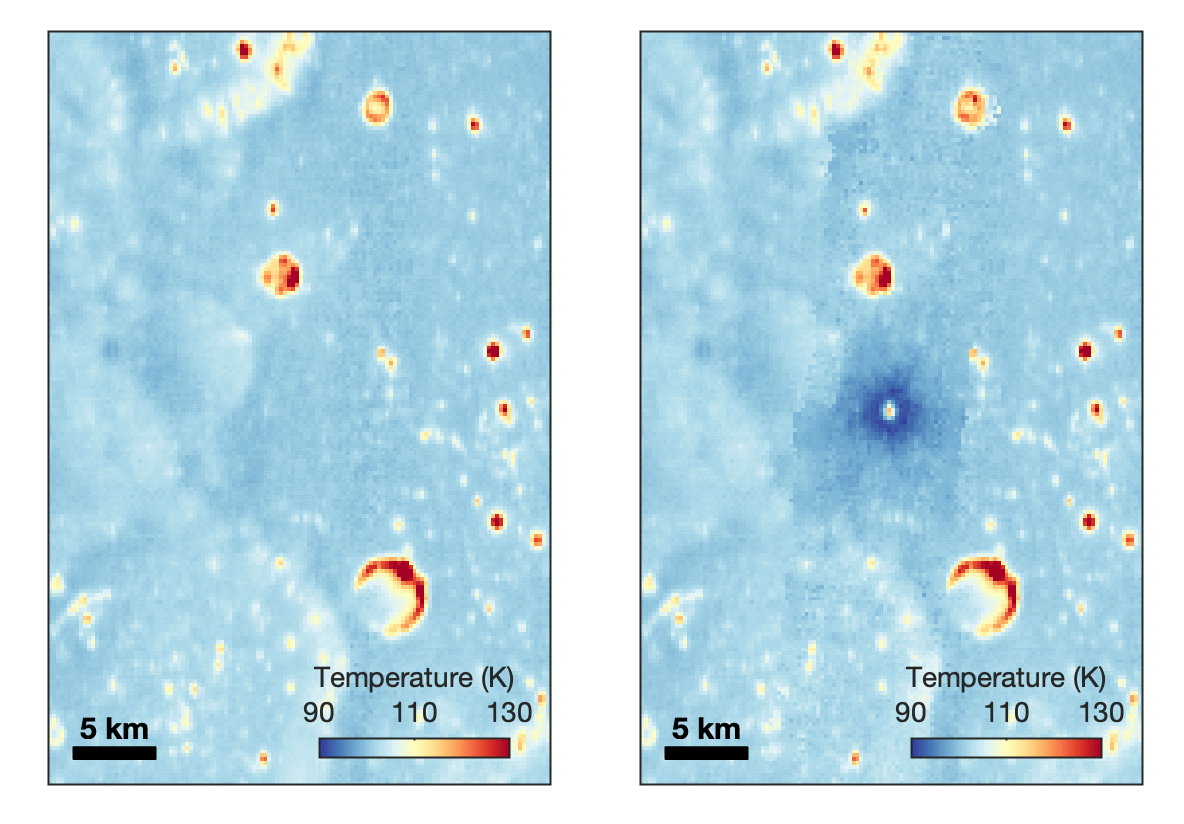
Animated imagery shows the eastern lunar region before and after McGetchin crater formed. Credit: NASA Goddard/UCLA/JHU APL
Researchers believe the impact disturbed or “fluffed up” the Moon’s regolith, the loose layer of dust and broken rock covering the surface.
This makes the material less dense and less capable of retaining heat overnight.
The scale of the disturbance is scientifically significant because it demonstrates that a major collision can physically alter the lunar surface far beyond the crater itself. NASA notes that understanding these changes could eventually help researchers assess how rover wheels and other equipment interact with recently disturbed lunar terrain.
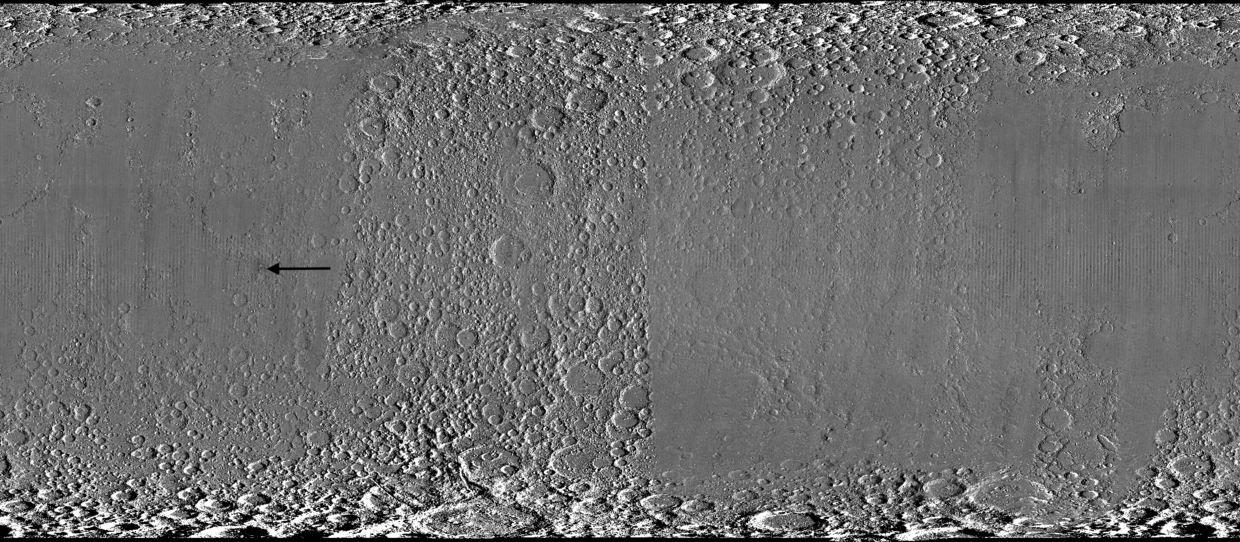
Global view of the Moon assembled from hundreds of Wide-Angle Camera images captured by NASA’s Lunar Reconnaissance Orbiter. Credit: NASA
A Changing Moon
The discovery provides another reminder that the Moon, although appearing largely static from Earth, remains exposed to continuing bombardment.
Unlike Earth, the Moon has no substantial atmosphere capable of slowing or destroying incoming objects before they reach the surface.
NASA estimates that impacts large enough to create McGetchin may occur only about once a century or less frequently. Smaller collisions are far more common. Scientists estimate that impacts capable of producing craters around nine metres wide occur roughly 140 times across the Moon each year.
The newly discovered crater therefore gives scientists a rare opportunity to study the immediate geological and thermal consequences of a comparatively large lunar collision.
Renewed International Focus on the Moon
The discovery comes as the Moon becomes an increasingly important focus for major space powers.
NASA’s Artemis programme is intended to return astronauts to the lunar surface and ultimately support a sustained human presence. Russia and China, meanwhile, are developing plans for the International Lunar Research Station, with longer-term proposals including power infrastructure to support scientific operations.
As lunar activity expands, understanding recent impacts and the way they alter surface conditions will become increasingly relevant to landing-site selection, infrastructure and robotic exploration.
Does This Affect New Zealand?
For New Zealand, the immediate significance is scientific rather than geopolitical.
The discovery demonstrates how long-running orbital observation programmes can reveal changes that would otherwise remain invisible, while providing new information about impact hazards and surface conditions relevant to future lunar exploration.
There is also a broader connection to New Zealand’s growing participation in the international space economy. As lunar exploration moves from occasional missions toward sustained scientific and potentially commercial activity, research into surface conditions, spacecraft operations and planetary science becomes increasingly relevant to countries participating in the wider space sector.
McGetchin is therefore more than another crater on a distant landscape. It is a newly created natural experiment, formed within the past two years, that scientists can now observe almost from the moment of impact.
Independent reporting. Original context. Credited sources.
Source
RT, “‘Once-in-a-century’ crater discovered on Moon (PHOTOS)”, 18 September 2026.
Read the original RT report
NASA, “NASA’s Moon Orbiter Spots New, ‘Once-in-Century’ Moon Crater”.
Read the NASA report