New Zealand’s political parties broadly agree the country needs substantially more electricity and that households need relief from rising power costs. The real election argument is over who should finance new generation, how much control the major electricity companies should retain, and whether household solar can finally give consumers meaningful power of their own
Power has become more than another election policy. It sits underneath household living costs, manufacturing, transport, data centres, food production and New Zealand's ability to attract and retain productive industry.
That makes the competing energy policies outlined by Power Compare especially important. National and ACT favour increased private investment and competition, Labour places greater emphasis on household solar and consumer protection, the Greens propose a new publicly owned generator, New Zealand First wants structural separation of the major generator-retailers, while Opportunity proposes a major renewable build-out and regulatory consolidation.
The promises differ substantially, but there is a more fundamental question for households than which party can announce the most megawatts.
Will this in fact make New Zealand stronger? The practical test is whether the policy produces abundant, reliable electricity at a lower total cost, strengthens competition, reduces household vulnerability to rising prices and supports productive New Zealand businesses without simply transferring costs from power bills to rates, taxes or public debt.
The Problem Is Not Simply Generating More Electricity
New Zealand already produces an unusually high proportion of its electricity from renewable sources. MBIE reports that renewables supplied 92 percent of electricity generation in the June 2026 quarter, the highest renewable share recorded for a June quarter. Solar generation reached a June-quarter record and geothermal generation also hit a record.
Yet household electricity costs increased 10 percent over the same period, with MBIE identifying higher network charges as the principal driver. The March quarter had shown an 11.7 percent annual increase in average household electricity costs, also driven primarily by higher lines charges.
That distinction matters.
Building more generation may reduce pressure on wholesale electricity prices, but it does not automatically guarantee lower household bills. Consumers ultimately pay for generation, transmission, local distribution, retailing and the capital expenditure required to expand and maintain the system.
Any credible energy policy therefore has to answer two questions simultaneously: where will the additional electricity come from, and how will the total delivered cost to the household actually fall?
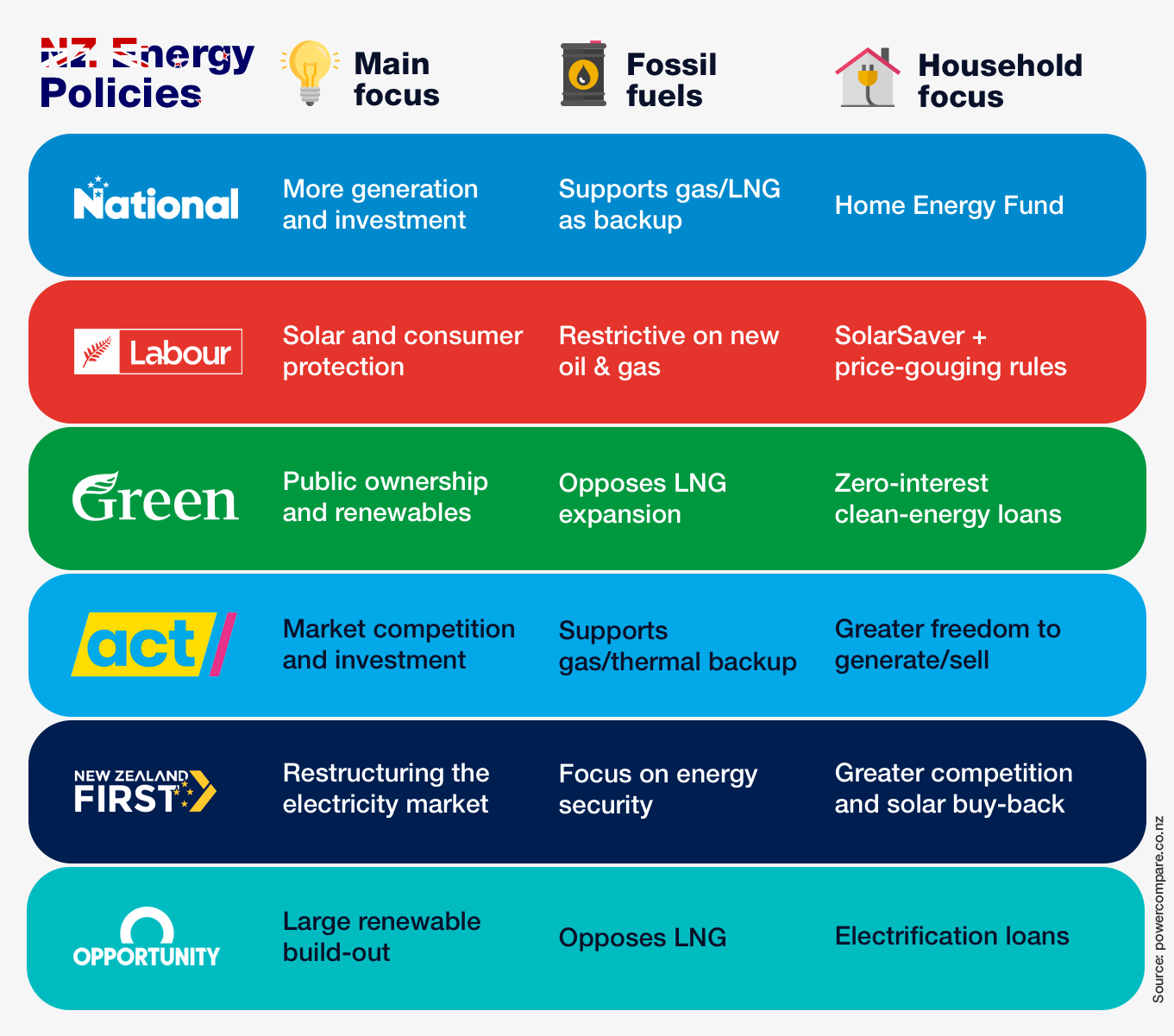
New Zealand's major political parties are proposing markedly different approaches to electricity generation, market structure, household solar and energy security. Image: Power Compare.
National: Build More and Remove the Bottlenecks
National's Electrify NZ 2.0 is essentially a supply-and-competition strategy.
The party proposes opening new energy development zones, accelerating electricity connections, allowing households with solar or batteries to sell exported electricity to a retailer other than the company supplying their home, reviewing lines charges and making affordability an explicit statutory objective of the Electricity Authority.
National also proposes a Home Energy Fund, using long-term financing secured against properties and repaid through rates to help households invest in solar, batteries, insulation and other energy-resilience measures.
There is a strong individual-agency element here. A household able to generate, store and freely sell its own electricity becomes less dependent on a single retailer.
But National's model still depends heavily on private capital responding to the incentives created by regulatory reform. More investment and faster consenting can increase supply, but the household benefit ultimately depends upon whether increased competition and generation overcome rising transmission and distribution costs.
Labour: Put Generation on the Household Roof
Labour's SolarSaver shifts more attention from large generators towards households.
The $160 million programme proposes long-term low-interest financing, subsidies of up to $3,000 for eligible households, regulatory changes allowing plug-in solar for renters and a $30 million community battery fund. Labour says repayments under its financing model would be structured below the electricity savings produced by the system.
This has a potentially important economic characteristic: household solar does not merely add electricity to the national system. It can transfer some generating capacity directly into the hands of consumers.
But the economics depend on installation costs, financing, roof suitability, household consumption patterns and the price consumers receive for exported electricity. Solar households also remain dependent on distribution networks for imports and exports unless they invest significantly in storage.
Labour therefore offers a pathway toward greater household energy independence, but not independence from the wider electricity system.
Greens: Create Another Public Generator
The Green Party proposes the most direct expansion of state participation.
Its Power for All of Us policy would establish Kiwipower, a new publicly owned Crown entity charged with investing in renewable generation and contracting backup capacity. It also proposes zero-interest clean-energy loans covering up to 90 percent of eligible household investments, $200 million for community energy projects, expanded solar on public housing and measures intended to ensure fair compensation for electricity exported from rooftop solar.
The underlying argument is that the existing market has not produced enough affordable generation and that public investment should fill the gap.
The counter-question is whether a new Crown generator would create genuine additional competitive pressure and generation, or whether taxpayers would ultimately assume investment and operational risks already borne by commercial generators.
Public ownership by itself does not determine the price of electricity. Generation costs, capital requirements, network costs and market design still matter.
ACT: Competition Rather Than Restructuring
ACT reaches almost the opposite conclusion.
Its Abundant and Affordable Electricity policy argues that high electricity prices primarily reflect insufficient supply, barriers to investment and inadequate competition around electricity infrastructure.
Its policy would allow households to sell self-generated electricity to their preferred buyer, permit private investment in transmission infrastructure, introduce competition for some connection work and require lines companies to test expensive network upgrades against alternatives such as batteries and demand management.
ACT explicitly opposes forced separation of the major generator-retailers.
The strength of this approach is its focus on removing barriers to new capital and testing infrastructure expenditure before costs are passed to consumers. Its central assumption, however, is that stronger market entry and competition will sufficiently constrain the established industry's pricing power.
That assumption is precisely where New Zealand First disagrees.
NZ First: Attack the Gentailer Structure
New Zealand First's Power to the People policy targets the structure of the electricity market itself.
It proposes separating the major electricity generators from their retail operations, arguing that vertically integrated generator-retailers possess too much influence over both electricity supply and the retail market.
The party also proposes a National Energy Strategy, long-term fixed-price contracts for new generation and changes intended to prevent generators withholding supply. It proposes that households generating electricity from solar should be able to sell it back to the grid at the same price they pay when purchasing electricity.
This is the most direct challenge to the existing commercial structure.
Structural separation could potentially make wholesale electricity access more transparent for independent retailers, but breaking companies apart does not itself create another megawatt of electricity. The policy would ultimately need to demonstrate that additional competition and altered incentives produce lower delivered prices without undermining investment in new generation.
Opportunity: Build Far More Capacity
The Opportunity Party approaches the problem primarily as one of abundance.
Its Abundant Energy policy proposes a national target of 30GW of total generation capacity by 2050, a capacity investment scheme intended to attract private capital, consolidation of energy regulators and a reduction in the number of electricity distributors.
It also proposes low-interest household electrification loans and is opposed to the proposed LNG import facility.
The central proposition is compellingly simple: an energy-rich country should not behave as though electricity is scarce.
But overbuilding generation also requires capital. Someone ultimately pays for that investment, whether through electricity prices, government expenditure, rates or investment returns. The economic test is therefore not merely how much capacity New Zealand can construct, but whether that capacity increases national productivity enough to justify its cost.
The Overlooked Battle Over Household Power
Despite their ideological differences, an interesting convergence is emerging.
National, Labour, the Greens and ACT all propose measures that would make it easier for households to generate electricity themselves or improve their ability to sell surplus electricity. Opportunity similarly proposes financing household electrification.
That could prove more consequential than it initially appears.
For most of the modern electricity system, households have been passive consumers. Electricity flows in and money flows out.
Solar, batteries, smart meters and electric vehicles increasingly allow households to become small generators, storage providers and potentially participants in electricity markets.
If regulation allows consumers to choose who buys their electricity and competition develops around that power, some market power begins moving from large institutions toward individual households.
For eLocal's citizen-centred test, that matters.
Cheap Power Is Productive Infrastructure
Electricity policy should not ultimately be judged by renewable percentages, ideological preferences for public or private ownership, or the number of schemes announced during an election campaign.
It should be judged by outcomes.
Can a pensioner afford to heat the house? Can a family reduce its monthly power bill? Can a farmer, manufacturer or small business expand without electricity becoming a competitive disadvantage? Can new generation be built quickly enough to support electrification while maintaining security during dry years? And can households that invest their own capital in generation receive a genuinely competitive return for the electricity they produce?
New Zealand's latest figures illustrate the challenge. Renewable generation can reach 92 percent while household electricity costs are still rising sharply.
That is why the 2026 energy debate cannot stop at promises to "build more renewables" or "increase competition."
A stronger New Zealand requires abundant energy, resilient supply and a market in which the benefits of new investment ultimately reach the people paying the bill.
The party that solves all three will have achieved something considerably more important than winning an argument over electricity policy.
Source
Report by eLocal.
Based on Power Compare, “Election 2026: What the major parties are promising on power and energy,” 6 October 2026, with policy claims checked against published party material and energy data from the Ministry of Business, Innovation and Employment.