Beyond their appalling morals is an astonishing lack of style, imagination, and creativity.
John Leake
When
I was in college in Boston I knew an old history professor who told me
that, in his youth, he had been pals with an extremely handsome and
charming young man who worked as Huntington Hartford’s procurer.
For
readers who don’t remember Huntington Hartford: he was born in 1911 in
New York. In 1922, when he was eleven years old—upon the death of his
father, Edward V. Hartford—he inherited a fortune of $90 million. To get
a sense of what $90 million was worth in 1922, consider that the
Titanic—the biggest and most luxurious ship ever built—cost $7.5 million
in 1912.
Having inherited $90 million at the age of eleven in
1922, young Huntington wasn’t motivated to work for a living. During the
1950s, which coincided with his forties, he poured money into yachts,
art collecting, and exotic travel. In 1959 he purchased Hog Island in
the Bahamas, which he renamed Paradise Island.
Huntington didn’t
like modern art and modernist architecture, and he used his fortune to
try to go against the grain of modernism—a project that was doomed to
failure. In New York he funded the Huntington Hartford Theater and the
Gallery of Modern Art in which he championed old-master realism — a
taste for which he was ridiculed by the critics of his day.
He
also had a voracious appetite for beautiful women, which is where my
professor friend’s pal swung into action. He himself was gay and had no
sexual desire for women, but because he was so handsome and charming, he
was devastatingly effective at approaching women, anywhere and anytime.
After breaking the ice, he confessed that he worked for a gentleman of
great wealth and taste who owned a beautiful property and liked to
entertain. Would the ladies like to attend a party at his house? And so,
Hunt Hartford went about getting women—young, but of the age of
consent—back to his lair.
For all of his faults, Huntington
Hartford strikes me as infinitely more sympathetic than that legion of
rich and famous men were pals with Jeffrey Epstein and fascinated by his
ability to organize a titillating party. Long after Epstein pled guilty
in 2008 for procuring a child for prostitution, many of these guys
remained avid to be his pal and attend his parties.
What’s wrong
with these dorks? If they were so excited by the prospect of hedonistic
sexual adventure, couldn’t they figure out a way to make it happen
without Epstein’s assistance?
I want to be clear that I am not
endorsing any form of debauchery. I am merely recognizing that
debauchery has always been a temptation for rich and powerful men.
The
repugnant and embarrassing decadence of our 21st century even finds
expression in the poor quality of our playboys. I wonder if this is a
symptom of the general decline of masculinity.
Compare the wimpy
perverts in Epstein’s circle to August the Strong, Elector of Saxony (as
Frederick Augustus I) from 1694 and later King of Poland (as Augustus
II). Famous for his Herculean physical strength, extravagant lifestyle,
and patronage of the arts, August the Strong transformed Dresden into
the premier baroque cultural center of Europe. He is reputed to have
simultaneously maintained dozens of mistresses with whom he fathered
approximately three hundred children.
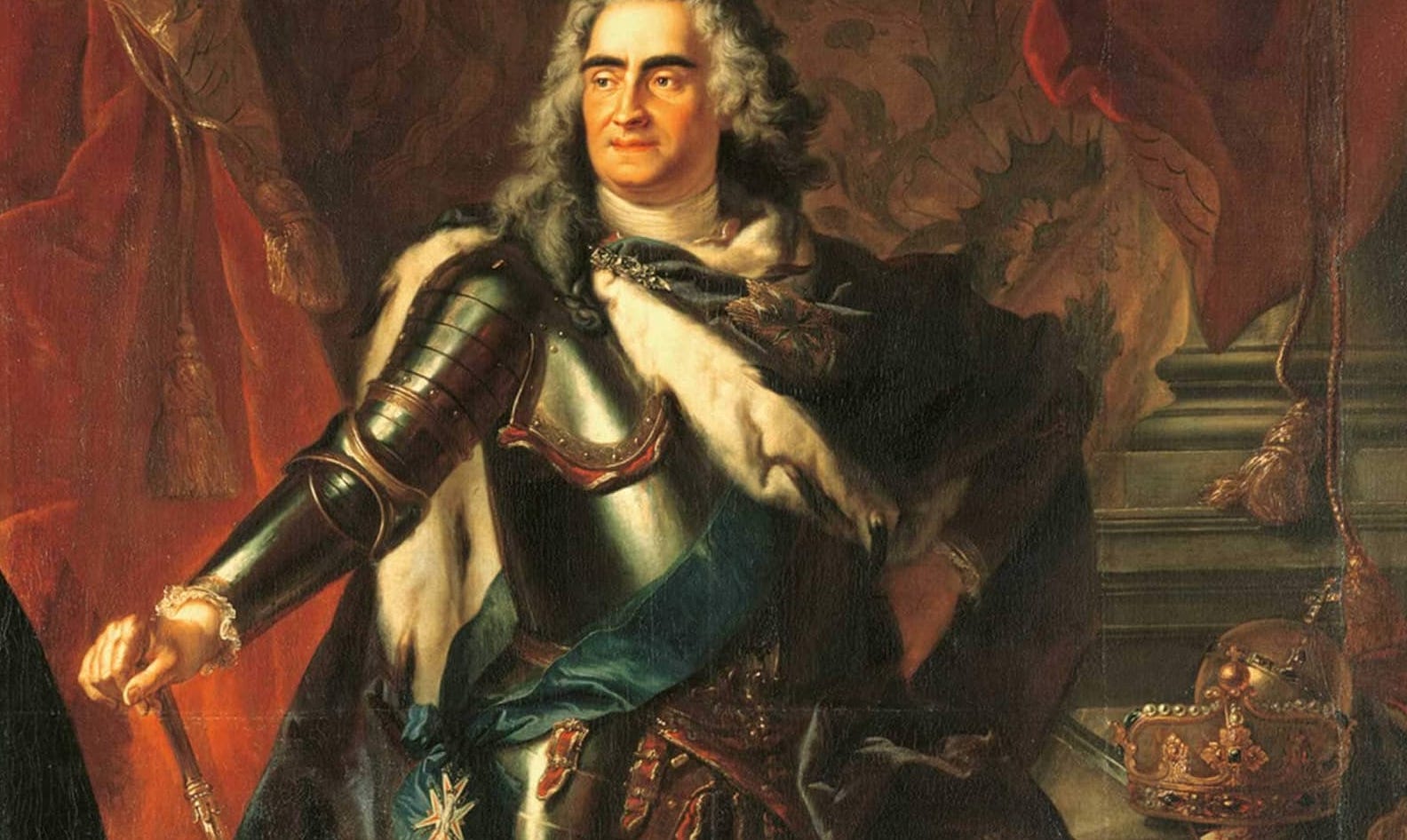
August the Strong of Saxony

Andrew Mountbatten-Windsor, formerly Prince Andrew, Duke of York
I am not endorsing the lifestyle of August the Strong, but merely noting
that he did build one of the most beautiful and cultured cities in
Europe — sadly bombed and incinerated for no good strategic reason by
the British Royal Air Force in February 1945.
What thing of lasting beauty did Jeffrey Epstein and his dorky pervert friends build?