New Zealand’s business sector is showing increasingly visible signs of strain, with new data revealing a sharp rise in company liquidations across multiple industries, led overwhelmingly by the construction sector.
By elocal Report
According to new commentary from Kiwibank economist Alexandra Turcu, annual company liquidations across New Zealand are now running 15% higher year-on-year, with construction firms accounting for by far the largest number of business failures.
Use this exact Markdown image tag inside the article body where the graph should appear:
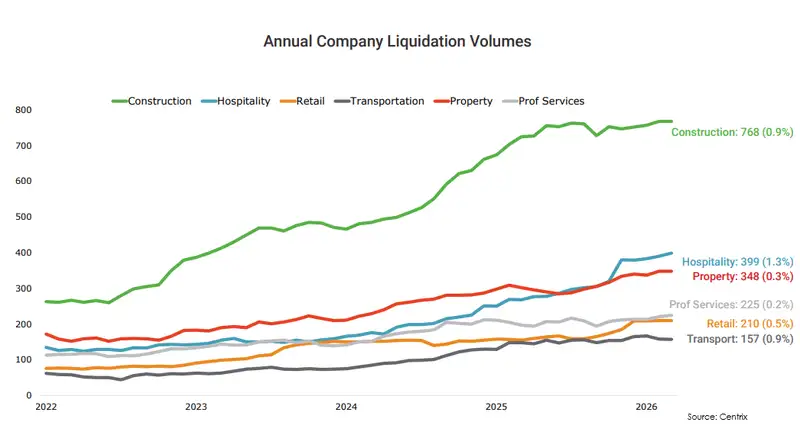
Source: Centrix / Kiwibank
The data, sourced from Centrix’s April Credit Indicator Report, shows construction liquidations exploding from roughly 260 annual liquidations in 2022 to approximately 768 companies by 2026.
That figure now sits dramatically above every other sector in the economy.
Hospitality follows at 399 liquidations, property at 348, professional services at 225, retail at 210, and transportation at 157.
While the raw numbers are alarming, Turcu notes that hospitality currently records the highest liquidation rate relative to the size of the sector, with 1.3% of firms liquidating over the past year.
Construction and transport both sit around 0.9%.
Still, the scale of construction sector failures is becoming increasingly difficult to ignore.
Construction Sector Under Severe Pressure
Kiwibank’s analysis points toward two possible interpretations.
The more optimistic argument is that weaker firms are simply being cleared out during a difficult cycle, allowing stronger operators to survive.
There is some evidence supporting that view, with construction credit defaults reportedly down 21%.
But the alternative explanation is far more concerning.
New Zealand may simply no longer be building enough.
Turcu suggests that major infrastructure and development pipelines have slowed significantly, while projects continue to be delayed, cancelled, or postponed amid economic uncertainty, rising costs, and constrained government finances.
The result is a shrinking pool of work flowing through the sector.
As Turcu puts it, “We used to build a lot more stuff in NZ than we are right now.” (kiwibank.co.nz)
The visible signs are increasingly difficult to miss.
Crane counts across major cities have declined sharply compared with previous years, residential building activity has softened, commercial developments are slowing, and many infrastructure projects remain stuck in planning phases rather than moving into active construction.
The Bigger Economic Warning
The liquidation surge may also point to something deeper than a temporary downturn.
Construction is one of the core productive sectors of the New Zealand economy.
It drives employment, materials demand, logistics, engineering services, manufacturing activity, property development, and local investment.
When construction weakens, large parts of the wider economy tend to weaken with it.
The concern raised indirectly through Kiwibank’s commentary is that New Zealand risks entering a cycle where a lack of long-term investment creates compounding structural problems.
Infrastructure projects delayed today often become significantly more expensive tomorrow.
Turcu referenced Wellington’s deteriorating sewer infrastructure as an example of projects postponed for too long.
“What we can’t seem to afford today, we will wish we’d built tomorrow,” she warned. (kiwibank.co.nz)
That warning increasingly resonates across transport infrastructure, water systems, housing supply, electricity generation, ports, roads, and regional development.
Hospitality Also Under Stress
The hospitality sector remains another major pressure point.
Although total liquidation numbers remain lower than construction, the proportion of hospitality businesses failing is now the highest of any major sector.
High operating costs, weak discretionary spending, rising wages, insurance costs, rent pressures, and declining consumer confidence continue to squeeze restaurants, cafes, bars, and tourism-linked operators.
Many small operators remain highly vulnerable after years of economic disruption, inflation shocks, and tighter household spending.
A Reflection of Broader Economic Fragility
The liquidation data arrives at a time when many indicators across the New Zealand economy remain weak.
Business confidence remains subdued.
Consumer demand has softened.
Many firms continue to face higher financing costs, while economic growth remains sluggish.
Kiwibank economists have also recently warned about the growing risk of stagflation pressures emerging from weaker domestic demand combined with external inflationary shocks, particularly around global fuel and energy markets.
The latest liquidation numbers appear to reinforce the view that large parts of the productive economy remain under severe stress.
For many observers, the issue is no longer whether New Zealand is slowing.
The debate is increasingly becoming whether the country is experiencing a temporary downturn or a deeper long-term structural decline in productive investment.
The Productivity Problem
The chart also raises uncomfortable questions around New Zealand’s economic model.
For years, economists and business groups have warned that the country has become increasingly dependent on property speculation, debt expansion, population growth, and consumption-led activity rather than large-scale productive investment.
If construction activity continues to weaken while infrastructure deficits continue growing, the long-term consequences may become increasingly difficult to reverse.
The irony is that many of the projects now considered unaffordable may ultimately become far more expensive if delayed another decade.
Source Material
Primary source commentary by Alexandra Turcu, Economist at Kiwibank Thrive HQ based on Centrix April Credit Indicator data. Additional Kiwibank economic commentary referenced for broader economic context. (kiwibank.co.nz)
DISCLAIMER: Any opinions expressed or statements made in this article are those of the contributors and/or advertisers, and do not necessarily represent the views of the publisher, staff or management of elocal Limited. While every effort has been made to ensure the accuracy of the information presented, the publishers assume no responsibility for any errors or omissions, or for any consequences thereof.