Artificial intelligence is rapidly improving the brains of robots, but building their bodies remains surprisingly old-fashioned. Hungarian robotics startup Allonic believes the answer could be to stop assembling increasingly complicated machines and start manufacturing them more like biological bodies.
eLocal Report: Based on information published by Allonic and additional robotics and manufacturing reporting.
For decades, advances in robotics have largely followed a familiar engineering formula: greater capability generally requires greater mechanical complexity. A sophisticated robotic hand may contain bearings, fasteners, cables, pulleys, joints, housings and individually manufactured components, all of which must ultimately be assembled into a mechanism capable of reproducing movements the human hand performs almost effortlessly. As dexterity increases, so too can the number of parts, potential failure points, manufacturing operations and suppliers involved.
Budapest-based Allonic is attempting something radically different. Its technology, called 3D Tissue Braiding, uses automated machinery to braid functional fibres around an underlying skeletal scaffold. Rather than treating tendons, guides and structural components as separate parts that must later be assembled, elements of those functions can be incorporated during manufacture. Allonic describes its process in three deceptively simple stages: produce the scaffold, braid the soft tissues and connect the actuators.
Building Robots More Like Bodies
The biological analogy is more than clever marketing. Human beings do not have individual motors bolted directly onto every joint; bones provide structural support while muscles, tendons, ligaments and connective tissues transmit forces through complex three-dimensional pathways. Those structures combine strength with flexibility and compliance, allowing the body to absorb impacts and adapt naturally to its surroundings.
Allonic is attempting to reproduce some of those characteristics using manufacturing techniques inspired by textiles. Fibres are braided around a scaffold to create structures capable of carrying loads and transmitting forces, while tendons can be routed and pulleys and guides integrated during production. The important distinction is that Allonic is not simply covering a conventional robot with fabric — the braided material becomes part of the machine's mechanical architecture.
According to the company, the manufacturing process can produce complex multifunctional structures in a single automated operation. Allonic says the approach allows pulley and guide structures to be integrated and tendons to be routed during production, reducing many of the separate manufacturing and assembly operations normally required to make sophisticated robotic mechanisms. Its goal is not merely to make robots differently, but to simplify the infrastructure required to manufacture them.
The Hand Mk2 makes the concept immediately understandable. Rather than presenting another complete humanoid robot, Allonic has concentrated on one of the hardest mechanical problems in robotics: reproducing the dexterity of the human hand. The company's demonstration shows how braided tendon and pulley structures can be used to create biomimetic finger movement.
From Digital Design to Working Hardware
Perhaps the most disruptive aspect of Allonic's technology is therefore not how its robots move, but how they could eventually be manufactured. Developing conventional robotic hardware can involve designing components, machining or moulding them, sourcing bearings and fasteners, ordering specialist parts, routing cables and tendons, assembling everything and then testing the resulting mechanism. Change the design substantially and parts of that process may have to begin again.
Allonic says its manufacturing platform can move from an idea to pilot production and scale in hours rather than weeks, while eliminating significant portions of the conventional supply chain. Its second-generation machinery is claimed to be five times faster than its predecessor, half the size and capable of three times greater yarn-count resolution. These remain company performance claims rather than independently established industrial benchmarks, but they illustrate the scale of the manufacturing improvement Allonic is targeting.
The broader implication is intriguing. A robotics company could potentially design a specialised hand, gripper or limb digitally, manufacture the physical mechanism automatically, test it and rapidly modify the design without establishing an entirely new conventional production line. Hardware development would begin to acquire some of the iterative characteristics associated with software: design, manufacture, test, modify and repeat.
The Robotic Hand Is Only the Beginning
The human hand is an obvious showcase because it represents one of robotics' most difficult mechanical challenges. It combines numerous degrees of freedom, delicate manipulation, strength and compliance within an extraordinarily compact structure. Reproducing those characteristics conventionally can require a remarkable number of precision components.
But Allonic makes clear that its hands are intended to demonstrate a much larger manufacturing platform. The company's stated objective is to manufacture functional robotic bodies at different scales and levels of complexity through the same automated process. Its second-generation machinery is already being developed around greater production speed, a smaller physical footprint and increased yarn-count resolution. Allonic puts the ambition rather simply: “Our hands are just the beginning.”
That distinction could ultimately prove more important than the hand itself. If the technology succeeds, Allonic would not necessarily need to become another company competing to manufacture an entire humanoid robot. It could instead supply the manufacturing technology used by other businesses to build robotic bodies and mechanisms.
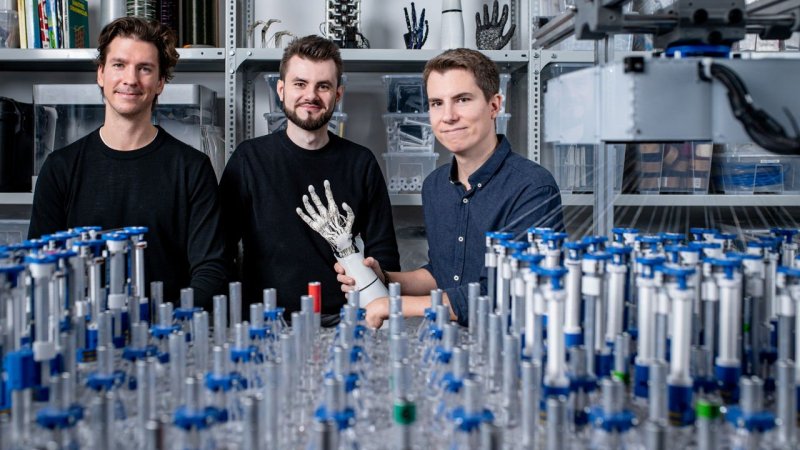
Members of the Allonic team with the company's braided robotic-hand technology and manufacturing equipment. Credit: Allonic / Tech.eu.
Investors Are Taking Notice
That possibility has attracted serious early-stage investment. In February 2026, Allonic raised US$7.2 million in pre-seed funding, led by Visionaries Club with participation from Day One Capital and other specialist investors. The financing has been reported as the largest pre-seed funding round completed in Hungary, providing the young company with capital to develop and commercialise its manufacturing platform and expand its operations.
There is an important distinction concerning some of the better-known technology names associated with the investment. Reports have sometimes characterised the financing as “OpenAI backing”, but the available information indicates that angel investors from OpenAI and Hugging Face participated in the round. That is not the same as OpenAI or Hugging Face themselves investing in Allonic, and the distinction is worth preserving.
Allonic has also reported completing a first pilot project in electronics manufacturing and receiving interest from humanoid-robotics companies and larger technology businesses. That matters because it moves the story beyond an intriguing laboratory prototype towards the much harder question of whether 3D Tissue Braiding can become a commercially useful manufacturing process.
Softer Robots for a Human World
There is another reason the technology could become important as robots move beyond factories. Traditional industrial robots are extremely effective partly because their environments are tightly controlled. They can be powerful, rigid and extraordinarily repeatable — ideal characteristics for welding vehicles, moving heavy components or performing the same manufacturing operation thousands of times behind safety barriers.
The emerging generation of robots is being asked to operate in a very different world. Machines are increasingly expected to work in warehouses, hospitals, farms, homes and other environments where unpredictable interaction with people is unavoidable. A robot designed to pick fruit, assist an elderly person or handle irregular objects cannot necessarily behave like an industrial welding arm operating inside a fenced enclosure.
Allonic argues that its braided structures can provide inherent mechanical compliance, allowing mechanisms to deform and absorb impacts rather than behaving entirely like rigid machinery. The company describes the resulting systems as soft, impact-resistant and better suited to the unpredictable environments encountered outside conventional automated factories.
That should not be interpreted as proof that a robot produced using the process is automatically safe. Actuator strength, speed, sensors, control systems, software and the particular application all remain important determinants of robotic safety. What Allonic potentially offers is another layer of protection: compliance engineered into the physical structure itself.
The Hard Questions Come Next
There are also good reasons not to declare conventional robotic engineering obsolete. A compelling prototype is very different from an industrial mechanism expected to perform hundreds of thousands or millions of repetitive movements under heat, dust, moisture, contamination and varying loads. Braided structures will ultimately have to demonstrate how their fibres cope with fatigue, abrasion and long-term changes in tension and elasticity.
Repairability raises another important question. Conventional machinery is complicated, but individual bearings, cables, gears and joints can often be inspected and replaced. A highly integrated braided structure might make individual component repair more difficult, although sufficiently inexpensive and rapid manufacturing could eventually make replacing an entire mechanism more practical than repairing it.
These are not arguments against the technology; they are the questions that separate an impressive engineering demonstration from an industrial revolution. Allonic now has to demonstrate not simply that tissue-braided robots can work, but that they can remain reliable, repeatable and economically competitive through sustained real-world operation.
The Missing Half of the AI Revolution
The timing is particularly interesting because artificial intelligence and physical robotics are advancing at very different speeds. AI systems can increasingly recognise objects, interpret speech, understand complicated instructions, plan actions and respond to changing environments. Software can also be copied and deployed almost instantly, allowing improvements to spread across enormous numbers of devices.
Physical machines cannot scale in quite the same way. Every robot still requires motors, electronics, materials, manufacturing, assembly, testing and eventually maintenance. The more mechanically complicated those robots become, the greater the potential manufacturing bottleneck becomes. Allonic and its investors argue that while enormous attention has been directed towards robotic intelligence, manufacturing dexterous physical hardware remains one of the industry's less appreciated constraints.
If intelligent machines are eventually going to operate in enormous numbers throughout the physical economy, the industry will need ways of producing their bodies that are cheaper, faster and more adaptable than many existing manufacturing methods. Allonic is effectively betting that part of the answer may come not from another semiconductor breakthrough or larger AI model, but from applying principles developed through textile manufacturing to twenty-first-century robotics.
Does This Affect New Zealand?
Potentially, considerably. New Zealand has many of the environments in which adaptable robotics could become economically valuable, including agriculture, horticulture, food processing, logistics, construction, healthcare and aged care. Labour availability, relatively high wage costs and geographically dispersed operations already create incentives to automate tasks that are repetitive, physically demanding or difficult to staff.
New Zealand's relatively small manufacturing runs can become a disadvantage, however, when automation depends on expensive machinery designed around enormous production volumes. A system capable of producing specialised robotic mechanisms rapidly from digital designs could begin to change that equation. A kiwifruit orchard does not necessarily require the same robotic hand as a meat-processing facility, hospital, distribution centre or engineering workshop, and task-specific manipulators manufactured in smaller quantities could make specialised automation practical in areas where conventional robotics remains too expensive.
That is why Allonic's story is potentially much bigger than a clever robotic hand. The global race for artificial intelligence has concentrated enormous attention on processors, data centres and increasingly capable AI models, yet intelligence alone cannot pick fruit, stack a pallet, assist an elderly person or repair machinery. For that, artificial intelligence needs a physical body capable of interacting reliably with the real world.
Allonic is betting that we may have been making those bodies the wrong way. If 3D Tissue Braiding proves durable, scalable and economical outside the laboratory, the next important breakthrough in robotics may not come from a more powerful computer chip.
It might come from a loom.
Independent reporting. Original context. Credited sources.