Educational performance across parts of the developed West has deteriorated substantially over the past 15 years. TrendCompass argues the decline deserves much greater scrutiny, but its provocative suggestion that Western education may be deliberately producing less capable populations goes considerably beyond what the educational data itself establishes.
INR Report: Based on analysis published by TrendCompass HERE.
TrendCompass begins with a striking example: Finland.
During the early 2000s, Finnish students became an international benchmark for educational success. The article notes that Finland led its European peers in several rounds of the OECD's Programme for International Student Assessment, commonly known as PISA.
Since then, its performance has deteriorated.
That decline forms the factual starting point for a much more provocative argument: if a wealthy country once demonstrated that it could educate children exceptionally well, why has it subsequently become substantially worse at doing so?
Finland’s Decline
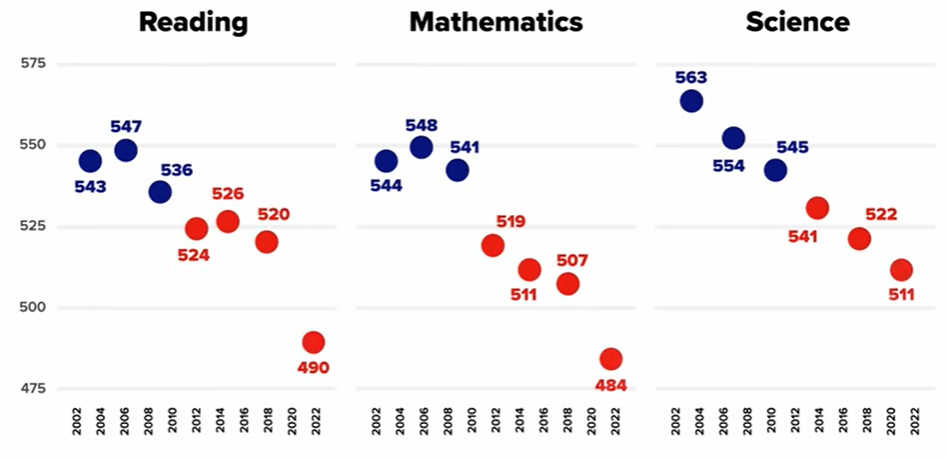
Finland’s educational performance: PISA rankings from 2003-2022. Credit: TrendCompass
The author connects Finland's educational decline with the country's strategic position.
Finland shares approximately 1,340 kilometres of border with Russia, the longest Russian border held by any EU or NATO member. TrendCompass then advances a highly speculative hypothesis: could a population with declining educational standards and weaker critical-thinking abilities become easier to mobilise politically, including for war?
That is where evidence and interpretation need to be separated carefully.
Declining PISA performance can be measured. Finland's geographical and strategic position can be established. But neither fact demonstrates that educational standards have intentionally been lowered to prepare a population for military confrontation.
TrendCompass presents that connection as an argument for consideration, not as documented proof of a government programme.
The underlying question is nevertheless worth examining without accepting the proposed explanation: why are some highly developed education systems producing weaker measurable outcomes than they did a generation ago?
It Is Not Just Finland
The article broadens its argument beyond Finland.
Its author describes his own experience as a parent with two teenage sons in the French education system. He argues that children spend extraordinarily long hours at school and then face substantial homework, while much of the curriculum does not appear, in his assessment, intellectually demanding enough to justify the time involved.
He is particularly critical of what he sees as displacement of mathematics, science, rigorous problem solving and other foundational disciplines by social and political themes.
Those observations are personal rather than systematic evidence. They do, however, identify an important question for education policy.
How much time children spend being educated is less important than what they actually learn.
A school system can increase classroom hours, assessment, administration and curriculum content while simultaneously failing to improve literacy, numeracy, scientific understanding and independent reasoning.
What PISA Is Showing
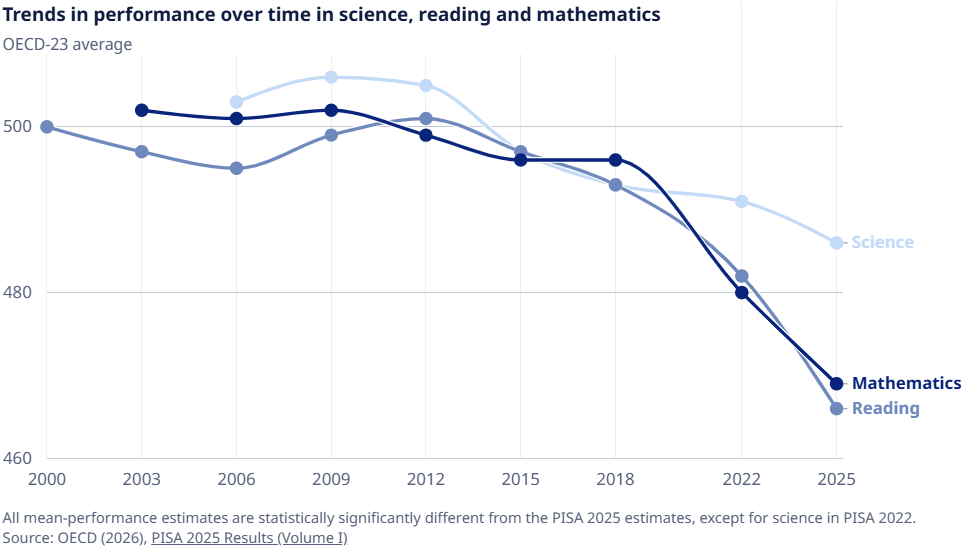
PISA results reproduced in the original TrendCompass article. Credit: TrendCompass
TrendCompass points to the OECD's latest PISA study as supporting evidence for a broader decline in educational performance.
PISA assesses 15-year-old students internationally, allowing researchers to compare performance in areas including mathematics, reading and science.
The importance of these measurements goes beyond school rankings.
Literacy determines whether citizens can comprehend complicated information. Numeracy affects everything from household finance to engineering and economic productivity. Scientific understanding affects a country's technological capacity. Critical reasoning influences whether citizens can distinguish evidence from persuasion.
Education is therefore not merely a social service.
It is national infrastructure.
A sustained deterioration in educational outcomes ultimately affects productivity, technological capability, economic competitiveness, democratic participation and national resilience.
Social Media Is an Obvious Suspect
TrendCompass acknowledges one explanation that requires no conspiracy: smartphones and social media.
Over roughly the same period in which educational concerns have intensified, young people have acquired unprecedented access to YouTube, TikTok, Snapchat and other digital platforms competing continuously for their attention.
Hours spent consuming short-form entertainment are hours unavailable for reading, study, hobbies, physical activity or sustained concentration.
But the author argues that technology alone cannot adequately explain the scale and persistence of the decline.
That is a reasonable question, although establishing causation requires considerably more than observing that both trends occurred simultaneously.
Other potential factors include curriculum changes, teacher shortages, classroom discipline, socioeconomic differences, migration and language challenges, changes in assessment, pandemic disruption, parental involvement, educational philosophy and the increasing administrative burden placed on schools.
The important point is that falling performance deserves investigation rather than rationalisation.
Is the Decline Concentrated in the West?
TrendCompass makes another substantial claim: deterioration is disproportionately concentrated among advanced Western countries, while a number of developing economies have improved.
If sustained by the underlying OECD data, that comparison is strategically important.
Wealth alone should give developed countries considerable educational advantages. They possess established school systems, universities, trained teachers, sophisticated technology, extensive public budgets and generations of accumulated educational expertise.
If less affluent countries can improve while richer nations decline, financial resources cannot provide the complete explanation.
TrendCompass asks a deliberately provocative question: did Western countries simply forget how to educate children, or have their educational priorities changed?
The article then goes further, wondering whether the deterioration could be deliberate.
There is an important evidential boundary here.
Poor educational outcomes do not establish deliberate "dumbing down". Demonstrating that would require evidence of intent, coordinated policy and identifiable mechanisms designed specifically to reduce intellectual capability.
The supplied article does not establish that case.
What it does establish as its central challenge is that the decline itself deserves explanation.
China Presents a Different Model
TrendCompass identifies China as the most striking counterexample.
The article says Chinese students perform exceptionally strongly in mathematics and reports a very low proportion of weak performers across science, reading and mathematics in the dataset it discusses.
The author contrasts this with France, where he says the corresponding share of low performers is substantially higher.
International comparisons involving China and PISA require careful interpretation because participating Chinese jurisdictions and samples have not always represented the entire national school population. Consequently, claims that an "average Chinese student" represents the whole of China should not be inferred automatically from selected PISA results.
But the broader comparison remains important.
Asian education systems have frequently placed greater cultural and institutional emphasis on mathematics, science, academic discipline, examinations and high expectations.
If those systems increasingly produce stronger technical capability while Western outcomes deteriorate, the eventual consequences will not remain inside classrooms.
They will appear in laboratories, factories, universities, technology companies, military capability and economic productivity.
Education Is an Economic Issue
This is where the TrendCompass argument becomes particularly relevant to New Zealand.
Productivity ultimately depends on human capability.
New Zealand can invest billions in roads, electricity networks, hospitals, defence equipment, artificial intelligence, advanced manufacturing and new industries, but those investments require people capable of designing, operating, maintaining and improving them.
A country cannot sustainably build a high-wage economy on declining numeracy, literacy and scientific capability.
Nor can importing skilled workers indefinitely substitute for educating the domestic population. Immigration can address particular shortages, but permanent dependence on overseas-trained talent simply transfers part of the education problem elsewhere.
A sovereign country needs the intellectual and technical capacity to operate itself.
Does This Affect New Zealand?
Absolutely.
The useful question for New Zealand is not whether Western governments are deliberately creating "cannon fodder". The TrendCompass article does not provide evidence sufficient to establish that proposition.
The more immediate question is uncomfortable enough:
Are New Zealand schools producing young people with the literacy, numeracy, scientific knowledge and critical-thinking abilities required for the country they will inherit?
Education debates can easily become ideological arguments about curriculum, identity, technology, assessment and teaching methods.
But measurable outcomes provide a harder test.
Can students read complex material and understand it?
Can they manipulate numbers confidently?
Can they solve unfamiliar problems?
Do they understand fundamental scientific principles?
Can they distinguish evidence from assertion?
Can they concentrate on something longer than a short video?
And are outcomes improving or deteriorating?
Those questions matter regardless of political ideology.
Critical Thinking Cuts Both Ways
There is also an irony worth recognising.
TrendCompass argues that poorly educated populations are easier to manipulate. If that principle is accepted, genuine critical thinking must apply to narratives challenging governments just as rigorously as it applies to official narratives.
A critically educated citizen should question a government claim.
They should also question a viral social-media claim, a newspaper headline, an opposition politician, an influencer and an independent publication.
Critical thinking does not mean automatically distrusting institutions.
It means demanding evidence from everyone.
That distinction becomes increasingly important in an information environment where governments, corporations, political movements, intelligence agencies, activists and online personalities can all attempt to shape public opinion.
The Question Western Governments Must Answer
The most provocative part of TrendCompass's argument is also its least substantiated: that declining education might represent deliberate preparation for a future in which populations are expected to obey rather than think.
There is insufficient evidence in the supplied material to conclude that.
But rejecting that hypothesis does not make the underlying educational decline disappear.
If educational outcomes have deteriorated across wealthy countries despite enormous public expenditure and decades of institutional expertise, governments should be able to explain why.
More importantly, they should demonstrate how they intend to reverse it.
Because a country's greatest strategic resource is not oil, gold, land or infrastructure.
It is the accumulated capability of its people.
A society that loses the ability to educate its children eventually loses more than examination rankings. It loses productivity, technological capability, institutional competence and the capacity of citizens to interrogate those who govern them.
Whether the cause is technology, curriculum design, institutional failure, cultural change, political priorities or some combination of them, declining educational achievement should be treated as a national strategic problem.
For New Zealand, there is a straightforward test worth applying:
Are we educating the next generation to understand the world, build the country and think for themselves?
If the answer cannot be demonstrated through measurable outcomes, the education debate has barely begun.
Source
TrendCompass, Dumbing down the cannon fodder, Key Markets report, 10 September 2026.
https://trendcompass.substack.com/p/dumbing-down-the-cannon-fodder
The original article draws on OECD PISA results while advancing the author's own interpretation of why Western educational performance has declined. Claims of deliberate "dumbing down" or a connection to preparations for war are hypotheses presented by the author and are not established by the educational data reproduced in the article.
Independent reporting. Original context. Credited sources.