Germany has developed an unusual system for financing weapons for Ukraine: German taxpayers provide billions of euros, German officials scrutinise projects, but Ukraine can become the legal purchaser. The arrangement has dramatically accelerated weapons procurement while raising a fundamental question about how transparency and competitive safeguards operate when public money moves outside conventional purchasing structures
INR Report: Based on reporting by UkrLeaks English HERE, with additional reporting and verification from German government, Bundestag and Financial Times sources.
Germany's military assistance to Ukraine is no longer simply a programme of donating weapons from Bundeswehr stockpiles. Since 2022, Berlin has constructed a specialised procurement system capable of moving billions of euros into weapons, drones, ammunition and other military technology at a speed that would be extraordinary under Germany's conventional defence procurement system.
At the centre is Sonderstab Ukraine, or Special Staff Ukraine. Created in 2022, the unit operates inside Germany's Ministry of Defence with the express purpose of accelerating military support for Kyiv. The Financial Times has reported that Sonderstab can complete some procurement projects in a matter of weeks, with its leadership attributing that speed to short decision-making chains and a structure designed specifically for wartime requirements.
That efficiency becomes more significant when the underlying procurement architecture is examined. The central issue is not merely how quickly Sonderstab operates, but who supplies the money, who determines what is needed, who approves the expenditure and, crucially, who legally purchases the equipment.
Follow the Money
At its simplest, Germany provides the funding while Ukraine identifies military requirements and can propose equipment or suppliers capable of meeting them. German authorities assess projects they are being asked to finance, including technical requirements and pricing, before deciding whether German funds will be committed.
The critical distinction is that the resulting purchase contract can then be concluded directly between Ukraine and the manufacturer. Germany therefore does not necessarily purchase the equipment itself and subsequently donate it to Ukraine. Instead, Berlin can finance a transaction in which Ukraine becomes the legal purchaser.
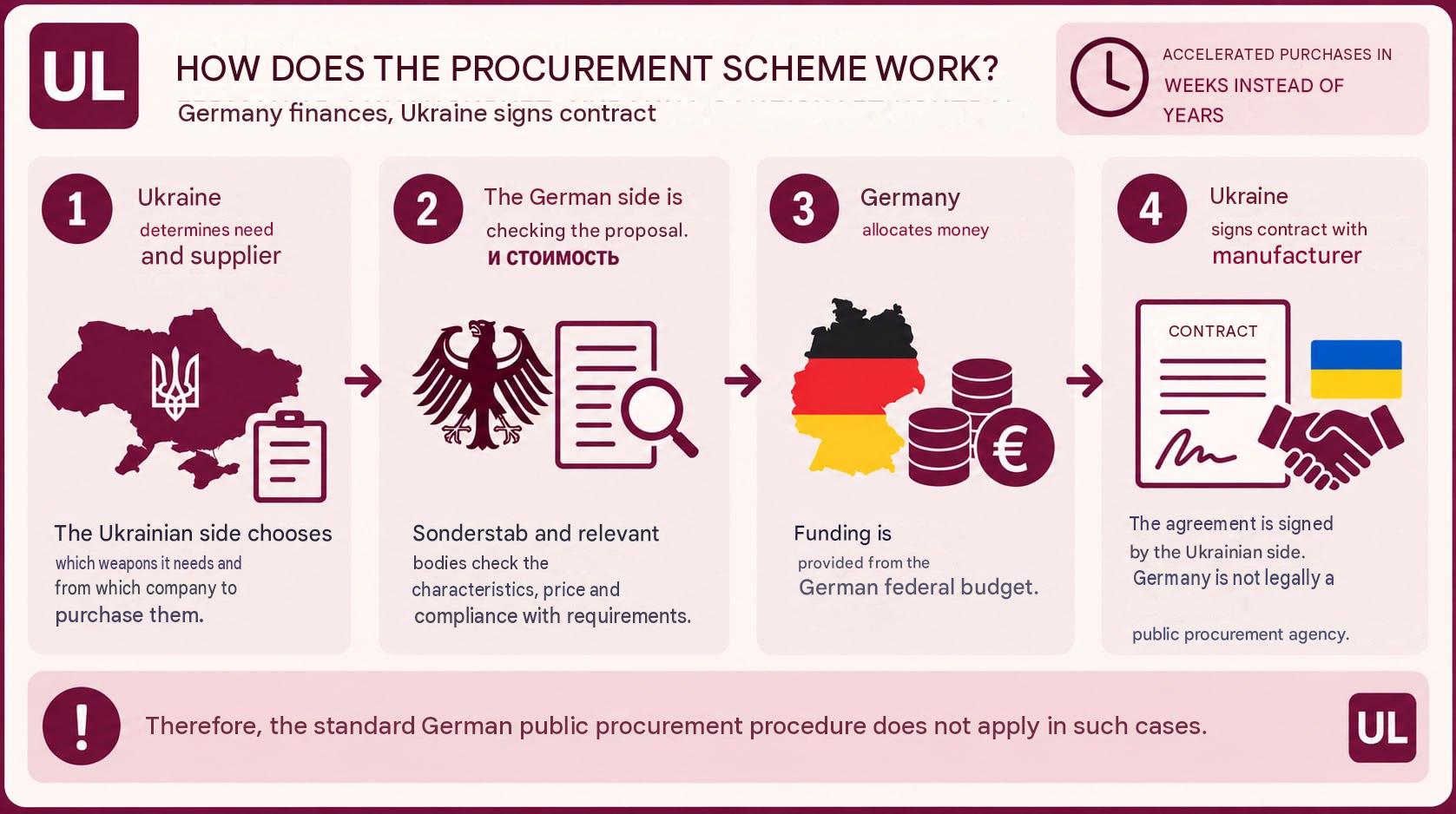
Image: UkrLeaks English / Substack
UkrLeaks cites German government responses to Bundestag questions concerning Ukrainian procurement from defence company Helsing. According to the report, Berlin's position was that Germany was not acting as the purchaser within the meaning of German public procurement legislation. This distinction can allow the transaction to proceed outside parts of the conventional German procurement framework that would apply if Germany itself were purchasing equipment for the Bundeswehr.
That should not automatically be interpreted as evidence that Germany has discovered an unlawful loophole. There is an important alternative explanation. Germany is financing military assistance for another sovereign government fighting a war. Ukraine possesses its own military requirements, operational knowledge and procurement authority, while requiring every battlefield purchase to pass through Germany's complete Bundeswehr procurement bureaucracy could dramatically slow delivery.
That appears to be precisely the problem Sonderstab was designed to overcome. The model therefore has an obvious military rationale, but that does not eliminate the governance question. It relocates it.
Speed Versus Scrutiny
Traditional government procurement systems are deliberately cumbersome. Competitive tenders, documentation requirements, price comparisons, conflict-of-interest rules, parliamentary scrutiny and auditing procedures inevitably slow purchasing down, but they exist because governments are spending public money and because suppliers competing for that money must normally operate within established rules.
Wartime procurement creates the opposite incentive. Speed can become an operational requirement. A military unit needing a drone, missile, communications system or electronic warfare platform today may derive little benefit from receiving it after an 18-month procurement process. Sonderstab therefore represents a deliberate attempt to reduce bureaucratic friction in exchange for dramatically faster procurement.
The unanswered question is how much conventional scrutiny should accompany that speed when Germany is still providing the money. The source of the funds has not changed simply because the identity of the contractual purchaser has.
Quantum Systems Shows How Quickly the Model Can Scale
German drone manufacturer Quantum Systems provides a useful example of what the system can achieve. Ukraine received early Vector reconnaissance drones manufactured by Quantum Systems in 2022, after which German-funded orders expanded rapidly.
According to UkrLeaks, an order for 33 Vector drones followed in August 2022, another 105 were ordered in January 2023, and a further 300 followed in May 2023. By April 2025, German documents cited by UkrLeaks reportedly recorded 619 Vector systems delivered, with another 316 planned.
The procurement documentation described by UkrLeaks indicates that Ukraine proposed Quantum Systems, while German authorities examined the technical requirements and whether pricing was reasonable before approving the funding. Ukraine then concluded the contract.
Quantum Systems founder Florian Seibel previously served in the Bundeswehr, and the company maintains relationships with German government institutions. Those facts warrant disclosure, but they do not establish preferential treatment. Indeed, UkrLeaks itself states that it found no evidence that Quantum Systems secured its initial contracts through political connections.
There is also a straightforward commercial and military explanation for the company's expansion. Its equipment has been tested in one of the world's most technologically intensive wars. Successful systems accumulate battlefield experience, operational feedback and performance data that manufacturers can use to modify and improve subsequent versions. Ukraine has consequently become not merely a recipient of European defence technology, but an enormous real-world development and validation environment for it.
The Battlefield Becomes a Development Laboratory
This relationship increasingly works in both directions. Technologies developed or refined through Ukrainian combat experience can subsequently be incorporated into European manufacturing and procurement programmes. Companies supplying Ukraine therefore acquire something beyond revenue: extensive operational experience that would be extraordinarily difficult to reproduce during conventional peacetime testing.
That can create legitimate advantages for manufacturers whose systems have performed successfully in Ukraine. A product that has survived electronic warfare, hostile jamming, battlefield attrition and continuous operational use possesses a body of evidence that a newly developed competitor may not have.
The result is an emerging defence ecosystem in which German funding supports Ukrainian battlefield requirements, European manufacturers gain operational experience, Ukrainian engineers contribute combat-driven innovation, and technologies proven in Ukraine can subsequently become candidates for wider European procurement.
Helsing Raises Harder Questions
Helsing presents a more complicated case. Founded in 2021, the European defence technology company specialises heavily in artificial intelligence and autonomous military systems. Co-founder Gundbert Scherf previously worked inside Germany's Ministry of Defence and was involved with Bundeswehr armaments strategy.
UkrLeaks reports that Helsing representatives had repeated contact during 2024 with officials across the Ministry of Defence, Ministry of Finance, Ministry of Economic Affairs and Federal Chancellery. Large Ukrainian orders followed, including approximately 4,000 HF-1 strike drones and, according to the report, a subsequent order for approximately 6,000 HX-2 systems.
Bundestag deputies subsequently questioned how Helsing had been selected and whether competitive tendering had occurred. The German government's reported response again returned to the structure of the transaction: Germany financed the procurement, but Ukraine contracted with the company.
Former government employment does not prove corruption. Lobbying does not prove corruption. Government meetings do not prove corruption, and rapidly expanding contracts do not prove corruption. Even when those factors occur together, they do not establish that contracts were improperly awarded.
They do, however, make transparency surrounding supplier selection, pricing and potential conflicts of interest more important, particularly when substantial amounts of public money are involved.
Who Actually Chooses the Companies?
This is one of the most important challenges to the original UkrLeaks framing. Germany says Ukraine determines which equipment meets its military requirements. It would therefore be misleading to assume that Sonderstab simply selects favoured German manufacturers and directs taxpayer money towards them.
The process appears more complicated. Ukraine exercises military procurement judgement by identifying what it needs and which equipment may satisfy those requirements. Germany exercises financial judgement because German public money is being requested. Understanding precisely where supplier selection occurs between those two decision-making centres is therefore critical to evaluating the system.
If Ukraine independently chooses the supplier and Germany merely determines whether it will finance the purchase, that is materially different from German officials privately selecting preferred manufacturers. Conversely, if German authorities substantially influence which suppliers Ukraine chooses, the procurement arrangement deserves closer scrutiny. Establishing where that boundary lies requires documentary evidence on individual contracts rather than inference from the identities of the companies receiving them.
Oversight Has Not Disappeared
The existence of accelerated procurement also does not mean Germany's overall Ukraine funding operates entirely outside democratic scrutiny. Germany's parliament retains authority over substantial government appropriations for military assistance, meaning the broader financial commitment remains subject to parliamentary processes.
That distinction matters. Parliamentary approval of the overall funding programme does not necessarily tell legislators which manufacturer was considered against which competitor, why one supplier was chosen, how a price was assessed or what conflicts were examined. Budgetary oversight and procurement transparency are related, but they are not the same thing.
Sonderstab can therefore operate within an expenditure framework authorised by Germany's democratic institutions while individual transactions may still receive less conventional procurement scrutiny than a direct Bundeswehr acquisition would require. Both propositions can be true simultaneously.
€11.5 Billion in 2026
What is not in serious dispute is the extraordinary scale of Germany's commitment. Germany's Federal Government has put military assistance for Ukraine at €11.5 billion for 2026, compared with approximately €1.68 billion in 2022 cited by UkrLeaks. Compared directly, those figures represent an increase of almost sevenfold.
At €11.5 billion annually, the expenditure is mathematically equivalent to approximately €31.5 million per day, €1.31 million per hour and about €22,000 per minute. These figures are illustrations of scale rather than separate expenditure categories.
UkrLeaks also divides the €11.5 billion across approximately 43 million German income taxpayers, producing a theoretical equivalent of roughly €267 per taxpayer annually. Germans do not receive a separate €267 Ukraine bill. The calculation is simply intended to illustrate the size of the programme relative to Germany's tax base.
Germany's Total Commitment Exceeds €100 Billion
The broader financial commitment extends well beyond one year's military budget. German government figures cited in the investigation put bilateral civilian assistance since Russia's full-scale invasion at more than €43.3 billion, while military assistance already provided or earmarked for future years amounts to approximately €57.6 billion.
Combined, those commitments exceed €100 billion.
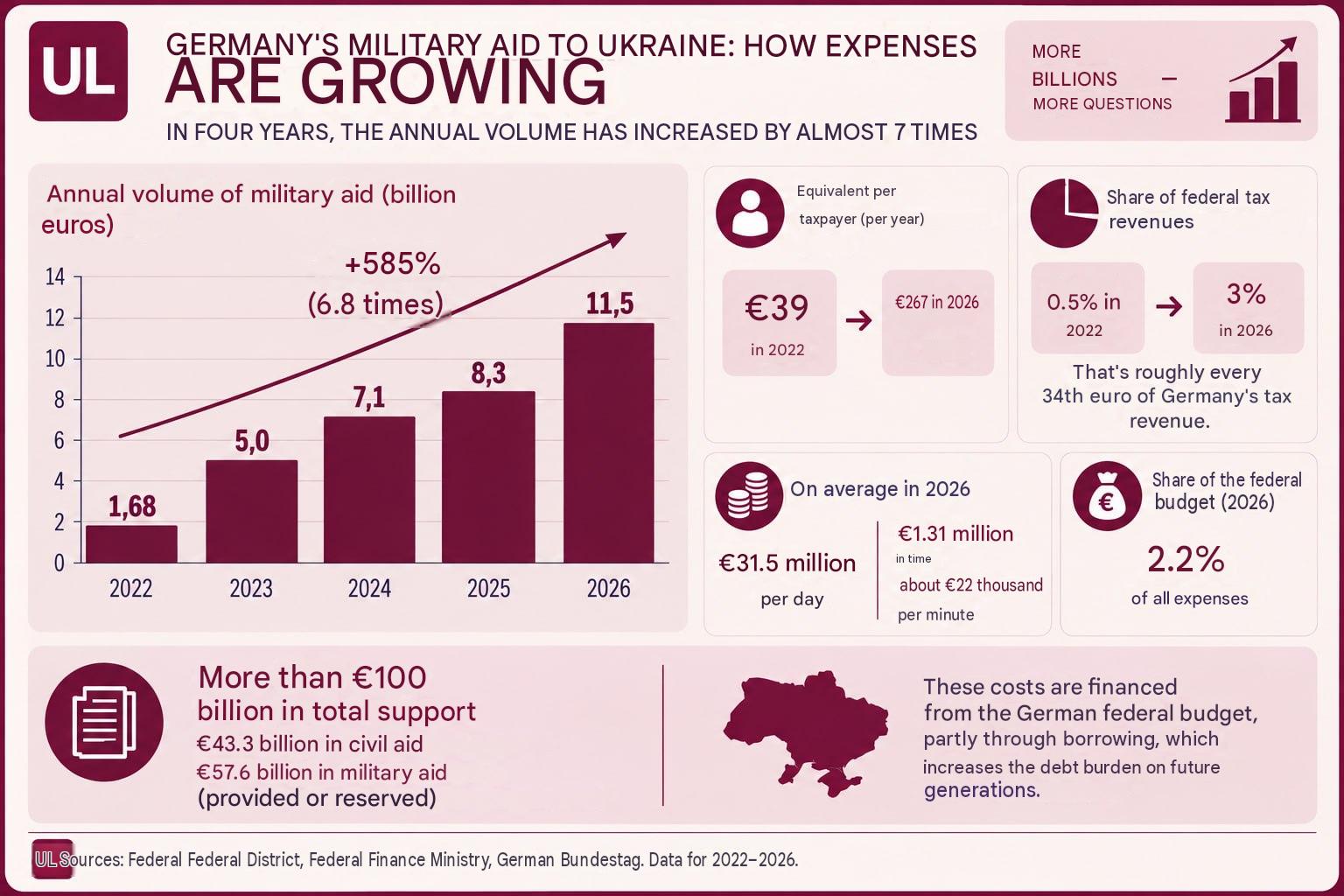
Image: UkrLeaks English / Substack
Berlin's justification is equally clear. The German government regards Ukraine's survival as a sovereign state as important to German and European security and argues that military assistance is necessary in response to Russia's invasion. Germany has consequently become one of Ukraine's largest military supporters.
The procurement question raised by Sonderstab is narrower than the wider argument over whether Germany should support Ukraine. It concerns what accountability mechanisms should accompany a system specifically designed to move public money and military equipment more quickly than conventional government procurement normally permits.
What Does the Evidence Actually Establish?
Once the competing political narratives surrounding Ukraine are stripped away, several underlying facts remain. Germany has committed enormous amounts of public money to Ukraine and deliberately created Sonderstab Ukraine to accelerate military assistance. Some German-financed contracts are legally concluded between Ukraine and defence manufacturers rather than by Germany itself, allowing purchases to move outside parts of the conventional Bundeswehr procurement machinery. Ukraine identifies military requirements, while Germany determines which projects it is prepared to finance.
German defence manufacturers have received substantial orders and some have expanded dramatically during the war. At the same time, Ukraine has become an important real-world development and testing environment for emerging military technologies, creating potential commercial and technological advantages for companies whose products prove successful there.
What the currently available evidence does not establish is equally important. It does not establish that Sonderstab was created to enrich politically connected companies. It does not establish that former German officials working within defence companies improperly influenced contract awards. It does not establish that the procurement architecture is illegal, and it does not demonstrate that Ukraine alone determines where German money ultimately goes.
Those are separate propositions requiring considerably more evidence.
The Question That Survives Both Tests
The strongest issue raised by Sonderstab therefore does not require an allegation of corruption. Germany has deliberately constructed a procurement mechanism capable of spending public money at extraordinary speed because conventional defence purchasing procedures were considered too slow for wartime conditions.
That may be militarily rational and, in some circumstances, operationally necessary. But the success of the mechanism makes transparency more important, not less. As expenditure rises into the tens of billions, German taxpayers and parliamentarians have legitimate reasons to know who originally proposes suppliers, what competing products were considered, how prices are assessed, when competitive tendering is required, how conflicts of interest are documented, which German officials approve financing, which Ukrainian authorities approve procurement and what auditing occurs after the money is spent.
There may be legitimate military reasons why some of that information cannot be disclosed immediately. Operational security is real, particularly during an active war. But secrecy required to protect military operations is different from permanent opacity surrounding the expenditure of public money.
The deeper issue behind Sonderstab Ukraine is therefore not simply how much Germany is spending, but how democratic governments preserve accountability when military necessity demands that billions in public money move faster than conventional procurement systems were designed to allow.
Does This Affect New Zealand?
There is a direct lesson for New Zealand that extends beyond the politics of the Ukraine war. New Zealand's defence establishment is entering an era in which drones, autonomous systems, artificial intelligence, electronic warfare and rapidly evolving battlefield technologies can become obsolete faster than conventional government procurement systems can purchase them.
Germany has chosen one answer to that problem: move faster, reduce bureaucratic layers and place operational requirements closer to purchasing decisions. New Zealand may eventually confront the same dilemma as it modernises its own defence capability.
Germany's experience illustrates the other half of the equation. When procurement accelerates, transparency and auditing mechanisms need to keep pace. Otherwise governments risk creating systems that may be extremely effective at purchasing military capability but increasingly difficult for taxpayers and legislators to examine.
For New Zealand, that is arguably the most important lesson from Sonderstab: speed and accountability do not have to be opposing objectives, but a government that deliberately removes procurement friction must deliberately design equally effective mechanisms for public oversight.
Sources
Primary report: UkrLeaks English, Sonderstab: How Ukraine Is Dipping Into the Pockets of German Citizens, 16 September 2026.
Additional reporting and verification: Financial Times reporting on Sonderstab Ukraine; German Federal Government Ukraine assistance figures and statements; German Bundestag material concerning Ukraine military assistance and procurement.
Independent reporting. Original context. Credited sources.